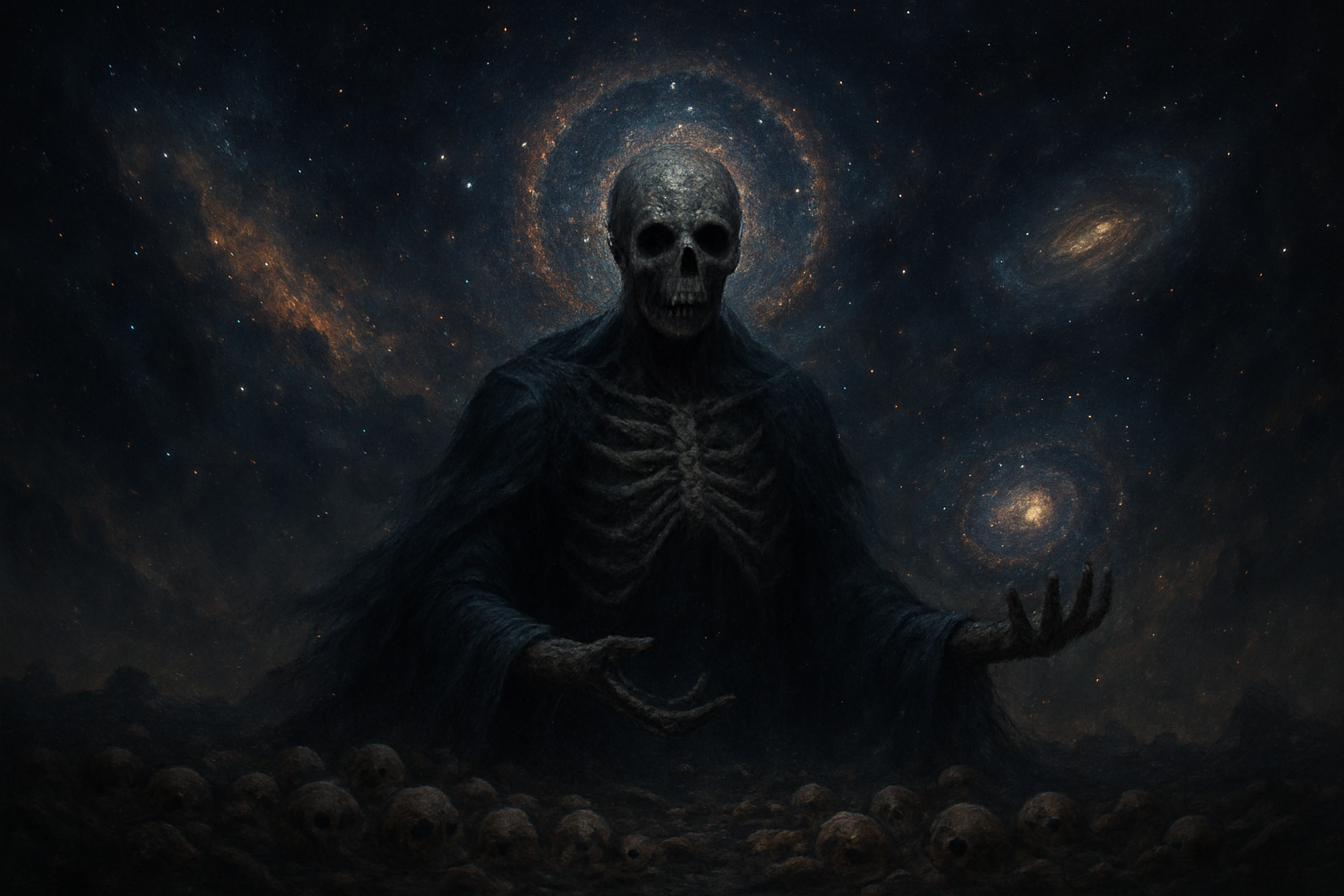
Stellar Necropolis: Mythology of Cosmic Death
The vast expanse of the cosmos, with its infinite mysteries and celestial bodies, has long captivated human imagination. Among its many wonders is the concept of a “stellar necropolis,” or the mythology surrounding the death of stars and celestial bodies. Across cultures, the cosmic dance of life and death is mirrored in myths and legends that speak to the grandeur and the inevitable decline of the heavens above.
The Death of Stars
In astronomical terms, a star’s death is a spectacular process. The transformation of a lively star into a white dwarf, neutron star, or black hole often marks the celestial end of an era. This stellar death, witnessed in the sky as supernovae or soft gamma-ray repeaters, has been a source of wonder and inspiration throughout the ages.
“For small creatures such as we, the vastness is bearable only through love.” — Carl Sagan, Cosmos
Mythological Interpretations of Cosmic Death
Norse Mythology
- Ragnarok: The Norse mythology endpoint presages the destruction of the world, culminating in a great battle. Stars are believed to fall from the sky as signs of the impending doom, symbolizing cosmic death.
- Fenrir and Skoll: The myth of the wolves Fenrir and Skoll, who chase the sun and moon, symbolizes the temporary eclipses and eventual swallowing of celestial bodies, accounting for their disappearance from the skies.
Hindu Mythology
- Shiva, the Destroyer: In Hindu tradition, Shiva embodies both destruction and rebirth. His cosmic dance represents the cycle of creation, preservation, and destruction, akin to stars undergoing the life cycle in the universe.
- Vishnu and the Night of Brahma: Vishnu’s role in the Great Dissolution, or Pralaya, involves absorbing the cosmos into himself, functioning like a cosmic reset akin to stars living and decaying in cycles.
Greek Mythology
- Phaethon and the Chariot of the Sun: The tale of Phaethon illustrates how the heavens might spiral into chaos. His disastrous handling of the sun’s chariot caused celestial disasters, symbolizing cosmic disturbance and disorder.
- Orion and the Scorpion: The myth surrounding Orion, the giant huntsman placed in the stars, highlights constellations’ life and eventual obsolescence as they drift beyond human sight, mirroring death among the stars.
Indigenous and Folk Beliefs
Various indigenous cultures also hold profound respect for the cosmos and its cycles, interpreting celestial phenomena through stories passed down through generations.
Native American Astronomy
- Algonquin Tribes: They believed in the “Star People” who descended from the cosmos. The appearance and disappearance of stars in the night sky often symbolized spirits returning to the heavens.
- Great Plains Tribes: For these tribes, the Milky Way was seen as the “Path of Souls,” a passage that souls traveled upon death, guided by the stars to the afterlife.
Australian Aboriginal Astronomy
- The Emu in the Sky: Certain Australian Aboriginal groups perceive the dark patches of the Milky Way as the form of an emu. The disappearance of its shape indicates a time of transformation and rest for the cosmos.
- Ngalindi, the Moon Man: The Yolngu people of Australia’s Northern Territory have a story where Ngalindi is punished and wanes to a sliver before disappearing, which they use to explain the moon’s phases and its symbolic death and rebirth.
Cosmic Death in Modern Culture
In contemporary culture, the idea of stellar death has taken on new meaning through science fiction and popular media. Stories explore the broader impact of cosmic events on civilizations, exploring themes of destruction, renewal, and exploration of the unknown.
Literature and Film
- Arthur C. Clarke’s “2001: A Space Odyssey”: The concept of transformation through cosmic events is central to Clarke’s narrative, where encounters with alien monoliths prompt an evolution of human consciousness, paralleling stellar death and rebirth.
- Marvel’s “Avengers: Infinity War”: The use of cosmic artifacts known as the Infinity Stones to wield destruction reflects humanity’s fascination with apocalyptic power contained in cosmological events.
Music and Art
- Gustav Holst’s “The Planets”: This orchestral suite brings planets to life as mythological and astrological figures, with their journeys mirroring celestial cycles and transitions.
- Van Gogh’s “Starry Night”: The swirling patterns and vibrant colors capture the dynamic nature of the cosmos, presenting the night sky as a living, breathing entity subject to the wonders and finalities of celestial existence.
The Enduring Legacy of Cosmic Death
As science increasingly demystifies the cosmos, the myths and stories surrounding celestial death continue to captivate and inspire. They provide a lens through which we can understand our place in the universe and the eternal cycle of life and death.
“We are star stuff harvesting sunlight.” — Carl Sagan, The Cosmic Connection
Ultimately, the mythology of cosmic death speaks to the human condition itself, embodying themes of destruction, rebirth, and the eternal quest for meaning among the stars.
For further exploration into the intersection of mythology and science, readers might delve into works by scholars such as Joseph Campbell or Mircea Eliade, whose analyses offer profound insights into the human experience through myth.
Comments