Author: editor

  • The Obscure Mind – Dark Philosophy for Modern Thinkers

    The Obscure Mind – Dark Philosophy for Modern Thinkers

    In the midst of 21st century’s light-speed technological advancements and glittering positivity, there exists a shadowy corner of thought known as dark philosophy. It is an arena where thinkers grapple with the limitations of human existence, the meaninglessness of life, and the inevitability of death. For those brave enough to venture into the depths of the obscure mind, dark philosophy offers a unique perspective often overlooked by mainstream philosophical ideals.

    Understanding Dark Philosophy

    Dark philosophy, at its core, challenges the very essence of what it means to live a fulfilling life. It grapples with themes such as nihilism, existentialism, and pessimism. While these concepts might seem bleak or even daunting, they provide a much-needed counterbalance to the relentless pursuit of happiness and optimism that pervades modern society. Here are some fundamental aspects:

    • Nihilism: Originating from Latin nihil meaning “nothing”, nihilism posits the belief that life is without objective meaning, purpose, or intrinsic value. Prominent philosopher Friedrich Nietzsche, known for declaring “God is dead,” believed that life should be lived for the moment as there is no universal moral system.
    • Existentialism: Thinkers like Jean-Paul Sartre and Albert Camus explored how individuals must find meaning within themselves, rejecting predetermined definitions imposed by society. Sartre famously stated, “Man is condemned to be free,” emphasizing personal responsibility in creating one’s own purpose.
    • Pessimism: As a philosophical attitude, it generally suggests that the perceived world is fundamentally flawed and fraught with suffering. German philosopher Arthur Schopenhauer argued that human desires are inherently unattainable, leading to frustration and disillusionment.

    The Modern Resonance of Dark Philosophy

    In today’s fast-paced world, dark philosophy resonates with many who feel disillusioned by conventional measures of success and happiness. Here are reasons why this school of thought appeals to modern thinkers:

    “We love life, not because we are used to living but because we are used to loving.” – Friedrich Nietzsche

    • Rejection of Superficiality: As society becomes increasingly materialistic, dark philosophy offers an escape by emphasizing deeper, often uncomfortable truths over fleeting pleasures and superficial achievements.
    • Understanding Suffering: By confronting suffering rather than avoiding it, individuals can attain resilience and profound insight. For instance, Camus’ notion of the ‘absurd’ illustrates the inherent contradictions in human existence which, when embraced, empowers individuals to live authentically.
    • A Sense of Liberation: The acceptance of life’s inherent meaninglessness grants a freeing sense that allows one to explore possibilities unfettered by societal expectations. As philosopher Lars Svendsen notes, “Meaning has become a matter of choice,” giving individuals the power to define their existence.

    Challenges and Misconceptions

    Despite its avant-garde appeal, dark philosophy faces numerous challenges and misconceptions:

    • Misperceived as Cynical: Many dismiss dark philosophy as cynical or nihilistic, overlooking its potential to evoke positive thinking through acceptance and personal empowerment.
    • Emotional Strain: Confronting one’s darkest thoughts can be emotionally taxing, leading some to retreat into denial or despair rather than acknowledging and working through existential anxieties.
    • Intellectual Elitism: The often complex and challenging nature of dark philosophical texts may be perceived as exclusive or inaccessible, alienating those unfamiliar with its intricacies.

    Dark Philosophy in Action

    For those intrigued by dark philosophy’s allure, practical application is key. Here’s how one might integrate its principles into daily life:

    • Embrace Solitude: Set aside time for introspection and solitude to explore your thoughts and feelings without external influence.
    • Meditative Practices: Employ mindfulness and meditation techniques to foster acceptance of life’s unpredictability and transience.
    • Creative Outlets: Use art, writing, or music as means to express and process complex emotions stirred by dark philosophical themes.

    Ultimately, dark philosophy challenges us to face the shadows within ourselves and the world around us, offering an unflinching examination of human nature and existence. For the modern thinker, it is a call to authenticity, resilience, and profound reflection—a path less traveled, yet rich with transformative potential.

    “The world breaks everyone, and afterward, some are strong at the broken places.” – Ernest Hemingway

    While embracing the ideas of dark philosophy may not lead to conventional happiness, it opens up a realm of possibility that allows for deep personal growth and a raw, unvarnished appreciation of life.
  • Necrotic Rituals – Practices to Embrace Impermanence

    Necrotic Rituals – Practices to Embrace Impermanence

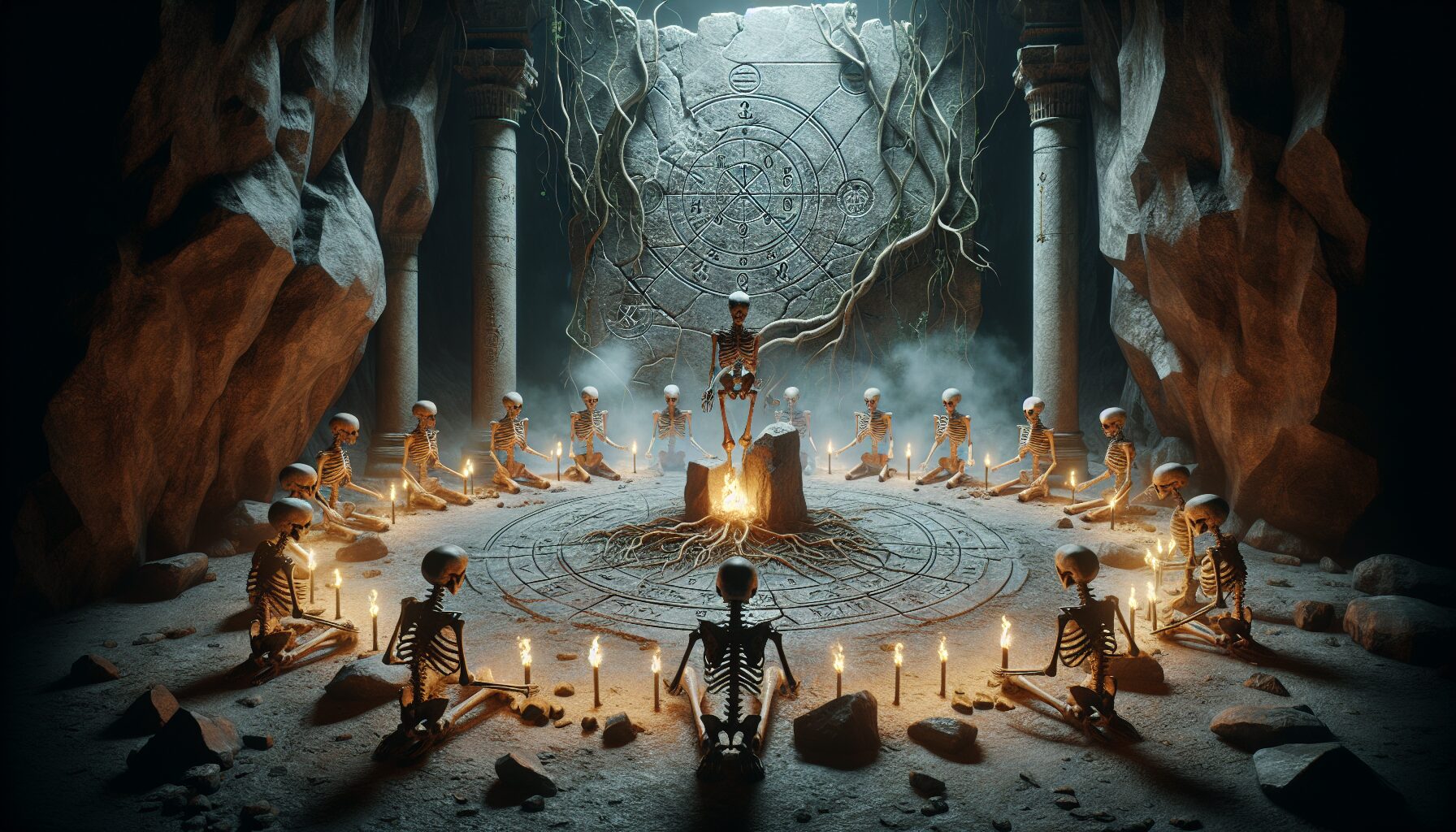
    In the rich tapestry of human civilization, the inevitability of death has always been a profound muse. Across cultures and eras, necrotic rituals have offered a lens through which societies understand impermanence and the art of letting go. Far from being mere macabre observances, these rituals are testaments to humanity’s enduring endeavor to embrace the transient nature of life.

    The Philosophical Underpinnings of Necrotic Rituals

    Impermanence is a central theme in many spiritual philosophies, serving as a reminder that everything that begins also has an end. This concept is especially pronounced in the philosophical traditions of Buddhism. Thich Nhat Hanh, a renowned Buddhist monk, once said, “Thanks to impermanence, everything is possible.” (Thich Nhat Hanh) This quote underscores the potential for growth and change, highlighting the importance of accepting life’s ephemerality.

    Necrotic rituals manifest this understanding by providing frameworks within which communities can process loss, celebrate life, and transition between states of being. By engaging with death in a structured way, participants can find peace and closure.

    Historical Practices Acknowledging Impermanence

    • Ancient Egyptian Mummification: The intricate processes involved in mummification demonstrate the Egyptians’ profound respect for the afterlife. By preserving the bodies of the deceased, Egyptians viewed death not as an end but a transition to another state, underscoring the cyclical nature of existence.
    • Mexican Día de los Muertos: Celebrated primarily in Mexico, the Day of the Dead is a vibrant remembrance of ancestors. Altars, or ofrendas, are adorned with photographs, marigold flowers, and favorite foods of the deceased, illustrating a joyous acceptance of death as a natural part of life’s continuum.
    • Tibetan Sky Burials: This practice is based on the Vajrayana Buddhist belief in transmigration of spirits. The ritual involves exposing the body to the elements and scavengers, symbolizing the return of the body to nature and the continuous cycle of life and death.

    The Modern Resurgence of Necrotic Rituals

    In contemporary times, there is a growing movement to rekindle traditional necrotic rituals. This resurgence is often driven by a desire to counteract the often sterile and impersonal modern treatment of death. By re-engaging with these ancient practices, individuals can find solace and meaning in death’s inevitability.

    “Death is not the opposite of life but a part of it.” —Haruki Murakami

    This recognition has led to the development of new ceremonies that emphasize sustainability and community. Green funerals and natural burials, for instance, reflect a growing awareness and respect for the environment, resonating with the ethos of returning to the Earth.

    Ritual as a Personal Journey

    Participation in necrotic rituals is often a deeply personal journey. For many, these practices provide a space for reflection, catharsis, and the fostering of connections. Here are a few ways individuals engage with these practices today:

    • Personal Altars: Inspired by traditions such as Día de los Muertos, individuals create small altars at home. These spaces often include photographs, mementos, and offerings, serving as a daily reminder of loved ones who have passed.
    • Journaling and Creative Expression: Many turn to writing, art, or music as a means to process grief and explore the concept of impermanence. Through these creative outlets, people can transform pain into something beautiful and enduring.
    • Mindful Practices: Meditation and mindfulness are powerful tools for embracing change and impermanence. These practices can cultivate a deeper appreciation for the present moment and foster acceptance of life’s fleeting nature.

    Embracing Impermanence in Everyday Life

    While traditional rituals provide structured ways to engage with death, there are countless opportunities to embrace impermanence in daily life. Simple activities such as mindful breathing, spending time in nature, or appreciating the ephemeral beauty of a sunset can serve as reminders of life’s transient beauty.

    Moreover, rethinking our relationship with material possessions can lead to greater peace and fulfillment. Adopting a minimalist lifestyle, for instance, encourages the notion that less is more, emphasizing experiences over things.

    A Global Dialogue on Death

    The conversation surrounding necrotic rituals is becoming increasingly global. With platforms that connect people from around the world, there is a unique opportunity to share and learn from diverse cultural practices. As societies continue to evolve, the integration of traditional and contemporary rituals can provide a holistic approach to embracing impermanence.

    In conclusion, necrotic rituals offer profound opportunities for reflection and growth. By engaging with these practices, individuals and communities around the world can find deeper meaning and connection with the cycle of life and death. Through understanding and acceptance, the acceptance of impermanence becomes not a source of fear, but a catalyst for living more fully.

    For more insights into these practices, explore resources from cultural studies, browsing through collections such as the fascinating articles at The Metropolitan Museum of Art.

  • Angels of the Edge – Liminal Beings in Myth and Art

    Angels of the Edge – Liminal Beings in Myth and Art

    Angels of the Edge: Liminal Beings in Myth and Art

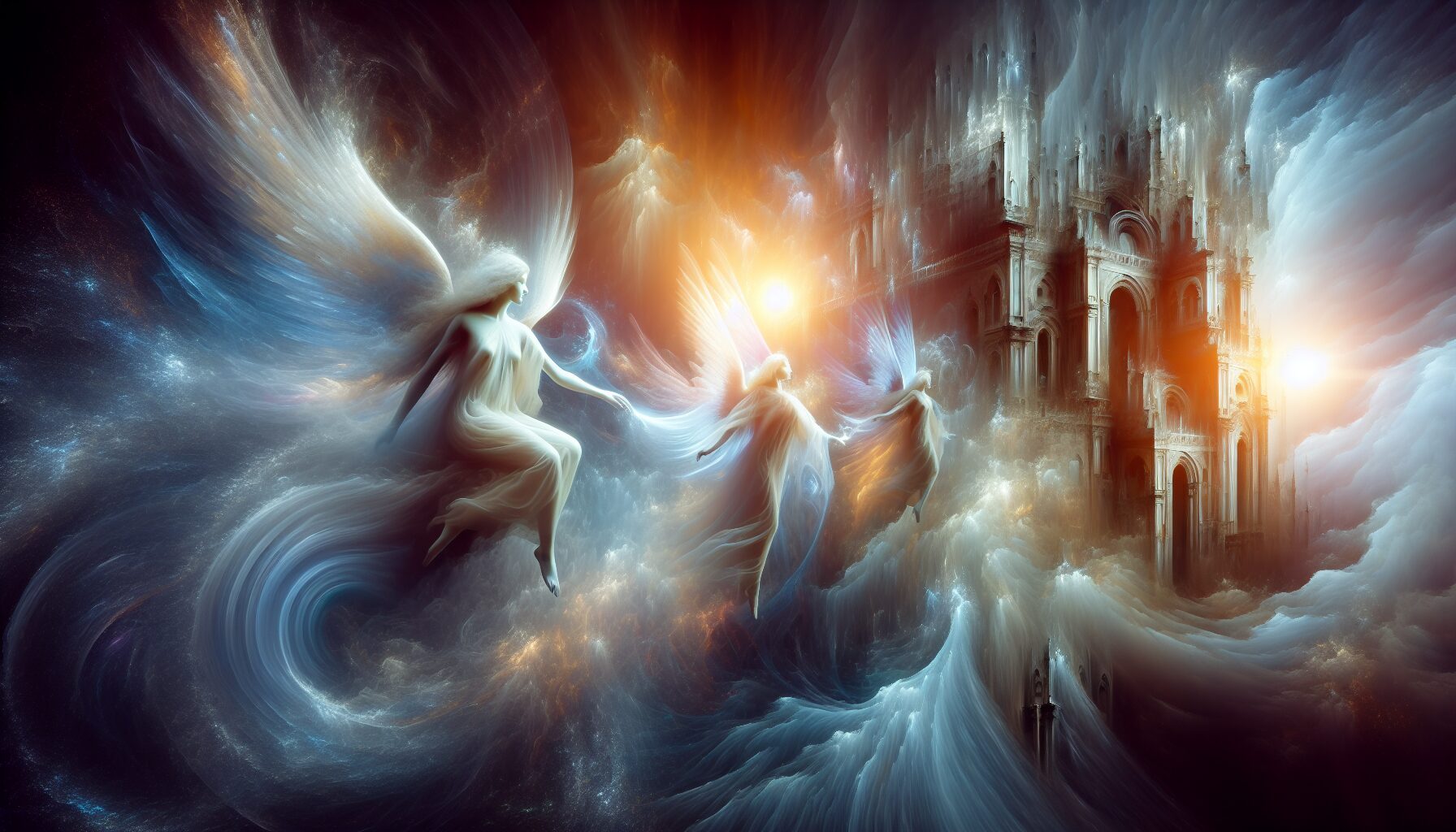
    Throughout history, liminal beings have captured the human imagination, standing as enigmatic figures at the boundaries of reality and the unknown. Among these figures, angels hold a prominent place, transcending cultures and time with their mystique and multifaceted portrayals in myth and art.

    Understanding Liminality

    The term liminal refers to the threshold or edge between different states of being. Victor Turner, a cultural anthropologist, described liminality as the space between, the phase where transformation occurs. Liminal beings exist in this space, often challenging the dichotomies of existence, such as life and death, or good and evil.

    The Mythical Role of Angels

    In various religious contexts, angels serve as messengers of the divine, intermediaries between heaven and earth. In the Judeo-Christian tradition, angels like Gabriel and Michael are depicted as powerful entities that guide and protect humans, often appearing at pivotal moments. Similarly, in Islam, angels are considered servants and warriors of God, integral in guiding humanity.

    “We are like angels with just one wing and we can only fly by embracing each other.” – Luciano De Crescenzo

    Angels in Art

    Artists have long been fascinated by the concept of angels, and this is reflected in countless artworks that explore their ethereal beauty and otherworldly presence. During the Renaissance, painters like Sandro Botticelli and Leonardo da Vinci depicted angels with delicate features, bathed in divine light, symbolizing purity and grace.

    • Baroque Period: Artists such as Caravaggio infused angels with dramatic intensity and emotion, embodying the ferocity and majesty often associated with these beings.
    • Modern Interpretations: In contemporary times, artists and filmmakers reinterpret angels, sometimes blending them with themes of science fiction and fantasy, reflecting societal changes and evolving spiritual understandings.

    The Enduring Appeal of Angels

    The enduring fascination with angels lies in their ability to embody the dualities of existence, offering a window into our fears, hopes, and aspirations. As beings of the edge, they challenge us to ponder the mysteries of the universe and our place within it. Whether through religious texts or modern media, angels continue to resonate with people across the globe, a testament to their lasting power as liminal guides.

    For further exploration, see National Geographic for a deeper dive into the symbolic meanings of angels across cultures.

  • Ash and Spirit – Transformation Through Mortality

    Ash and Spirit – Transformation Through Mortality

    Ash and Spirit – Transformation Through Mortality

    Ash and Spirit – Transformation Through Mortality

    Throughout history, humans have been deeply fascinated by the concepts of mortality and the spiritual transformation that many believe accompanies our physical end. The juxtaposition of ash and spirit embodies this profound connection between life’s ephemeral nature and the enduring mysteries of the afterlife. This idea has found expression in numerous cultural, religious, and philosophical traditions around the globe.

    The Symbolism of Ash

    Ash, primarily the residue of fire, symbolizes both destruction and purification. In Hindu spirituality, sacred ash (vibhuti) is often used as a symbol of the transitory nature of life. According to Hindu beliefs, applying ash on the body reminds individuals of the ephemeral nature of worldly pleasures and attachments.

    “From dust you came, and to dust you shall return.” — Biblical saying

    This iconic biblical sentiment underscores that life, ultimately, returns to its simplest earthly form. Ash is often seen as a stark reminder of mortality, yet it can equally represent renewal, as it enriches the soil and fosters new life.

    Spirit and the Idea of Transformation

    While ash reminds us of physical mortality, the concept of the spirit introduces the possibility of life beyond death. Many religious traditions suggest that the transformation through mortality is not an end but a metamorphosis into a higher form of existence. This transformation can be seen as a journey, a path toward understanding that transcends earthly limitations and gains significance in profound spiritual growth.

    Traditions Across Cultures

    • Ancient Egyptian Beliefs: The Egyptians believed in a vivid conception of the afterlife where the spirit (ka) would embark on a journey to the afterworld. This belief was so profound that immense resources were devoted to building grand tombs to ensure the ka’s safe passage.
    • Buddhist Perspective: Buddhists view life as a cycle of birth, death, and rebirth, with the ultimate goal of reaching Nirvana. Death is not an end but a transition to another phase in the journey towards enlightenment.
    • Native American Views: Many Native American tribes hold the belief that death is part of a natural cycle, with the spirit living on after the body’s death, transforming into forms that become part of the cosmic harmony.

    Philosophical Contemplations on Mortality

    Philosophy has long grappled with the concept of mortality. Existentialists, like Jean-Paul Sartre, have explored the meaning and consequences of death. Sartre’s existential philosophy views death as the ultimate freedom, where individuals face their true essence without the masks imposed by societal roles.

    “Death is not the opposite of life, but a part of it.” — Haruki Murakami

    Haruki Murakami, a contemporary literary figure, illustrates death as an integrated aspect of life rather than its conclusion. This view promotes the idea that understanding and accepting one’s mortality enriches the appreciation of life’s fragile beauty.

    Transformation Through Personal Mortality

    It is often in the face of mortality that individuals undergo profound transformations. Personal experiences with loss and the contemplation of one’s mortality can catalyze deep spiritual and personal growth. Such transformations can lead to a greater appreciation of life, stronger relationships, and a pursuit of meaningful connections with the world.

    A Sacred Transition

    Several rituals around the world help in the personal transformation following a loss. These rituals serve as a medium to honor the departed and as a catalyst for the living to deepen their understanding and acceptance of death’s role in the tapestry of life.

    • Dia de los Muertos: In Mexican culture, the Day of the Dead is a vibrant celebration that remembers and honors the deceased. It fosters a sense of connection and continuity between the living and the dead, emphasizing that death is but another stage of life.
    • Samhain: Celebrated by ancient Celts, Samhain marks the end of the harvest season and heralds the darker half of the year. It’s a time when the boundary between the worlds is thin, allowing spirits to pass through and reminding the living of the cycle of life and death.
    • Japanese Obon: A festival to honor the spirits of one’s ancestors, Obon is a reflective time allowing families to pay respects and receive visits from their departed loved ones, creating an enduring spiritual bond.

    Scientific Perspectives and Transformations

    Modern science, while often regarded as separate from spiritual and religious beliefs, also explores mortality and transformation. The field of Thanatology, the study of death and practices associated with it, considers the biological and psychological aspects of death, alongside its impact on the living. Some scientists explore the potential for life after death in the realm of quantum physics, although solid evidence remains elusive.

    In his book Death/Summer Interrupted, Stephen Cave refers to these scientific explorations as part of humanity’s continuous journey to understand, cope with, and transcend mortality.

    Conclusion

    The journey from ash to spirit is a narrative as old as humanity itself, a story that echoes across cultures and beliefs. Through understanding and embracing our mortality, we uncover moments of profound spiritual clarity and transformation. In the face of death, we often find the essence of what it means to truly live.

    Transformations through mortality, whether viewed through the lens of spiritual traditions, philosophical inquiry, or scientific exploration, enrich our lives and encourage a deeper appreciation for the mystical cycle of life.

  • The Hidden Library – Unearthed Texts of Occult Wisdom

    The Hidden Library – Unearthed Texts of Occult Wisdom

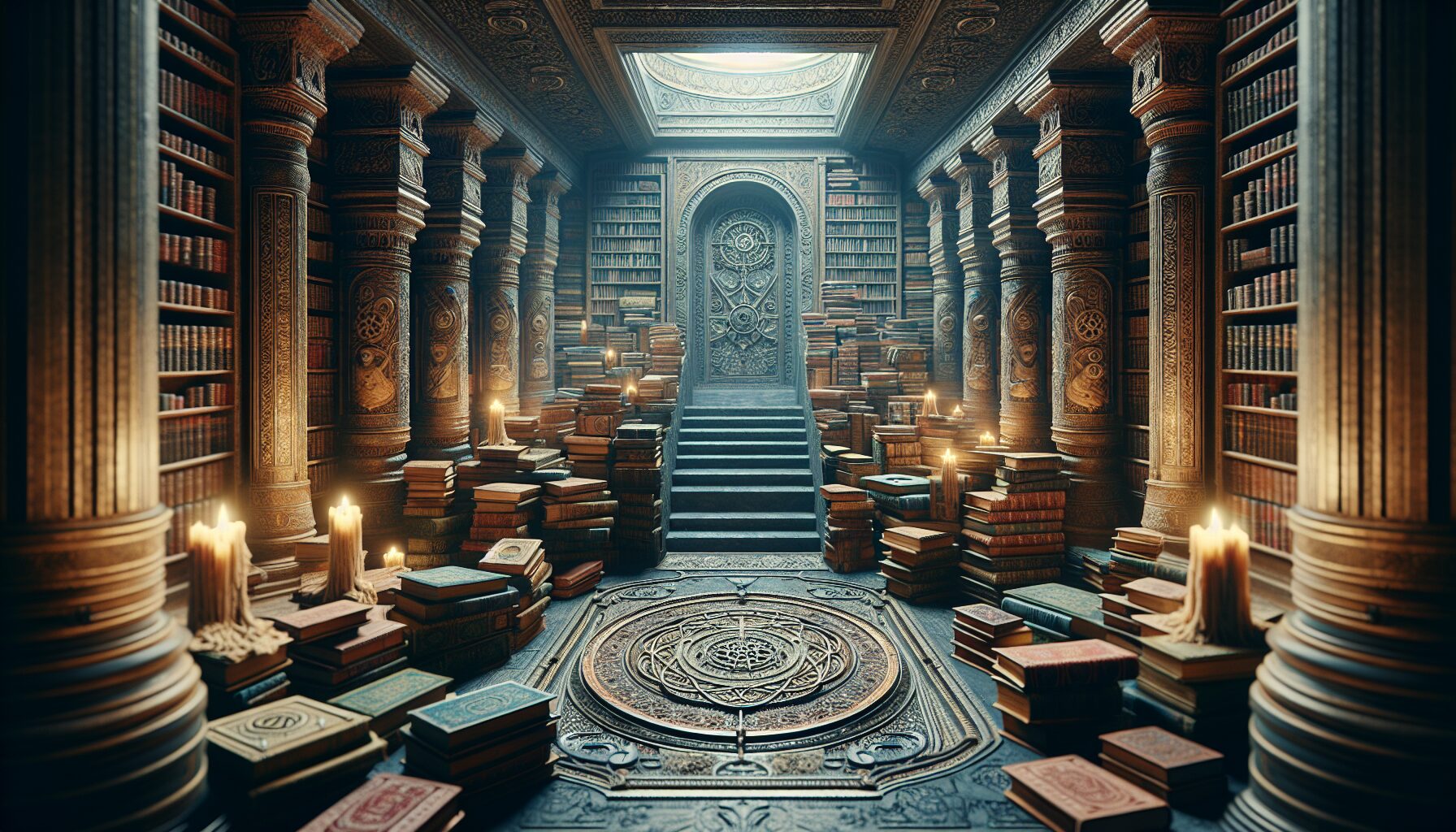
    The annals of human history are intertwined with mystery and the quest for forbidden knowledge. Occult wisdom—a term often used to describe esoteric knowledge that remains hidden from the masses—has a long and storied history, replete with secrecy and revelation. This hidden library of occult texts provides a fascinating glimpse into the human pursuit of understanding beyond the material world.

    The Nature of Occult Knowledge

    Occult knowledge is derived from the Latin word occultus, meaning “hidden” or “secret.” It encompasses a wide range of topics including alchemy, metaphysics, mysticism, and various forms of divination. Traditionally, these texts were preserved in secrecy, shared only among those deemed worthy or initiated into specific traditions.

    “The pursuit of occult wisdom is not just about gaining new knowledge; it is about understanding the universe at a deeper, more spiritual level.” — Encyclopædia Britannica, Occultism

    Legends of the Hidden Library

    Throughout history, many legends have arisen about the existence of secret libraries brimming with occult manuscripts. Among these, the most intriguing is the myth of the Library of Alexandria. It is said that it housed thousands of scrolls on alchemy and astrology before its destruction. While the library itself may be gone, the idea that secret collections of obscure wisdom exist persists in modern lore.

    • The Library of Alexandria: Often romanticized as a repository of all human knowledge.
    • The Vatican Secret Archives: Though not purely occult, it’s rumored to have hidden tracts of esoteric texts.
    • The Hermetic Texts: Early Christian Gnostic writings considered key to understanding alchemy and astrology.

    Famous Occult Texts Revealed

    Despite the enigmatic aura surrounding them, several occult texts have been unearthed and studied extensively. Here, we delve into a few of the most famous:

    • The Emerald Tablet: Attributed to Hermes Trismegistus, it is a foundational text in alchemy, referring to the cosmic unity of the microcosm and the macrocosm. A famous passage reads, “That which is Below corresponds to that which is Above, and that which is Above corresponds to that which is Below, to accomplish the miracle of the One Thing.”
    • The Book of Abramelin: A mystical guide from the 15th century, detailing a six-month ritual called the Abramelin Operation, aimed at obtaining the knowledge and conversation of one’s Holy Guardian Angel.
    • The Malleus Maleficarum: Also known as “The Hammer of Witches,” this notorious book from 1487 detailed the church’s understanding of witchcraft and provided a manual for witch hunters.

    Modern Reinterpretations and Discoveries

    In recent years, the resurgence of interest in occultism has led to a reevaluation and rediscovery of these ancient texts. Scholars and enthusiasts alike have sought to reinterpret these works through modern lenses, often marrying ancient wisdom with contemporary philosophical and scientific thought.

    “The study of ancient texts is not about recreating the past, but about engaging with it to understand its impact on modern thought.” — Journal of the History of Ideas

    Furthermore, technological advances allow for the digitization and virtual reconstruction of lost texts, enabling wider access and analysis by enthusiasts worldwide.

    The Influence of Unearthed Occult Wisdom

    Occult wisdom, despite its esoteric nature, has notably influenced various cultural and scientific developments throughout history:

    • Alchemy and Chemistry: Alchemy’s quest for the philosopher’s stone spurred early advancements in chemistry.
    • Astronomy and Astrology: Astrological charts laid the groundwork for astronomical observation.
    • Psychoanalysis and Mysticism: Carl Jung’s theories on archetypes echo concepts found in ancient mystical traditions.

    Occult texts continue to inspire both artistic and academic inquiry, challenging conventional ideas and offering alternative perspectives on the mysteries of life and the cosmos.

    The Continuing Allure of Occult Libraries

    The romantic notion of secret, hidden libraries captivates the imagination. Whether fueled by academic curiosity or spiritual yearning, these repositories serve as temporal portals, connecting those who seek to unravel the mysteries of existence.

    Ultimately, the hidden library of occult wisdom is a testament to humanity’s perpetual quest for truth amid the unknown. These texts, both real and imagined, embody our collective desire to transcend the ordinary and encounter the divine.

    As we continue to uncover and interpret these ancient manuscripts, we enrich not only our understanding of the past but also our perception of the present. In unlocking the secrets of these hidden tomes, we unlock parts of ourselves, forever linked to the eternal quest for knowledge.

    For more on this topic, explore the online archives of Occult World.

  • Twilight Archetypes – Mythcore Symbols for Modern Life

    Twilight Archetypes – Mythcore Symbols for Modern Life

    In an era where the lines between the digital and tangible worlds blur, the rise of mythcore offers a fascinating look into how ancient symbols continue to permeate modern consciousness. Twilight archetypes, those shadowy figures and mythic motifs, are enjoying a renaissance, capturing the imagination of a generation seeking depth and meaning.

    The Power of Archetypes

    Archetypes are universally understood symbols or behavior patterns that recur in stories across different cultures and eras. They serve as a bridge between the conscious mind and the collective unconscious, as posited by Carl Jung. According to Jung, “Who looks outside, dreams; who looks inside, awakes” (source: Carl Jung). In this context, archetypes invite us to explore our inner worlds, connecting us with universal human experiences.

    Key Mythcore Symbols

    • The Wanderer: Embodying both curiosity and restlessness, the wanderer seeks to embrace the journey itself. In mythcore, this archetype symbolizes a perpetual quest for knowledge and self-discovery, encouraging us to venture beyond our familiar boundaries.
    • The Shadow: Often depicted as the antagonist in stories, the shadow represents our repressed fears and desires. Today, embracing the shadow helps us confront personal and societal issues that need transformation.
    • The Muse: A source of inspiration and creativity, the muse archetype reminds us of the beauty and unpredictability of life. As more individuals pursue creative ventures, the muse becomes an essential symbol in our narratives.

    Relevance in Modern Culture

    Mythcore as a movement has found its place in artistic expressions, fashion, and digital culture. Platforms like Instagram and Pinterest are replete with imagery that draws on these archetypes, creating a sense of nostalgic yet contemporary mythos. This aesthetic embraces a world where past and present effortlessly coexist, allowing people to craft new identities that resonate with ancient motifs.

    “Myths are public dreams, dreams are private myths.” — Joseph Campbell

    As Joseph Campbell elucidated, these symbols guide us in understanding the shared psychological and cultural frameworks that shape our personal and collective narratives. In a world yearning for meaning, twilight archetypes offer a pathway to engage with our rich mythological past in the modern context.

    Conclusion

    Twilight archetypes and mythcore symbols serve as a toolkit for navigating contemporary life. By engaging with these timeless motifs, we not only connect with our historical roots but also find new ways to articulate our evolving identities. As the mythcore movement reinforces, the ancient and the modern are not disparate; they are facets of the same, ever-turning wheel of human experience.

  • Blackened Philosophy – Thinking Beyond Mainstream Thought

    Blackened Philosophy – Thinking Beyond Mainstream Thought

    Blackened Philosophy – Thinking Beyond Mainstream Thought

    Blackened Philosophy – Thinking Beyond Mainstream Thought

    The realm of philosophy has always been a domain where thinkers strive to unravel the complexities of existence, morality, and knowledge. However, there exists a certain form of philosophical inquiry that leaps beyond the confines of traditional discourse—a space we refer to as “Blackened Philosophy.” This term encapsulates ideas that challenge norms, question everything, and often tread the line between reality and the unknown.

    Origins and Meaning

    Blackened Philosophy” does not reference any specific philosophical school or thought. Instead, it symbolizes an approach, an audacity to delve into the darker, less-traveled paths of philosophical thinking. Influenced by existentialism, nihilism, and skepticism, this philosophy dares to question the very fabric of what we perceive as truth and existence.

    “The unexamined life is not worth living.”

    Socrates

    Socrates’ famous declaration underscores the necessity of critique and exploration inherent in philosophy. Blackened Philosophy embodies this spirit by encouraging a relentless questioning of the foundations upon which mainstream thoughts are built.

    Core Principles of Blackened Philosophy

    Although varied, there are several principles that often underpin this philosophical approach:

    • Abolition of Dogma: Nothing is sacrosanct. Every belief, tradition, and assumption should be scrutinized critically.
    • Embrace of Paradox: Conventional belief and logical reasoning are not always adequate. Embrace contradictions and discover deeper truths within them.
    • Existential Inquiry: Go beyond asking if something is true; ask why it matters. Explore existence’s raw and unmediated forms.

    Navigating Beyond the Mainstream

    Mainstream philosophy often centers around certain irrefutable tenets or ideas. Conventional wisdom insists on equilibrium, on concepts that ensure stability within the realms of moral, metaphysical, and epistemological debates. However, Blackened Philosophy frequently rebels against such norms.

    Challenging Moral Absolutism

    Moral absolutism posits that ethical standards apply universally without exception. Blackened Philosophy rejects this notion, advocating for a more nuanced understanding of morality that is subjective and contextual. Friedrich Nietzsche famously argued, “There are no moral phenomena at all, but only a moral interpretation of phenomena.”

    This critique propels thinkers to explore the vast range of ethical experiences, unshackled by prescribed moral codes. As the world grows increasingly complex, adopting a versatile philosophical lens becomes indispensable.

    Redefining Knowledge

    Rene Descartes, often regarded as the father of modern philosophy, declared, “I think, therefore I am.” This statement emphasizes a foundational belief in the certainty of one’s existence. Blackened Philosophy, in contrast, pushes even the boundaries of cogito ergo sum, questioning the nature and certainty of self-awareness and knowledge.

    Skepticism, a crucial tool in this philosophy, becomes the means through which understanding is continuously reshaped. As philosopher David Hume remarked:

    “A wise man, therefore, proportions his belief to the evidence.”

    David Hume

    Blackened Philosophy amplifies this sentiment by pushing beyond the limits of evidence, seeking subjective truths that may defy empiricism.

    The Dark Aesthetic

    The aesthetic of Blackened Philosophy often invokes dark imagery and symbolism. This reflects the depth and often daunting nature of philosophical inquiry it promotes. Literature, music, and art that embody this aesthetic help manifest its abstract principles into tangible experiences.

    Consider the works of Edgar Allan Poe or the melancholic compositions of black metal music, where themes like existential dread and the sublime emerge. These cultural artifacts give voice and substance to the abstract themes that Blackened Philosophy seeks to explore.

    Existentialism and the Absurd

    This philosophy often aligns itself with existentialist thought. Albert Camus, in his essay “The Myth of Sisyphus,” introduces the concept of the absurd—where the human tendency to seek inherent meaning conflicts with the chaotic, indifferent universe. Camus writes:

    “The struggle itself towards the heights is enough to fill a man’s heart. One must imagine Sisyphus happy.”

    Blackened Philosophy resonates with such ideas, inviting individuals not just to ponder but to embrace the contradictions and uncertainties of existence.

    Conclusion

    Blackened Philosophy is not about obtaining definitive answers but about embracing the journey of relentless questioning and exploration. It rejects the comfortably known, stepping instead into the shadows where new perspectives lurk. In doing so, it offers a profound challenge not just to established theoretical paradigms, but to our own preconceptions and biases.

    As we continue to navigate an ever-evolving world, the insights offered by thinking beyond mainstream thought can provide not only deeper understanding but also profound personal transformation. Blackened Philosophy is an invitation to those daring enough to venture into the unknown, with conviction not in finding answers, but in discovering new questions.

    Further exploration into this topic may be found in works by The Stanford Encyclopedia of Philosophy, where you can dive deeper into branches like existentialism, nihilism, and skepticism that inform much of this unorthodox approach.

  • Ritual of Silence – Mindful Practices in the Dark

    Ritual of Silence – Mindful Practices in the Dark

    Ritual of Silence – Mindful Practices in the Dark

    Ritual of Silence – Mindful Practices in the Dark

    In an era of perpetual noise and incessant distraction, the ritual of silence holds an enigmatic allure. By embracing moments of intentional tranquility, many find a route to inner peace and heightened awareness. Mindfulness in darkness is an ancient yet increasingly relevant practice.

    Historical Context

    The use of darkness and silence as tools for introspection is not new. Various cultures throughout history have incorporated these elements into their spiritual practices. Dark retreats, for instance, are a tradition that spans from the Tibetan Buddhist caves to the silent, pitch-black environments of Christian monastic cells.

    “The best way to deepen one’s spiritual awareness is often through the absence of noise,” writes Thich Nhat Hanh, the revered Vietnamese Thiền Buddhist monk.
    [source]

    The Science Behind Silence and Darkness

    The psychological impact of silence and diminished light has garnered considerable scientific attention. Studies suggest that silence can lead to a heightened appreciation for the subtleties of one’s surroundings, enhancing both mental clarity and emotional stability. A study by Imke Kirste found that silence can regenerate brain cells, reflecting its profound impact on neurogenesis.

    • Reduced Sensory Input: When the cacophony of modern life is muted, people can focus more deeply on their internal worlds.
    • Emotional Reset: Periods of silence and darkness allow individuals to process emotions and thoughts without external stimuli.
    • Improved Concentration: Habituating to tranquil environments may enhance one’s capacity for prolonged concentration and focus.

    Mindful Practices in the Dark

    Engaging in mindful practices in the dark involves a combination of purposeful actions and environmental awareness. Below are some techniques that can be cultivated to harness the benefits of silence and darkness:

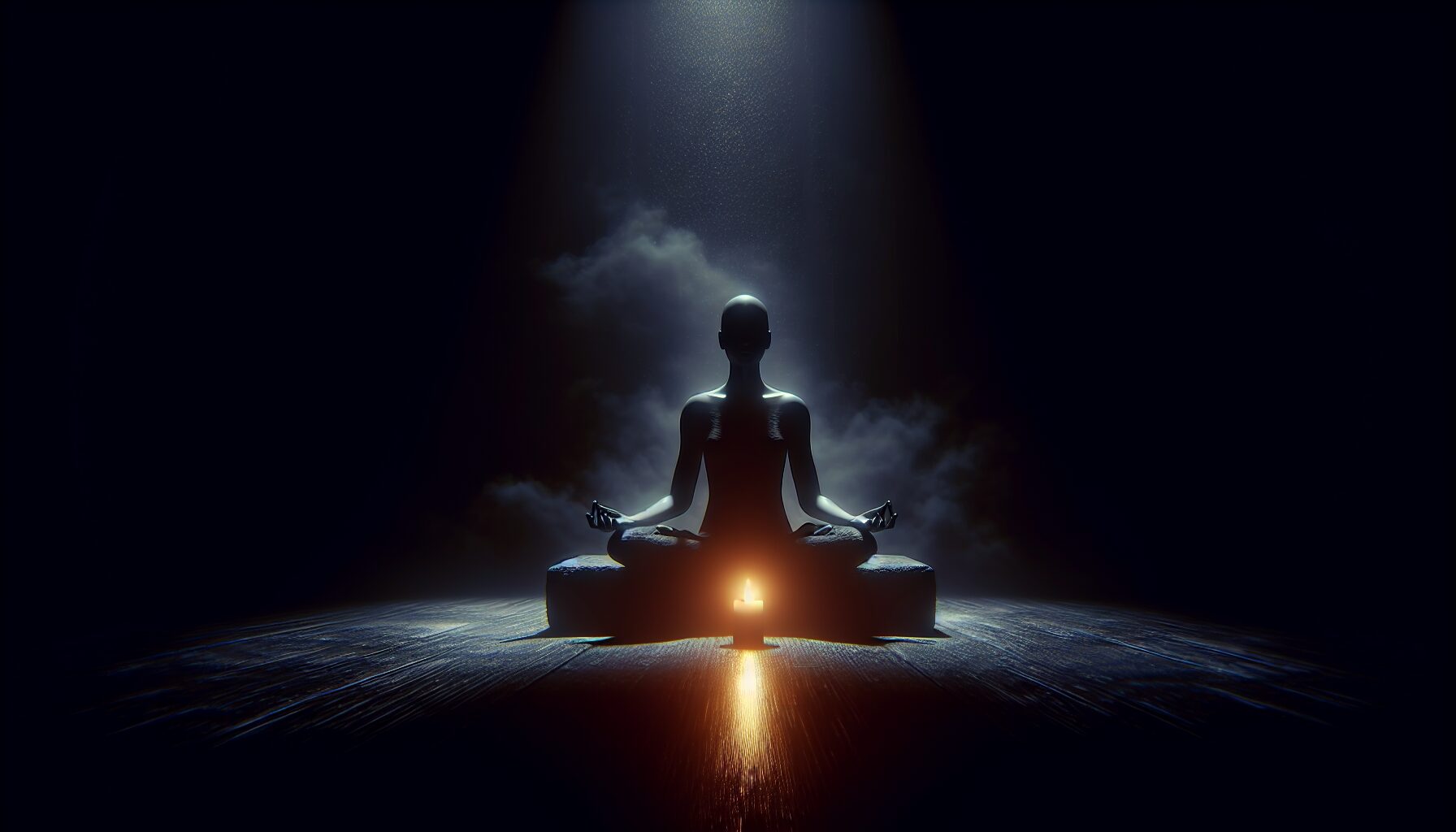
    • Dark Room Meditation: Find a quiet, dark space to sit comfortably and focus on your breath. Allow the darkness to envelop your physical senses, leading to a heightened state of mindfulness.
    • Sound Bath in Silence: Listen to ambient soundscapes or subtle tones that emerge in silence, like your heartbeat or the flow of your breath. This form of sound bath can be deeply therapeutic and grounding.
    • Silent Reflection: Allocate time each day to be alone with your thoughts in silence and darkness. Journaling afterwards can help articulate newly clarified insights that arise during this time.
    • Darkness Visualization: Use the absence of light to visualize concepts or scenarios, allowing the mind to explore creative pathways without visual distractions.

    Benefits of Incorporating These Practices

    Though modern lifestyles seem increasingly incompatible with periods of silence, the benefits are substantial. Intentional silence and reduced visual stimuli are linked with:

    • Lower Stress Levels: Comfort in silence correlates with lower cortisol levels, thus reducing stress.
    • Enhanced Creativity: By eliminating distractions, the mind is free to focus on innovative problem-solving and creative thought processes.
    • Spiritual Connection: Many report feeling a greater sense of connection to their spirituality or larger existential questions when they withdraw into silence and darkness.

    Challenges and Considerations

    While the benefits of these practices are significant, individuals may face challenges:

    • Confrontation of Self: Quieting external noise often brings dormant internal struggles to the forefront, necessitating emotional processing.
    • Anxiety and Fear: Not everyone finds comfort in dark environments, as these may evoke anxiety or fear in certain individuals.
    • Commitment: Scheduling regular periods of silence in a hectic lifestyle requires dedication and intentional planning.

    “Silence is a source of great strength,” states Lao Tzu, emphasizing how moments of quiet can evoke powerful personal transformation.

    Conclusion

    Despite a world that never seems to pause, the ritual of silence offers an oasis of calm and self-discovery through mindful practices undertaken in darkness. By consciously incorporating these practices, individuals can foster a deeper connection with themselves and the environment, ultimately leading to a more balanced, harmonious life.

    Whether beginning with short silence sessions or engaging in extensive dark retreats, embracing these rituals can provide profound personal insight, reset emotional well-being, and enrich one’s spiritual life.

    We encourage readers to explore these ancient practices, perhaps finding solace in the magic of silence.

  • The Obscure Aesthetic – Art, Literature, and Philosophy of Shadow

    The Obscure Aesthetic – Art, Literature, and Philosophy of Shadow

    The Obscure Aesthetic – Art, Literature, and Philosophy of Shadow

    The Obscure Aesthetic – Art, Literature, and Philosophy of Shadow

    The concept of shadows extends beyond the mere physical phenomenon of light and darkness. In the realms of art, literature, and philosophy, shadows represent an intriguing aesthetic that encapsulates mystery, introspection, and the unknown.

    Art: The Dance Between Light and Dark

    Artists have long been captivated by the interplay of light and shadow. The chiaroscuro technique, utilized by masters such as Caravaggio and Rembrandt, is exemplary in creating dramatic effects through stark contrasts. The use of shadow not only adds depth but also evokes emotion and narrative tension.

    “Chiaroscuro, the use of strong contrasts between light and dark, was a revolutionary means of composing in painting and drawing.” – Artsy Editorial

    Literature: Shadows of the Mind

    In literature, shadows frequently symbolize the subconscious and the hidden aspects of human nature. Gothic novels, such as Mary Shelley’s Frankenstein and Bram Stoker’s Dracula, explore the eerie and the unknown within the shadowy confines of human fears and desires. Shadows serve as a literary device to delve into themes of identity and duality.

    The poet Robert Frost once mused,

    “Always fall in with what you’re asked to accept. Take what is given, and make it over your way. My aim in life has always been to hold my own with whatever’s going. Not against: with.”

    Philosophy: The Duality of Being

    Philosophically, shadows have been employed to illustrate the concept of duality and the examination of existence. Plato’s Allegory of the Cave remains a profound metaphor where shadows represent perceptions of reality, challenging individuals to look beyond the surface to grasp the truer existence.

    Moreover, the philosophy of Martin Heidegger emphasizes the concept of ‘being’ (dasein), contemplating how shadows symbolize both obscured truths and the essence of self-discovery.

    The aesthetics of shadow continue to inspire and intrigue, offering a bridge between the visible and the invisible, the known and the unknown. Through art, literature, and philosophy, shadows beckon us to explore the deeper recesses of experience and reality.

  • Necropolis Meditations – Contemplating Mortality

    Necropolis Meditations – Contemplating Mortality

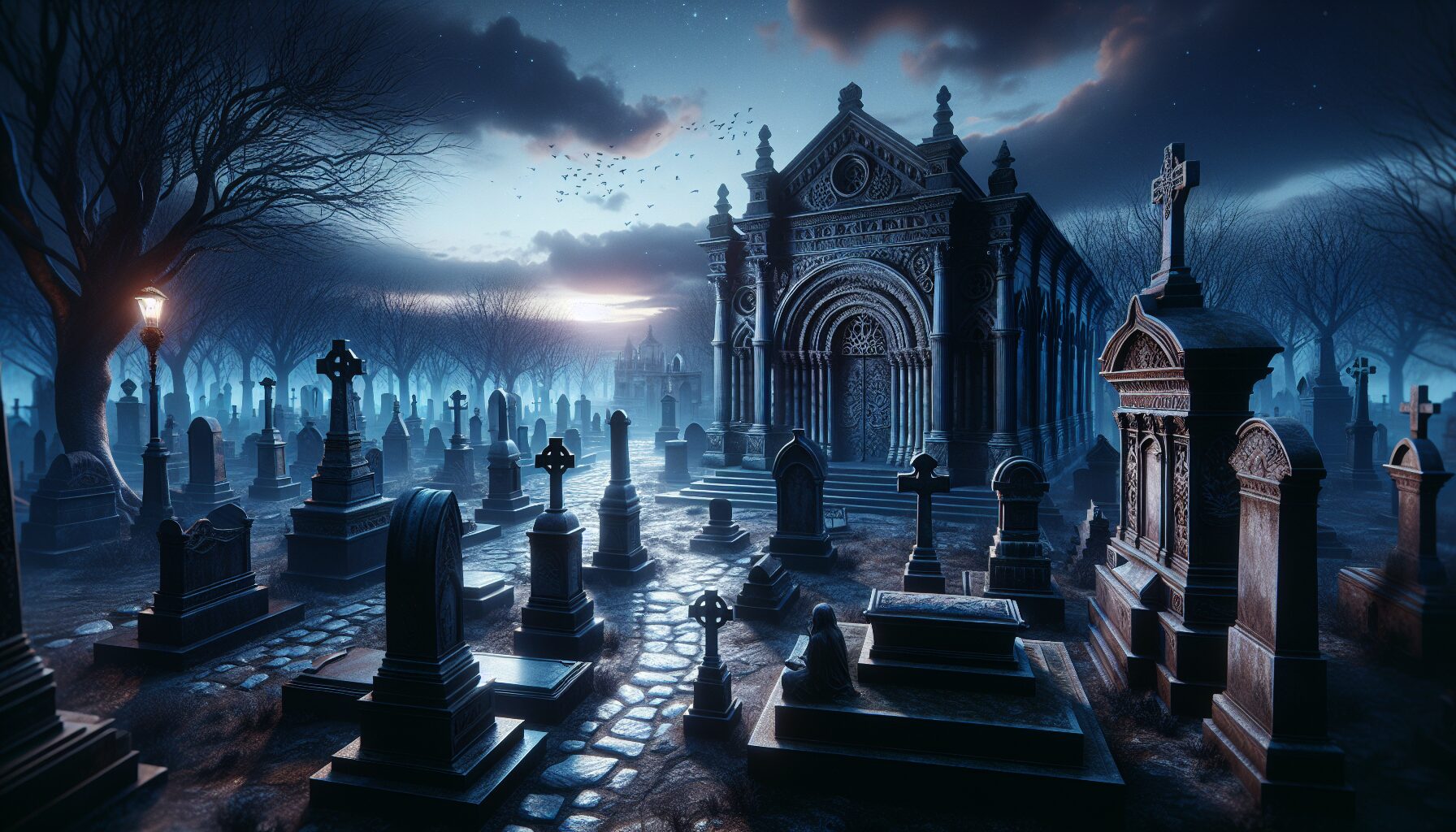
    In the quiet solitude of a necropolis, where silence hangs like a shroud over the gravestones, the contemplation of mortality becomes an intimate and reflective experience. These cities of the dead, with their solemn landscapes and stories carved in stone, offer a serene environment for pondering the inevitable human journey towards the end of life.

    The architecture of many necropolises is a testament to the myriad ways cultures grapple with death. Tombs, mausoleums, and gravestones become not only memorials for those who have passed but also reflections of the living’s acceptance and understanding of mortality. As British author C.S. Lewis poignantly wrote,

    “No one ever told me that grief felt so like fear.”

    These sacred spaces serve as reminders—each name, each date chiseled into stone, a testament to lives once vibrant. In the words of scholar Philippe Ariès, the necropolis represents “the invisible community.” It is where the living engage in an ongoing dialogue with those who have gone before, seeking wisdom and understanding amid the quietude.

    Such meditative settings prompt us to ask profound questions: How do we find meaning in the face of death? How can the inevitability of our mortality inspire us to live more fully? These are questions thinkers have pondered for centuries, their reflections echoed in the works of poets, philosophers, and spiritual leaders.

    • Marcus Aurelius, a Roman emperor and Stoic philosopher, advised that we “live each day as if it were our last, without frenzy, without apathy, without pretense.”
    • Sylvia Plath, in her posthumously published journals, revealed,

      “I can never read all the books I want; I can never be all the people I want and live all the lives I want.”

    While a necropolis may symbolize an end, it can also inspire beginnings—a catalyst for appreciating the present. For many, an afternoon spent walking among the tombstones provides clarity and a renewed sense of purpose. As we confront our own mortality, there lies a profound opportunity to re-evaluate our lives, prioritizing what truly matters and cherishing every moment with those we love.

    In these meditations, drawn from the shadow of the necropolis, we are reminded that though life is ephemeral, the love, impact, and memories we create are enduring. We leave behind, much like the monuments in a necropolis, echoes of our existence—proof of a life lived.

    For those seeking further contemplation, the works of Philippe Ariès and C.S. Lewis are rich with insights about life, death, and the spaces in between.