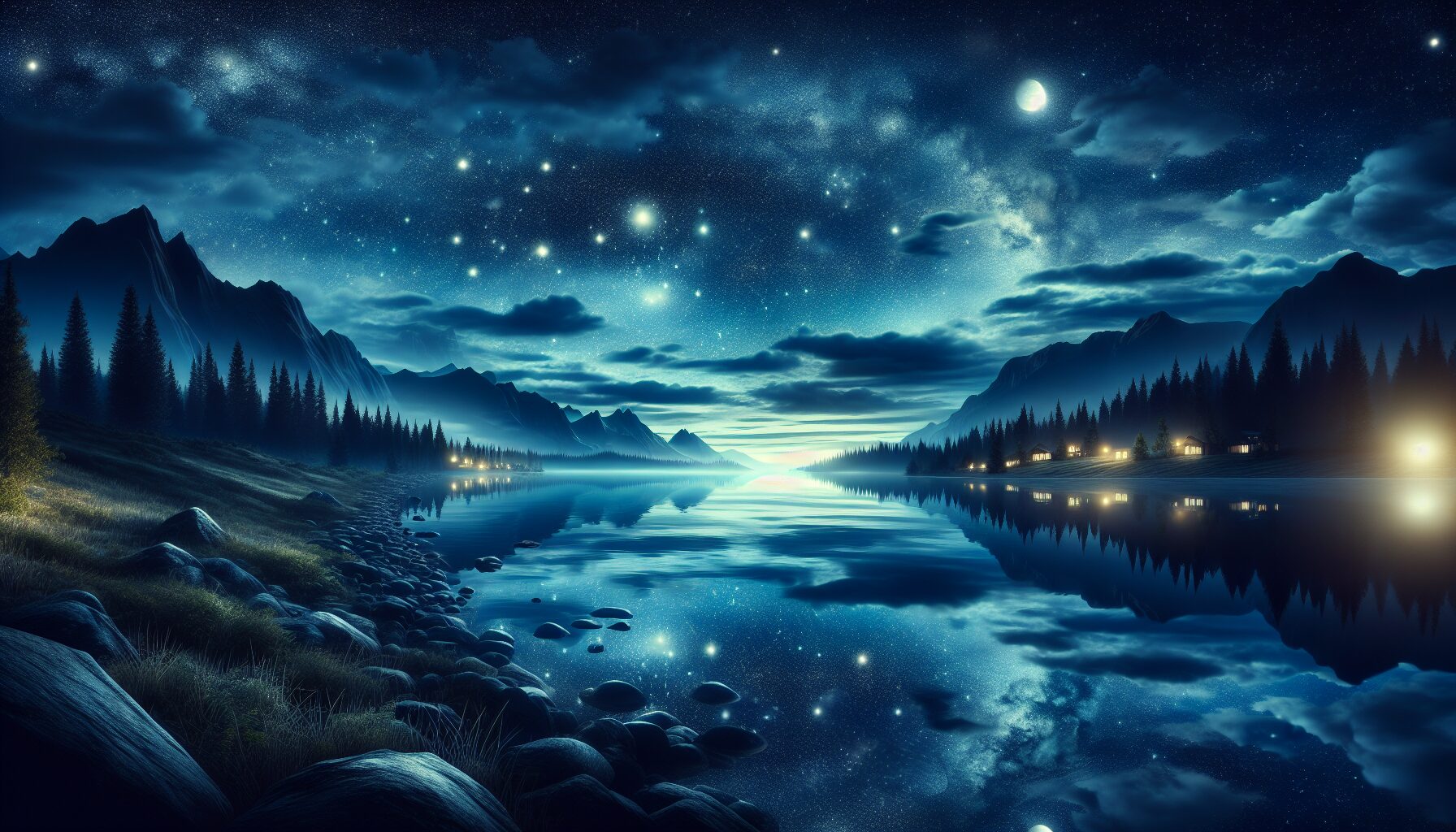
The mysteries of the night sky have long captivated human imagination. Since the dawn of civilization, people have looked up at the cosmos, pondering the countless stars shimmering like scattered diamonds on a velvet canvas. Yet, Earth’s night offers an array of enigmas beyond the celestial. The nocturnal world, teeming with life and phenomena unseen during daylight, presents a rich tapestry worthy of exploration.
The Biological Symphony of the Night
Nighttime unveils a distinct world of creatures that thrive in darkness. These nocturnal beings have adapted uniquely to life without light, using highly evolved senses such as enhanced hearing and night vision. Owls, for example, are equipped with exceptional auditory abilities, enabling them to hunt with precision. According to a study by the Royal Society Publishing, the owl’s silent flight and acute sense of hearing give them an edge in the nocturnal landscape.
Bats, another quintessential night dweller, navigate through echolocation, emitting calls that bounce off objects, revealing their surroundings. According to the American Association for the Advancement of Science, this form of biological sonar is so precise that some bats can detect textures and sizes of objects they encounter.
Ethereal Light of the Night
While the absence of sunlight defines night, it doesn’t imply darkness in absolute terms. The moon and stars provide a subtle luminescence, but the nocturnal world boasts its sources of light. Bioluminescence is a natural wonder where organisms like fireflies and certain deep-sea creatures produce light. This phenomenon, explained by researchers at Oxford Academic, involves chemical reactions within these organisms, often for attracting mates or deterring predators.
Moreover, the night sky occasionally becomes a stage for spectacular light displays known as auroras. These occur when charged particles from the sun collide with Earth’s atmosphere, leading to shimmering curtains of green, red, and purple. The National Geographic delineates the science behind these awe-inspiring displays, illustrating how Earth’s magnetic poles harness solar particles to paint the sky.
Human Perception and the Night
The human relationship with night has evolved significantly over centuries. From early fire-lit evenings to modern artificial lighting, our capacity to conquer the dark has grown. However, this has not come without consequences. Light pollution, a glaring by-product of modern society, obscures our view of the stars and impacts nocturnal wildlife.
Documented by the International Dark-Sky Association, light pollution disrupts natural ecosystems, confuses animal navigation and affects hormonal cycles, making it an ecological concern. “The ability to see the Milky Way is a heritage we should strive to preserve for future generations,” states Dr. John Barentine, an advocate for night sky preservation.
Technological Eyes in the Dark
Our quest to unveil the secrets of the nocturnal world extends into technology. Night vision devices, developed initially for military use, now aid in wildlife observation and exploration. Using infrared technology, these devices translate invisible light into visible images, granting humans the power to see in the dark.
Furthermore, space telescopes such as the Hubble have revolutionized our understanding of the night sky. By observing at various wavelengths, including those invisible to the naked eye, these telescopes reveal the universe’s hidden textures and phenomena, from distant galaxies to nebulae. Research published by the Hubble Space Telescope expands our cosmic comprehension, showcasing the vibrant tapestry of the cosmos.
Emotion and Inspiration: How the Night Articulates the Human Soul
Nights have always inspired artists, philosophers, and scientists alike. The starry firmament encourages contemplation and reflection, a thematic constant in art and literature. Van Gogh’s The Starry Night, painted during his stay in an asylum, remains an enduring testament to the emotional power of the night.
Reflecting on the allure of darkness, author Neil Gaiman eloquently encapsulates the human fascination with the night sky: “The night is also a kingdom. It’s not only that great musings and ideas are born out of this darkness, but also that in the night we encounter mysteries that stir our imagination” (Neil Gaiman).
The Future of Observing the Nocturnal World
As technology advances, our capacity to explore and understand the night will only expand. Innovations in satellite technology, deep-space exploration, and microscopic assessments of nocturnal creatures promise to unlock new chapters in our understanding of the world after dusk.
The quest continues, driven by an age-old wonder and a modern curiosity. In the words of the astronomer Carl Sagan: “Somewhere, something incredible is waiting to be known.” This voyage into the nocturnal realm exemplifies our intrinsic desire to explore beyond our daily experiences, opening our eyes to a universe suffused with unseen beauty and mystery beyond daylight.
“Night conceals a world lit by the beauty of stars and governed by a different rhythm of life,” recognizes astronomer Jane Houston. “In embracing the night, we embrace the unknown and expand our realm of discovery.”
The journey of the nocturnal eye invites us to uncover the layers of the world that thrive beyond the sun’s dominion—a testament to the enduring allure of darkness and its dazzling offerings.