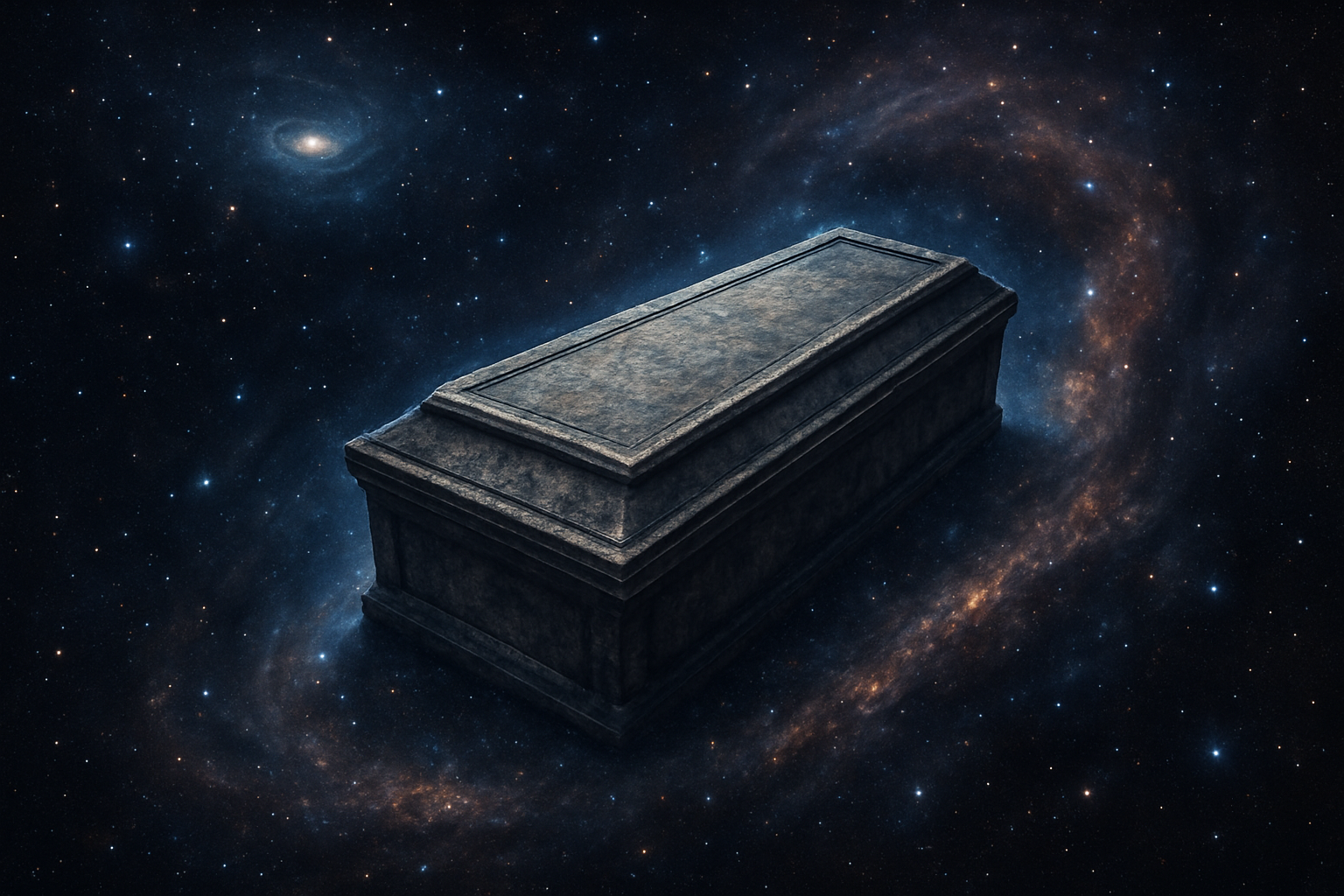
In an ever-expanding universe, the concept of death has often been viewed through the lens of earthly existence—bound by time and space. However, the notion of a “cosmic coffin” challenges us to rethink what death could mean in a universe that stretches far beyond the confines of our solar understanding.
The Enigma of Space-Time
Albert Einstein’s theory of relativity fundamentally changed the way we understand time and space, uniting them in a single continuum. According to NASA, “time is relative—it can vary for different observers depending on your speed through space.” This concept suggests that death, traditionally seen as a fixed point, might indeed be more fluid and interwoven with the universe’s limitless expanse.
“When a star dies, it can experience a ‘cosmic glorious finale,’ as it explodes in a supernova,” National Geographic explains. “The elements synthesized in its core are scattered across the cosmos, seeding future generations of stars and planets.”
Death of Stars: A Cosmic Perspective
Stars, the celestial bodies that illuminate our universe, offer profound insights into death beyond time. The lifecycle of a star, from its birth in stellar nurseries to its death in various forms, illustrates nature’s cyclical process—a dance of creation, existence, and destruction on a cosmic scale.
- White Dwarfs: After burning out, stars like our sun become white dwarfs. These dense remnants radiate away the heat over billions of years before fading into black dwarfs—hypothetical stellar remnants that no longer emit significant heat or light.
- Neutron Stars: More massive than the sun, these stars undergo supernova explosions, resulting in neutron stars or, if sufficiently massive, black holes.
- Black Holes: Black holes epitomize the idea of the “cosmic coffin.” These phenomena, where gravitational pull produces singularities in space-time, intrigue scientists. As Stephen Hawking posited, they might not be as terminal as we think, potentially allowing for radiation and information to escape—introducing uncertainties about absolute closure on cosmic death.
Quantum Mechanics and the Multiverse Theory
Quantum mechanics adds another dimension to our understanding of death. The multiverse theory posits the existence of multiple, parallel universes where every possible outcome of a quantum event occurs. Time magazine notes, “In some pocket universes, death might not be inevitable as it is on Earth, leading to speculation about immortality beyond conventional bounds.“
Furthermore, the quantum theory of entanglement suggests that particles can be interconnected across vast distances, implying that death—or the cessation of existence—could resonate throughout the multiverse, affecting entities in unpredictable ways.
Philosophical Implications of Cosmic Death
The existential questions prompted by cosmic death challenge human perceptions and beliefs. If we consider death as part of a larger cosmic process rather than an endpoint, it invites a reevaluation of meaning, legacy, and connection:
- Existence Beyond Memory: In a universe where stars themselves are recycled into new generations, human legacies could be viewed similarly—not in terms of monuments or historical records, but as elements of a larger cosmic tapestry.
- The Interconnected Universe: The understanding that all matter in the universe is interconnected supports the idea that death is not just a solitary event but part of a larger cosmic cycle. As Carl Sagan eloquently put it, “We are made of star stuff.” This interconnectedness extends our existence posthumously, transcending the limits of human perception.
Ethical Considerations and Future Implications
The insights gleaned from our exploration of cosmic death present ethical questions about our place in the universe. The pursuit of technologies such as cryonics and digital consciousness transfer seek to defy natural death, echoing a desire to transcend earthly mortality. However, such ambitions require us to confront ethical dilemmas concerning identity, continuity, and respect for the natural lifecycle.
Philosopher Nick Bostrom raises a poignant question: “If individuals can be ‘saved’ through technological means, what implications does this hold for the traditional concepts of life and death?”
The Dawn of Cosmic Understanding
As humanity ventures further into the cosmos, our understanding of death is likely to evolve. The exploration of extraterrestrial environments and the ongoing study of cosmic principles might uncover deeper truths about the universe’s processes. These advancements hold the potential to reshape not only our perception of death but our entire world view.
In conclusion, the cosmic coffin metaphor extends beyond a mere scientific curiosity; it offers profound philosophical and existential insights. As we continue to explore the universe and its myriad wonders, may we embrace a broader perspective of life and death—one that transcends time and space, reminding us of our place in a vast and ever-expanding cosmos.