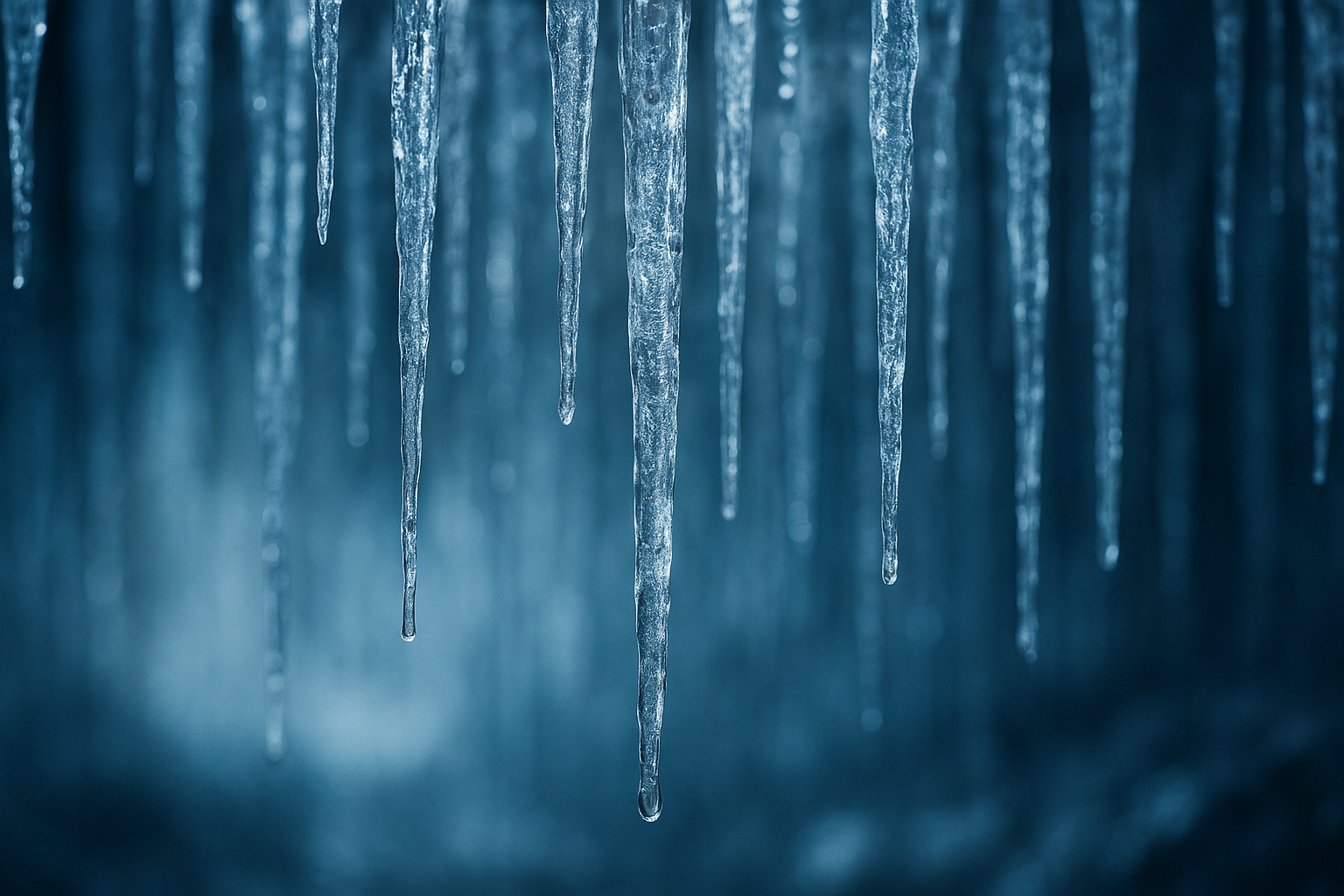
In the stillness of winter, when nature breathes softly beneath a delicate blanket of snow, icicles hang like nature’s chandeliers, glinting with an ethereal light. These frozen drips, forming so silently yet so profoundly, hold more than just the elegance of nature’s abstract art. They seem to murmur secrets carried from ancient times, whisperings from a distant past sealed within their crystalline forms.
But can we truly hear the arcane wisdom through these tendrils of ice? Or is this just an act of human imagination trying to find meaning in the humdrum of life’s mundane patterns?
The Nature of Icicles
To first understand the significance of icicles, we must appreciate how they are formed. When water drips down from surfaces in freezing temperatures, each droplet freezes upon contact with the cold, growing slowly from the edge of roofs, railings, or tree branches. What emerges is an icy stalactite that captivates the eye and, arguably, the soul.
Robert Macfarlane, a noted scholar on the motifs of nature, writes, “There is something both transient and eternal about icicles; they are as fleeting as the drips that form them, yet their forms echo the grandeur of ancient ice.” His observations emphasize the paradoxical nature of icicles, which possess a fleeting beauty yet connect us to the permanence and perpetuity underlying natural processes.
Icicles and Mythology
The mythology of ice is rich and varied across cultures, with icicles playing a subtle yet significant role in the narratives of winter and the supernatural. In Norse mythology, Ymir, the primordial giant, was formed from the icy rime of Niflheim. The dripping veins of frost, resembling icicles, sustained his immense life force, signifying a direct connection between ice and life.
“Amidst the eternal frost, life finds its root,” reads a passage from the Prose Edda, suggesting not only survival but the flourish of life even in the harshest of environments.
Similarly, in Japanese mythology, icicles are regarded as the tears of Yuki-onna, the Snow Woman, symbolizing both beauty and danger. These stories shape our perception of icicles as conduits of memory and emotion, offering a timeless arcane wisdom waiting to be heard.
The Symbolism of Sound
They say the sound of an icicle melting can be both tranquil and arresting. Listen closely as it drips into eternity, and you might hear more than just water. Could these sounds be whispers of the universe, shared throughout the quietude of winter?
- A study by the National Snow and Ice Data Center suggests that the formation of ice, while physically silent, represents a symphony of time and natural orchestra, resonating with frequencies that some believe reflect Earth’s ancient history.
- Musical compositions like the works of Vivaldi’s Winter from ‘The Four Seasons’, draw inspiration from these natural phenomenons. The Chicago Baroque Ensemble describes how the rising and falling intensity of the music mimics the formation and gradual dissolution of icicles.
A Scientific Wonder
From a scientific perspective, icicles represent unique microenvironments, preserving air bubbles, temperature records, and atmospheric conditions of the past. Scientists study icicles and other ice forms to understand climate patterns, a branch of study critical under the impact of global warming. These frozen relics hold data encrypted in their structure, much like a forgotten scroll waiting to divulge its story.
Researchers at the University of Toronto have developed methods to analyze the isotopic compositions within icicles, deriving data that sheds light on historical weather cycles and helping predict future climate phenomena.
Icicles in Literature and Art
Literature and art have long been enamored with icicles. Whether through descriptive language or visual interpretation, creators have sought to capture their transient beauty and mysterious allure.
- Emily Dickinson often used the imagery of icicles to evoke the passage of time and the interplay of warmth and cold in her poetry:
“The treacherous rare gasps, / Of Winter, the Icicle keels, / Glossy and so glistens, / It charms even the Sun away.”
- In visual arts, the works of Claude Monet explore the subtle play of light on icicles, capturing ephemeral beauty with his impressionist brushstroke. His lesser-known work, Ice Floes, is a testament to his fascination with water in its solid state.
The Personal Connection
Perhaps the deepest connection we find to icicles is a personal one, where every whisper and drip resonate with our own experiences. Standing beneath an icicle-laden roof, one cannot help but reflect upon nature’s cyclical rigor, the constancy of change, and the stories embedded in every frozen drop. It compels one to muse on questions of existence and continuity, forging an inner dialogue with the ancient wisdom they seem to embody.
Conclusion
The whispers in icicles are subtle, but for those willing to listen, they offer profound reflections on time, nature, and the universe. Whether seen through the eyes of a scientist analyzing ice formations or an artist harnessing their beauty, icicles bear silent witness to the world’s mysteries.
As you find yourself amid the winter wilderness, pause by the edge of a slowly shrinking icicle. Listen. Within its drip may lie the voice of the past, speaking of the grandeur of nature and our place within its eternal cycle.