Tag: myths
-
Mythic Shadows – Dark Stories from Ancient Lore
Throughout history, tales deeply entrenched in myth and mystery have captivated our imaginations, often reflecting the unexplored fears and dark corners of human nature. Ancient lore is rich with stories that evoke shadowy figures and haunting lessons, offering a glimpse into the fears and morals of past civilizations.
The Tale of Hades and Persephone
One of the most well-known dark myths originating from ancient Greece is the story of Hades and Persephone. Hades, the god of the underworld, abducted Persephone, the daughter of Demeter, the goddess of the harvest. This tale is not merely about love and abduction; it embodies the seasonal cycle of life and death. The ancient Greeks believed that Persephone’s descent into the underworld brought the barren winter, while her return marked the fertile spring.
“Although she was mourned for in heaven, happier far than she were the maidens who had gone before, for these suffered an eternity of memories in the lowering realms.” — Edith Hamilton, Mythology
Norse Myths: Ragnarok and the End of Days
In Norse mythology, the concept of Ragnarok serves as an apocalyptic tale that foretells the ultimate doom of the gods and humankind. According to the Prose Edda and Poetic Edda, two key sources of Norse myths, Ragnarok is a series of future events, including a great battle, ending with the death of major gods like Odin, Thor, and Loki, followed by natural disasters submerging the world in water. This speaks to the Norse belief in the cyclical nature of the world, highlighting inevitable destruction and rebirth.
The Egyptian Underworld: Duat
The ancient Egyptians harbored a deep belief in the afterlife and its challenges. The journey through the Duat was perilous, filled with obstacles and monstrous creatures. The deceased were expected to pass a series of tests, including having their heart weighed against the feather of Ma’at. Those found wanting were devoured by the fearsome goddess Ammit, a composite creature that was part lion, part hippopotamus, and part crocodile.
“In the Duat, the deceased are judged based on their actions on earth. Only the pure of heart may proceed to the peaceful fields of Aaru.” — Encyclopaedia Britannica
Conclusion
These stories, steeped in myth and darkness, offer more than mere entertainment; they mirror the values, fears, and worldviews of the ancient worlds from which they emerged. Through these tales, modern audiences can explore the universal themes of life, death, and rebirth, understanding that even in darkness, there is much to be learned.
-
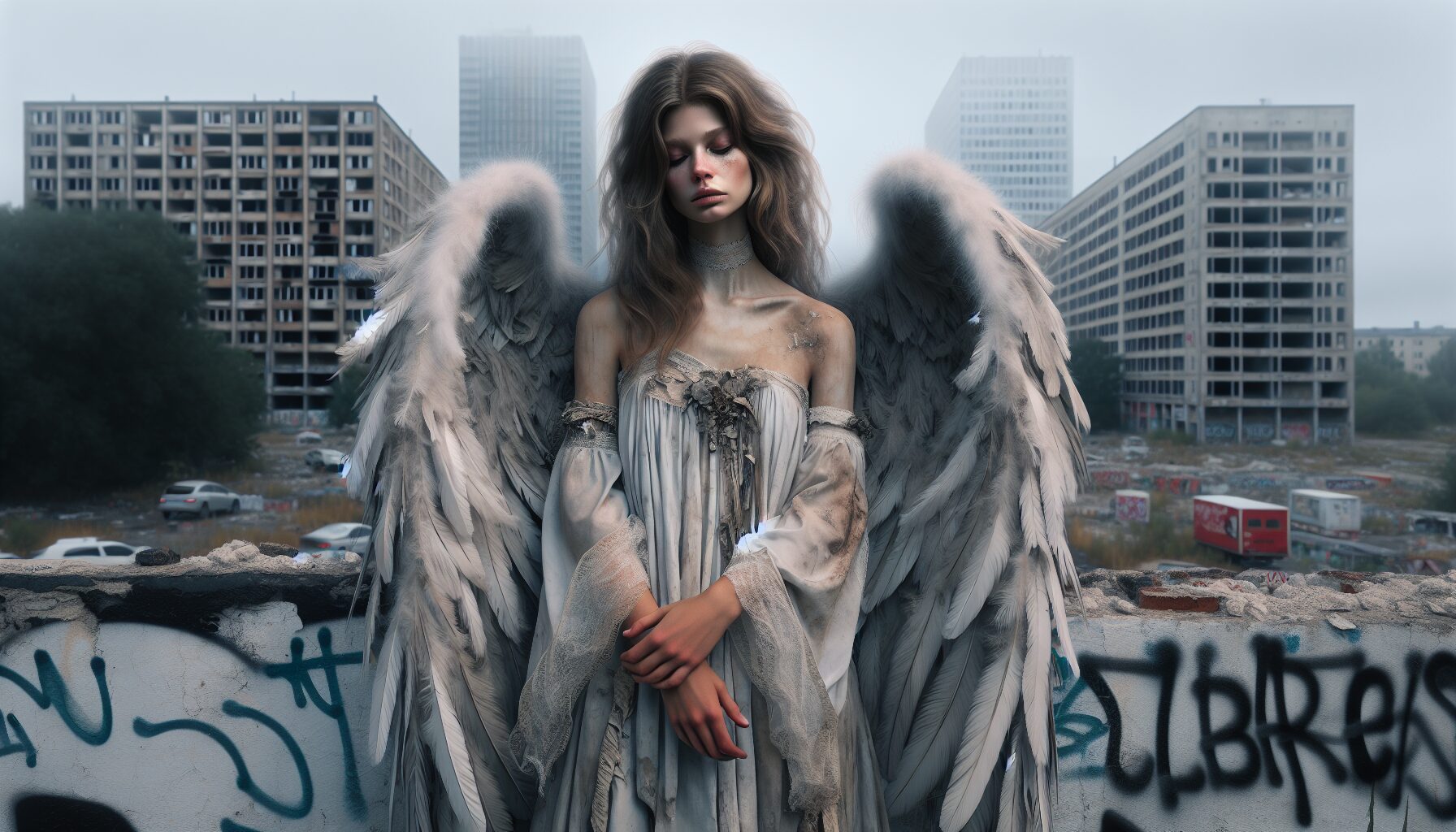
Angels in Decay – Mythcore Reflections on Modern Society
Angels in Decay: Mythcore Reflections on Modern Society
In the iridescent tapestry of contemporary culture, the term “Mythcore” emerges as a niche yet profoundly evocative artistic and philosophical stream. Bridging mythological motifs with modern existential reflections, it unveils layers of hidden truths through the lenses of metaphor and allegory. The concept of “Angels in Decay” provides a poignant backdrop through which we can explore the disintegration of societal myths and their reverberations across human consciousness.
The Rise of Mythcore
Before delving into the specifics of contemporary society’s angels in decline, it is essential to understand the foundational aspects of Mythcore. As a cultural movement, Mythcore seeks to reimagine ancient narratives within the framework of modern existential dilemmas. It intertwines elements of literature, art, and philosophical critique to question prevailing societal norms and offer escape or enlightenment.
“Mythcore isn’t just about revisiting old stories; it’s about finding meaning in a world that seems increasingly devoid of it,” notes cultural theorist Jonathan Jones.
Angels as Archetypal Beings
Angels, within various mythologies and religious discourses, have always embodied intermediary forces between the divine and the earthly planes. They represent purity, guidance, and the unseen hand of providence. However, within the Mythcore framework, angels often symbolize grandeur that has fallen from grace, mirroring society’s diminishing ideals and increasing moral ambiguity.
These divine messengers, in their decay, reflect how the sanctified notions of truth, justice, and beauty have eroded in the face of relentless modernity.
Decaying Myths in Modern Society
As technology and media shape our reality, societal myths — those longstanding beliefs and ideals that shaped our ancestors’ worldviews — are transforming into relics of a bygone era. The phenomenon of “Angels in Decay” encapsulates this transition.
- The Myth of Progress: The 20th and 21st centuries marked an era of unprecedented technological and scientific advancements. Yet, amid prosperity, myths of unbridled progress have been tarnished by environmental degradation and ethical dilemmas in artificial intelligence. The angel of technology, once a beacon of hope, now bears wings soiled by overreach and hubris.
- The Myth of Common Good: In theory, society thrives on collective well-being. In practice, however, the myth decays under the weight of individualism and divisive politics. As the angel of communal harmony struggles amid stark inequality, the Mythcore narrative questions if genuine altruism is obsolete.
- The Myth of Truth: In the digital age, information flows ceaselessly, yet the pursuit of truth appears more elusive than ever. Misinformation clouds our collective understanding, ensuring that the angel of truth is beleaguered by the shadows of lies and deception.
Art and Literature: Mirrors to a Decaying Society
Throughout history, art and literature have provided critical reflections on societal changes, serving as both commentary and catalyst. Within the Mythcore domain, they remain vital in unraveling the metaphysical underpinnings of angels in decay.
Consider the works of Neil Gaiman and his depictions of celestial beings in decay in The Sandman series—a profound exploration of myth intersecting with everyday reality. These narratives challenge the reader to witness angels as fallible, engaging characters that resonate with humanity’s struggles.
“Stories are how we perceive the world; they are the way we talk to each other; they are the things that we aspire to. They are the things we make up… about ourselves,” writes Gaiman (The Guardian).
Philosophical Implications
The philosophical undertones of angels in decline offer fertile ground for discourse. What does the decay of these celestial figures imply about our self-perception? What can we learn from the myths as they crumble? The Mythcore perspective encourages a reevaluation of existential crises and a resurgence of wonderment in understanding mortality and morality.
Philosopher Jean Baudrillard articulates the hyperreal condition of society, a space where truths become distorted by mere simulations. Mythcore advocates for peeling away these veneers to recover authenticity, even in entropic forms—championing beauty in decay.
Embracing the Decay: A Call to Action
Where does Mythcore’s narrative of decaying angels lead us? It urges not resignation but reflection and renaissance. By acknowledging the erosion of archaic myths, individuals are hopefully inspired to foster new narratives that embrace change, complexity, and compassion.
The call is clear: to transcend traditional belief systems and improve our shared social fabric, understanding that decay is not only an end but the prelude to rebirth and transformation. The angelic myth, even as it decays, can illuminate pathways for renewed hope and ethical evolution.
Conclusion
“Angels in Decay” within Mythcore reflections impel us to scrutinize, reimagine, and reconfigure contemporary society’s metaphoric angels for a promising future. Yes, angels may falter, but their essence lingers, urging humanity to navigate the labyrinthine modern milieu with a fresh sense of curiosity and conscience.
The intertwined fabric of myth, art, and philosophy beckons for new stories, scripting the unfinished symphony of angels, both celestial and earthbound.