Tag: other

  • Quantum Mysteries – Science and Arcana

    Quantum Mysteries – Science and Arcana

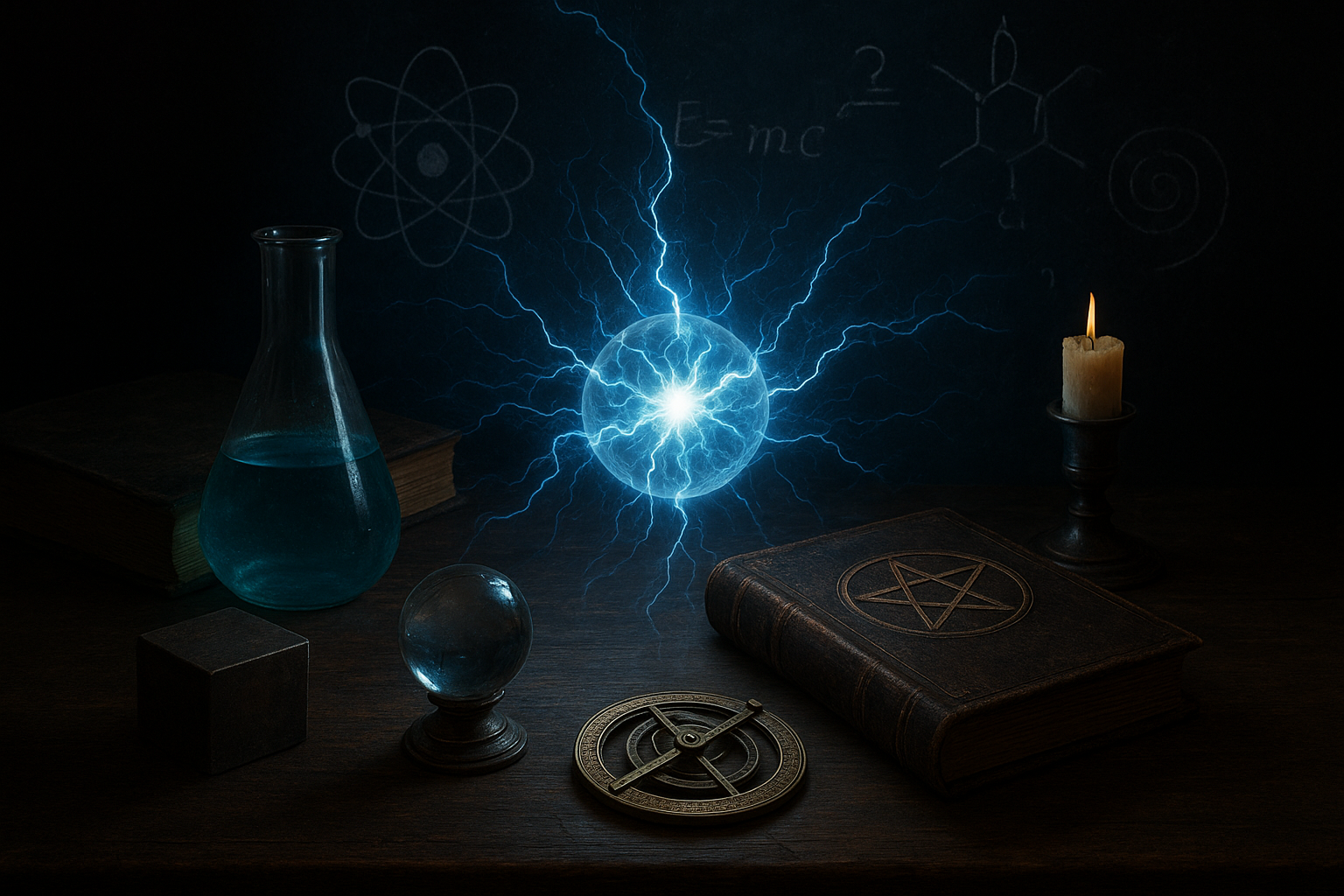
    The quantum realm is a wonderland of paradoxes and enigmas that continues to baffle scientists, philosophers, and mystics alike. As we delve deeper into quantum mysteries, we find ourselves at the intersection of science and arcane knowledge, exploring the tantalizing dance of particles and waves, possibilities, and realities.

    The Quantum Universe

    At the heart of quantum physics are phenomena that defy our traditional understanding of reality: superposition, entanglement, and uncertainty. Albert Einstein, though skeptical, famously remarked on the oddity of these concepts: “God does not play dice with the universe.” Yet, the probabilistic nature of quantum mechanics suggests that the universe is, at its core, a tapestry of unpredictability.

    One of the most puzzling aspects of quantum mechanics is superposition, the idea that particles can exist in multiple states simultaneously until observed. This concept is famously illustrated by the thought experiment known as Schrödinger’s cat, where a cat is deemed both alive and dead until someone opens the box to check.

    Entanglement and Mysticism

    Quantum entanglement is another bewildering property, where two particles become linked and instantly influence each other regardless of distance. Albert Einstein referred to this as “spooky action at a distance,” puzzled by the notion that entangled particles could affect each other faster than the speed of light.

    “When we change a property (such as spin) of one of the objects, so too will the other one change.”

    This phenomenon bears a striking resemblance to mystical ideas of interconnectedness and unity pervasive in many spiritual traditions. In the Eastern philosophies such as Buddhism and Taoism, the notion of interbeing—that everything is interconnected—echoes the inherent linkage of entangled particles.

    The Journey Ahead

    • Quantum Computing: As researchers harness superposition and entanglement, quantum computing promises to revolutionize technology, offering unprecedented computational power.
    • Quantum Consciousness: Some theories suggest our consciousness might be a quantum phenomenon, hinting at unexplored interfaces between mind and matter.
    • The Quest for Understanding: The road to deciphering quantum mysteries merges the empirical with the mystical, requiring openness to profound shifts in perspective.

    With every discovery, the quantum domain continues to challenge the boundaries between science and spirituality. As physicist Richard Feynman aptly stated, “I think I can safely say that nobody understands quantum mechanics.” In this uncharted territory, perhaps it is the blend of science and arcana that will ultimately guide us closer to truth.

  • The Titan\’s Atlas – Mythology of Other Worlds

    The Titan\’s Atlas – Mythology of Other Worlds

    The Titan’s Atlas – Mythology of Other Worlds

    Throughout human history, myths and legends have served as windows into the intriguing cultures and values of societies. One such myth, captivating in its depth and symbolism, is that of Atlas, the mighty Titan tasked with holding up the sky. From ancient Greece to modern interpretations, Atlas symbolizes the enduring burdens and responsibilities that transcend the earthly realm, hinting at a mythology of other worlds.

    The Burden of Atlas

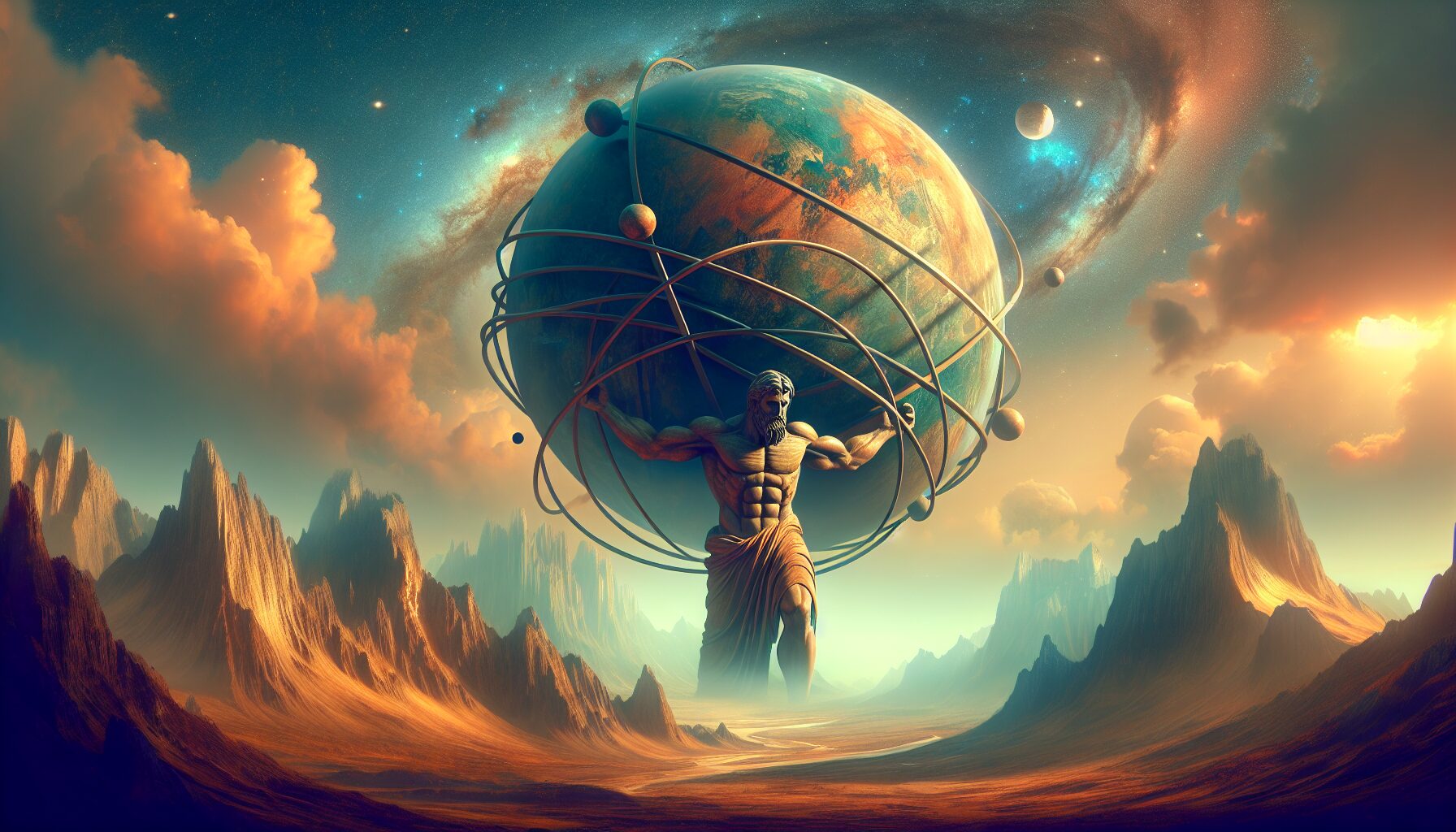
    In Greek mythology, Atlas was a Titan condemned to hold up the heavens for eternity as a punishment for his role in the Titanomachy, the epic battle between Titans and Olympians. This image of Atlas, muscles straining under the celestial weight, has been immortalized in art and literature, representing more than just physical strength. The story of Atlas reflects the theme of enduring responsibility and perseverance through insurmountable challenges.

    “Atlas, the founder of astronomy, showed mankind the turning sky, holding up celestial forces which are the source of our understanding of the universe.” – Diodorus Siculus

    Interpreting Atlas Across Cultures

    As the myth of Atlas spread, it evolved, intertwining with various cultural motifs and philosophies. In Roman interpretations, Atlas became associated with astronomical knowledge, a fitting representation of the Titan’s connection to the cosmos. The enduring power of Atlas’s image invites parallels to mythologies from across the globe, where colossal figures often depict links between earth and the divine.

    In Norse mythology, for instance, the cosmic ash tree Yggdrasil holds the universe together. According to the Encyclopedia Britannica, it symbolizes the structure of the cosmos, much like the myth of Atlas embodies a foundational pillar connecting earthly and celestial realms. Both myths convey the intricate balance and interconnectedness of all existence.

    The Titan’s Role in Modern Culture

    Today, Atlas’s legacy continues in a myriad of ways, from literature and film to brand names and logos, underscoring its enduring influence. The symbolism of Atlas has even transcended into scientific exploration, with namesakes like the National Aeronautics and Space Administration (NASA) Atlas program, which hints at the quest to support new realms beyond Earth.

    • Atlas as an icon of resilience
    • Representation in art and pop culture
    • Inspiration for scientific exploration

    The story of Atlas reminds us of the broader human struggle to understand our place in the universe while carrying our own burdens. As we explore other worlds, both mythological and physical, Atlas serves as a powerful symbol of strength, perseverance, and curiosity.