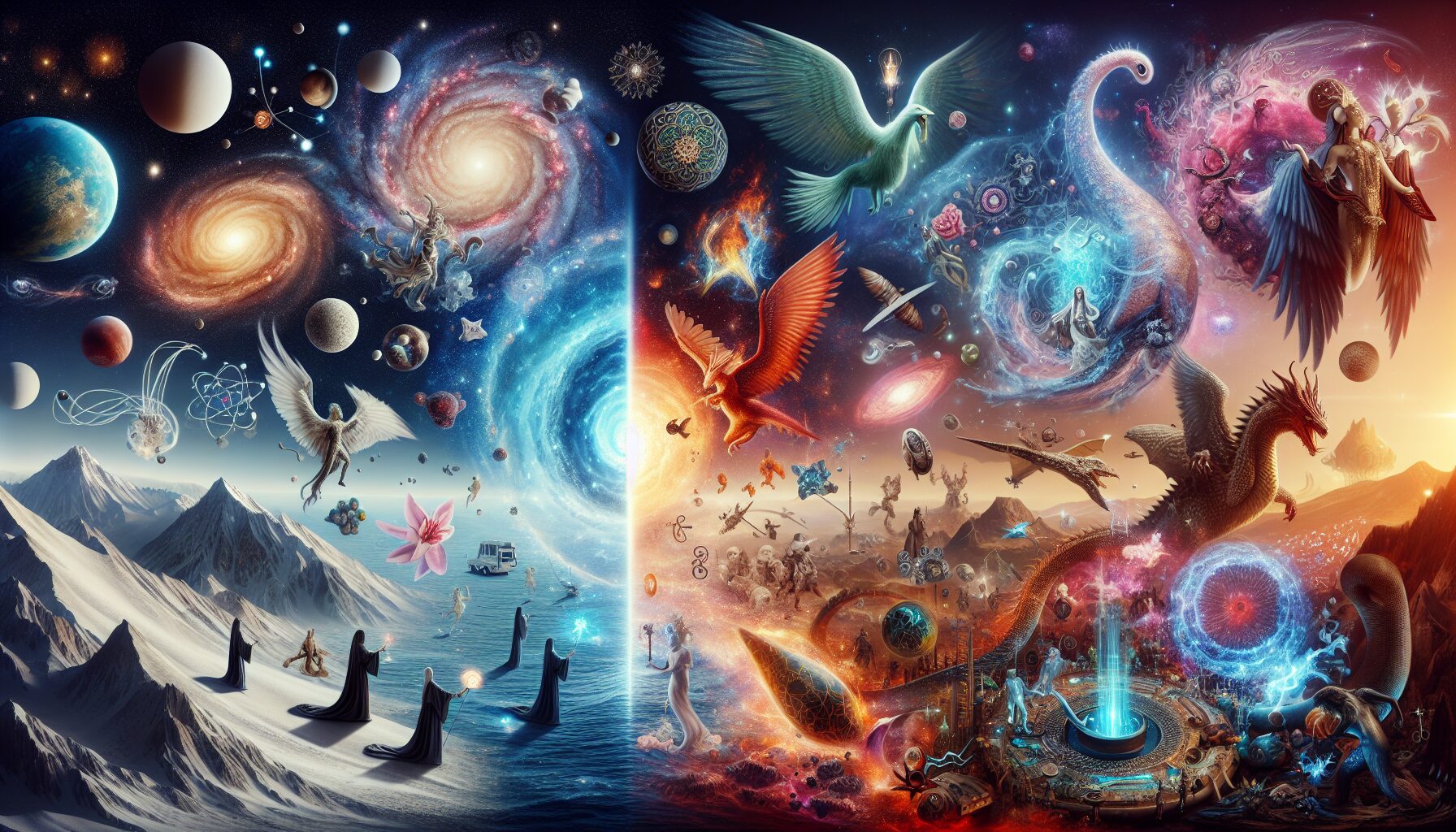
In the tapestry of human history, the cosmos has woven itself into the fabric of mythology and scientific inquiry alike. The Cosmic Forge is an exploration into how celestial phenomena and scientific discovery have shaped myths that resonate through cultures worldwide. This intersection of science and myth invites us to ponder the elegant dance between empirical truth and the stories crafted by human imagination.
The Origins of Cosmic Myths
Human civilization has always looked to the stars for answers. Ancient cultures across the globe spun tales that spoke of gods and monsters residing in the heavens. The Greeks visualized a celestial dome filled with constellations that told stories of heroes like Hercules and Odysseus. Similarly, the Egyptians crafted the story of Nut, the sky goddess who swallowed the sun each night, only to birth it anew each morning.
“When I consider the brief span of my life swallowed up in the eternity of time before and after, the small space I occupy and which I see swallowed up in the infinite immensity of spaces of which I know nothing, and which know nothing of me, I am afraid, and wonder to see myself here rather than there, now rather than then.” – Blaise Pascal
Pascal’s reflection is a timeless reminder of the awe that the cosmos inspires in humanity. For countless generations, the nighttime sky has served as both a clock and a canvas, mapping the passage of time while hosting narratives that explain natural phenomena through divine agency.
Scientific Revolution: Shedding Light on the Heavens
The advent of the scientific revolution brought about a pivotal shift in our understanding of the universe. Nicolaus Copernicus, Galileo Galilei, and Johannes Kepler began piecing together a heliocentric model that displaced Earth from the center, directing attention to the mechanisms governing celestial bodies. This paradigm shift liberated the stars from folkloric narratives and set the stage for the modern field of astronomy.
Copernicus’s “On the Revolutions of the Celestial Spheres” initiated this shift by challenging the geocentric model which placed Earth at the center of the universe. His work laid the groundwork for the explosion of astronomical knowledge that followed.
“You cannot teach a man anything; you can only help him find it within himself.” – Galileo Galilei
Galileo’s famed observation of Jupiter’s moons with his telescope showed celestial phenomena in real-time, dismantling the celestial perfection Aristotle and Ptolemy upheld. Kepler’s laws of planetary motion further solidified this new order, marking a profound union between scientific inquiry and cosmic storytelling that still influences us today.
Cosmology and Creation Myths
In the heart of many creation myths is a depiction of the universe’s origin. From the Big Bang Theory, which describes the universe’s expansion from a singular, immensely dense point, to the Hindu Brahmanda (Cosmic Egg) metaphor, parallels abound. Ancient Hindu scriptures referred to a universe that undergoes endless cycles of creation, preservation, and destruction, reminiscent of the Big Bang’s cyclical echoes.
Despite its mythical origins, the concept of a cyclical universe finds some resonance in contemporary theories like Roger Penrose’s Conformal Cyclic Cosmology, suggesting an eternal universe with repeated big bangs. Here again, myth and science brazenly intertwine, with echoes of the past reverberating through the latest hypotheses.
The Influence of Myth in Modern Scientific Thought
Contrary to the notion that science and myth are entirely disparate realms, many modern physicists continue to draw inspiration from mythological themes. Albert Einstein, for instance, famously regarded imagination as more critical than knowledge, suggesting a creative bridge between the realms of fantasy and empirical observation.
Stephen Hawking, whose work on black holes and cosmology further pushed the boundaries of human understanding, often likened scientific theories to myth. As reported by The Guardian, Hawking playfully regarded string theory as a real-world example of the cosmic serpent found in Norse and Mayan traditions.
“I think everyone should study physics before being allowed to write about fairy tales.” – Terry Pratchett, lecture on Discworld series.
Pratchett, a speculative fiction author known for his whimsical rebuttals of scientific literalism, crystallized the contemporary belief in science and myth’s mutual inspiration. The evolving universe of science fuels the imagination necessary for speculative creation, demonstrating how modern cultural narratives continuously reforge old myths into new and compelling frameworks.
Conclusion: The Ongoing Dance
The Cosmic Forge is an emblem of humanity’s dual capacity to observe and dream. Mythology provides a narrative framework that can make sense of complex natural phenomena, while science offers the tools to explore and understand those very phenomena. Together, they create a comprehensive picture of our place in the universe.
These storied heavens continue to be a source of wonder and curiosity, urging each new generation to gaze upward and ponder what lies beyond. In a world increasingly driven by technology and scientific endeavor, the spirit of myth remains a vital companion, reminding us that in the quest for knowledge, a little room for magic enriches the journey.