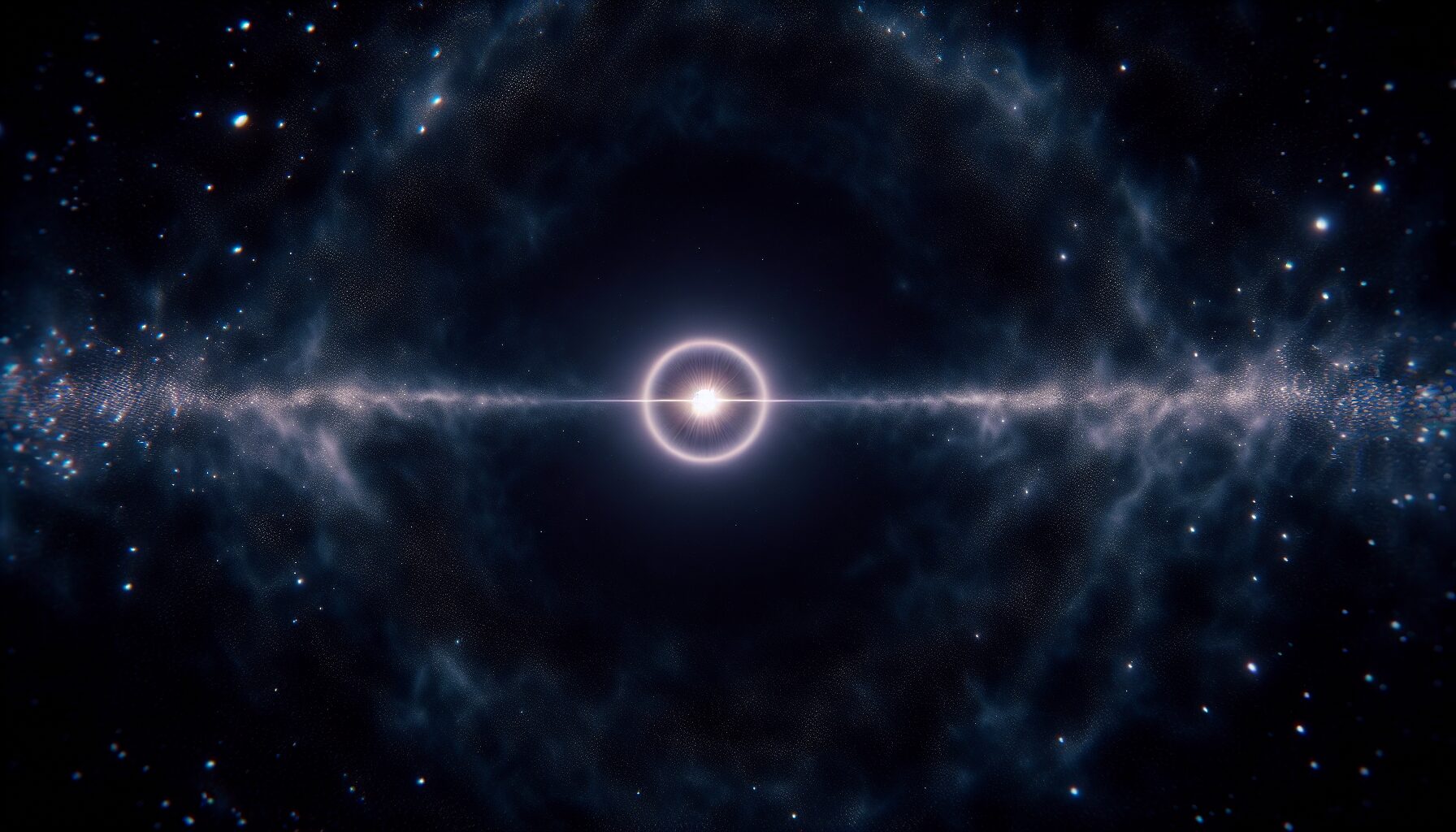
The fate of our universe has been a subject of intrigue and speculation among scientists and philosophers alike. From the Big Bang that marked its fiery inception, the universe has been in a state of perpetual expansion. However, what awaits at the end of this cosmic journey? According to some theories, the ultimate fate of the universe could be a vast, cold, and absolute darkness.
A Universe in Expansion
For centuries, humans have pondered the fundamental nature of the cosmos. The idea that the universe is consistently expanding was first proposed by Belgian astronomer Georges Lemaître in the 1920s, a notion that would later be supported by Edwin Hubble’s discovery of galaxies moving away from us in all directions. This evidence suggests that the universe is not in a static state but is dynamically evolving.
Current observations indicate that not only is the universe expanding, but this expansion is accelerating due to a mysterious force known as dark energy. As NASA describes, dark energy constitutes about 68% of the universe, and its properties remain largely unknown. Its discovery has dramatically altered our understanding of the cosmos and the potential pathways it might traverse in the distant future.
Theories on Cosmic Conclusion
The potential end of the universe is a topic that has spawned multiple hypotheses among cosmologists. Here are some of the predominant theories on how the universe might conclude:
- The Big Freeze: Also known as “heat death,” this theory posits that as the universe continues its accelerated expansion, galaxies will drift apart, stars will fade, and the universe will gradually succumb to a state of entropy. As thermodynamic energy irreversibly dissipates, the cosmos will eventually reach a uniform temperature—too cold to sustain any form of complex matter, let alone life.
- The Big Crunch: This hypothesis is essentially the reverse of the Big Bang. If the gravitational forces of matter within the universe are strong enough, they could eventually overcome the forces of expansion, causing the universe to collapse in on itself. However, current data from WMAP (“Wilkinson Microwave Anisotropy Probe”) suggest that this outcome is less likely given the dominance of dark energy.
- The Big Rip: According to this scenario, the relentless expansion of the universe, driven by dark energy, could reach a point where it tears apart galaxies, stars, and eventually even atoms and subatomic particles. “The universe would end in a singularity, a gravitational collapse at a single point in time,” as explained by theoretical cosmologist Robert Caldwell.
The Last Photon and the Looming Darkness
The advent of the “Big Freeze” or “Heat Death” would ultimately usher in the era of the last photon. This moment signifies the end of all light and energy transformation processes, where the once glorious luminescence emitted by countless stars and galaxies across the universe will be extinguished.
“Eventually, all processes that produce photons will cease, leaving matter in a random, chaotic state. What remains is a universe that is dark, dilute, and cold.” – Lawrence Krauss, theoretical physicist and cosmologist.
This foreseen darkness will not occur for an unimaginably long time—a span of time so vast it defies human comprehension. Yet it is a sobering reminder of the transient nature of everything in existence, from galactic clusters to the tiniest quanta of light itself.
The Philosophical Dimension
The concept of the universe dissolving into eternal darkness has profound philosophical implications. Many have pondered what this fate suggests about the nature of existence. Are we living in a universe indifferent to creation and destruction, or is there an underlying purpose that escapes our grasp?
The idea of a universe ending devoid of light challenges our perceptions of meaning and our understanding of time. It raises questions about the nature of consciousness and whether our existence is merely a brief flicker in the vast timeline of the cosmos.
For some, this realization is a clarion call to cherish the now and the wondrous beauty of the universe as it exists. For others, it is a contemplation of the scientific truths that govern our universe, and the persistent human endeavor to unravel its mysteries.
Conclusion
The ultimate demise of the universe in ice-cold darkness might seem a grim end to a magnificent beginning, but it is also a testament to the grandeur and complexity of cosmological phenomena. While the “last photon” heralds the end of cosmic light, it equally symbolizes a reminder of our place within this vast, ever-evolving universe. As our understanding advances, so too does our appreciation of the cosmos’ remarkable intricacies and the fleeting moments of brilliance within it.