Tag: presence

  • The Choir of the Celestial – Angels in Music and Mysticism

    The Choir of the Celestial – Angels in Music and Mysticism

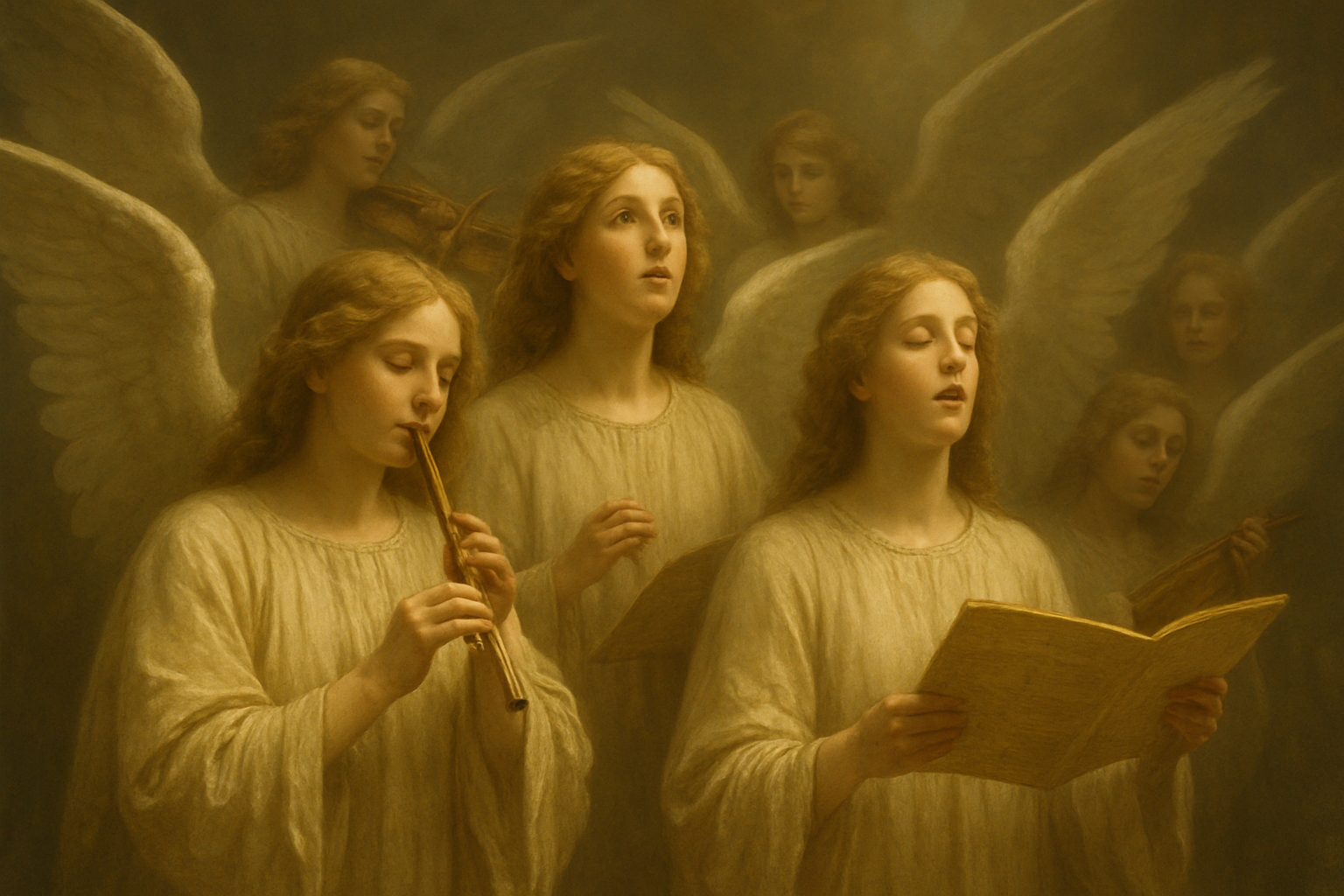
    Throughout history, angels have been a profound symbol, captivating the imaginations of artists and mystics alike. Their ethereal presence has inspired countless musical compositions and provided a wellspring of spiritual exploration and artistic expression.

    Angels in Musical Composition

    From Gregorian Chants to contemporary symphonies, angels have consistently been depicted as conduits of divine music. Their celestial associations have led to them being portrayed as the ultimate harbingers of harmony and peace. Consider Hildegard von Bingen, a 12th-century composer and mystic, who believed her music was inspired by angelic visions. Her compositions often sought to reflect the heavenly choir she envisioned in her spiritual visions.

    “Heavenly beings are free of schema and display beauty by their simplicity, and elevate the spirit through divine song.” – Hildegard von Bingen

    In modern times, compositions such as Olivier Messiaen’s Quartet for the End of Time, composed during World War II, invokes the presence of angels in its movements. Messiaen, a devout Catholic, often composed with a deep sense of spiritual and mystical themes, and angels regularly occupied a sacred place within his works.

    Mystical Significance of Angels

    Beyond the symphonic halls, angels have also played a key role in mystic traditions. In Christianity, Islam, and Judaism, angels serve as messengers between the divine and the mortal. Mystics such as Emanuel Swedenborg claimed direct communication with the angelic realm, detailing these encounters in his works, which have been integral to the understanding of heavenly hierarchies and the afterlife in spiritual teachings.

    Their significance transcends religious boundaries, resonating with many who view angels as embodiments of divine protection and comfort. Angels are often cited in near-death experiences and are part of spiritual practices such as prayer and meditation. Their symbolic presence acts as a beacon of hope, offering solace in the face of adversity.

    The Legacy of Angels in Culture

    In sum, angels have imprinted themselves upon music and mysticism, blending these disciplines into a holistic narrative that speaks to the interconnectivity of the divine and the earthly. Their perpetual allure and the relationship between sound and spirituality create a resonant chord that spans centuries.

    From scripture to symphony, the angelic role as intermediaries invites us to listen, reflect, and embrace the harmonies of the heavens that surround our everyday lives.

    For further insight into the roles of angels in religious traditions, you can read more from Encyclopaedia Britannica.

  • Angelic Vibration – Spiritual Frequencies and Angels

    Angelic Vibration – Spiritual Frequencies and Angels

    In the realm of spirituality, there is a belief in the existence of higher vibrational energies that permeate the universe. One profound aspect of this belief is the presence of angelic beings, entities thought to operate at these elevated frequencies. Understanding the concept of angelic vibrations can provide deep insights into our spiritual journey and how we might connect with these celestial guides.

    The Science of Vibration

    Everything in our universe is composed of energy, vibrating at various frequencies. This concept is not only confined to the esoteric but is supported by science. According to the law of vibration, one of the primary Universal Laws of Nature, everything, from the smallest atom to the largest galaxy, is in a constant state of oscillation. Albert Einstein once remarked, “Everything in life is vibration.” This resonates with the idea that seeing beyond the physical dimension involves recognizing these energetic patterns.

    Angelic Frequencies Explained

    Angels are often associated with higher frequencies, which is beyond the range typically perceived by human senses. These energies are said to transcend our physical world, offering guidance and support. They are considered messengers between the divine and the earthly realms, as noted in several religious and spiritual texts.

    “Angels are purely spiritual beings, which means their essence is entirely non-physical and free of the material constraints binding us.” – Spirituality.com

    • Harmony and Balance: Angels, as embodiments of higher frequencies, resonate with harmony, balance, and unconditional love. Their presence can be incredibly soothing, promoting peace and tranquility in one’s life.
    • Inspiration and Insight: By tuning into their vibrations, individuals may gain profound insights and inspiration that aid in personal growth and understanding.

    Connecting with Angelic Energies

    Communicating with angels requires raising one’s own vibrational frequency. This can be achieved through various spiritual practices designed to elevate one’s state of consciousness. Here are several methods to facilitate contact with angelic beings:

    • Meditation: Regular meditation helps quiet the mind and raise your vibrational frequency, opening a channel for angelic communication. Focused breathing, visualization, and setting a clear intention to connect with angelic realms can be particularly effective.
    • Prayer: Engaging in prayer or invocation with sincere intent can invite angelic presence into one’s life. Reaching out with gratitude and a humble heart is often recommended.
    • Sound Healing: Sound is a powerful tool for tuning into higher frequencies. Instruments like Tibetan singing bowls, tuning forks, and sacred chants can help attune your energy levels to those of angelic vibrations.

    The Role of Angels in Our Lives

    Many spiritual traditions believe angels have specific roles in our lives. They serve as protectors, guides, and healers, offering their assistance in times of need. It is often said that angels will not interfere in human affairs unless explicitly called upon, respecting the natural law of free will.

    In times of despair or uncertainty, inviting the presence of angels can provide reassurance and guidance.Archangel Michael, known for protection and courage, or Archangel Raphael, often associated with healing, are some of the more commonly summoned angels.

    “Their unwavering presence has been documented across cultures for centuries, acting as divine aides sworn to our welfare and growth.” – A Guided Life

    Embracing Angelic Influence

    To embrace angelic influence is to understand and acknowledge the interconnectedness of all things. By recognizing the vibrations of these celestial beings, individuals can foster a more profound connection with the universe and their inner selves. This bond can lead to a richer, more balanced life filled with love, peace, and spiritual progression.

    Connecting with angelic vibrations is an invitation to explore deeper dimensions of existence, transcending the material world to touch the divine. Whether through meditation, prayer, or simply a heartfelt desire to learn more about these mystical beings, the journey towards understanding angelic frequencies is deeply personal yet universally accessible.

    In the words of Saint Augustine, “Make room for the angels, for they will make a room for you.”

  • The Ethics of Specters: Essays on Ghosts

    The Ethics of Specters: Essays on Ghosts

    In the realm of the immaterial, where the known meets the unknown, lies an intriguing ethical conundrum: the existence and treatment of specters. These ethereal beings, often depicted as the residual presence of the departed, challenge our understanding of reality and morality. What do we owe them, if anything, and how should they be treated?

    Ghosts in Cultural Context

    Throughout history, ghosts have played a crucial role in various cultural narratives. From the vengeful spirits in Japanese folklore to the sorrowful specters of Western literature, such as the famous Ghost of Hamlet’s father, these entities raise questions about justice and the afterlife.

    “The past is never dead. It’s not even past.” – William Faulkner

    Faulkner’s words, though metaphorical, remind us of the ghostly presence of history, where unresolved issues linger in cultural memory much like ghosts in deserted halls. But how do we ethically engage with such specters?

    The Ethical Dilemma

    Firstly, acknowledging their presence is pivotal. In some beliefs, ghosts represent individuals who remain tethered to the physical world due to unresolved issues or trauma. Is it our moral duty to aid these spirits in finding peace? If we consider them sentient, the answer could be yes.

    Consider the perspective shared by Kishore Mahbubani, who speaks on the importance of understanding and reconciliation in human conflicts, principles which some argue extend to our relationships with ghosts. Acceptance, understanding, and perhaps a sense of duty to help them move on could be seen as necessary virtues.

    The Role of Stories and Beliefs

    Stories about ghosts often leave us pondering our beliefs about life, death, and morality. They challenge us to consider the ramifications of actions in life that might ripple into the afterlife. The Ethics of Specters: Essays on Ghosts posits whether tales of ghosts are cautionary, reminding us of unfinished business and the need for ethical considerations transcending mortal life.

    • Respect: Treating all beings, living or spectral, with kindness and respect.
    • Empathy: Understanding the existential plight of spirits as narratives of human emotion.
    • Resolution: Endeavoring to resolve our own “ghosts” of regret and unfinished business.

    In conclusion, whether we believe in the literal presence of ghosts or interpret them as metaphors, they serve an essential function in exploring human conscience and ethics. They remind us that ethics is not confined to the tangible but extends into the whispers of the past and the specters of our morally conflicted imaginations.