
Tag: serpents

  • The Serpent Constellation – Myth in the Stars

    The Serpent Constellation – Myth in the Stars

    In the vast canvas of the night sky, where stars twinkle like scattered diamonds, there lies a constellation that has captured human imagination for centuries—the Serpent, or Serpens. Divided into two parts, Serpens Caput and Serpens Cauda, this constellation weaves a tale rich with mythology, history, and astronomical significance.

    Astronomical Details of Serpens

    Serpens is unique among the 88 modern constellations. It is the only constellation divided into two separate parts:

    • Serpens Caput (the Serpent’s Head) lies to the west.
    • Serpens Cauda (the Serpent’s Tail) lies to the east.

    They are separated by the constellation Ophiuchus, the Serpent-Bearer. Together, these celestial patterns create a vivid representation of a serpent held by a figure, which has been captivating humanity since antiquity. According to the International Astronomical Union, Serpens sprawls across an area of 637 square degrees, making it the 23rd largest constellation in the night sky (IAU).

    Mythological Significance

    The legends surrounding the Serpens constellation have deep roots in various cultures and mythologies. The most renowned tale originates from Greek mythology. The constellation is often associated with the healer Asclepius, who discovered the secret to immortality from a serpent.

    “Asclepius was such a skilled healer that he could even bring the dead back to life. This knowledge disturbed Hades, the god of the underworld, and concerned Zeus, who feared it would disrupt the natural order. Consequently, Zeus struck Asclepius with a thunderbolt, but in recognition of his healing powers, placed him in the stars as the constellation Ophiuchus, holding a serpent.”
    – Edith Hamilton, Mythology: Timeless Tales of Gods and Heroes

    The serpent in these myths is symbolic of rejuvenation and wisdom, reflecting its shedding of skin and revealing a new form beneath. In Roman mythology, the tale is similar, with an added dimension of the serpent being a wisdom-bringer.

    Serpens in Cultural Contexts

    The image of a serpent bridging perceptions between malevolence and wisdom is not limited to Greek mythology. Across cultures, serpents have been seen as both protectors and adversaries:

    • Hindu Mythology: Serpents, or Nāgas, are considered demigods with significant spiritual connotations, often appearing in the Vedic texts as protectors of earthly treasures.
    • Egyptian Mythology: The serpent Apep (or Apophis) was seen as an enemy of the sun god Ra, embodying chaos that Ra defeats daily in his solar journey.
    • Norse Mythology: Jörmungandr, the Midgard Serpent, signifies both protection encircling the world and an apocalyptic threat leading to Ragnarök.

    These varied interpretations of serpents highlight their complex nature within human psyche, as both guardians of hidden knowledge and harbingers of change.

    Observation and Significance in Astronomy

    In practical astronomy, the Serpens constellation offers more than mythological intrigue. It is home to some fascinating celestial objects:

    • Messier 5: An ancient globular cluster located in Serpens Caput, believed to be about 13 billion years old.
    • IC 4756: An open cluster located in Serpens Cauda, known for its richness and extensive star field.
    • The Eagle Nebula (M16): Situated within Serpens Cauda, this nebula houses the famous Pillars of Creation, columns of gas and dust where new stars are born, captured in iconic images by the Hubble Space Telescope.

    These objects make Serpens a treasure trove for astronomers and stargazers alike, offering vistas of both ancient and newborn stars.

    Modern Interpretation and Influence

    Today’s fascination with the serpent and its starry manifestations continues to resonate in popular culture, science, and art. The serpent’s symbolism is often embraced in literature as a metaphor for transformation and mystery. Moreover, its mythologies inspire movies, video games, and art, reflecting perennial human themes of life, death, and rebirth.

    In science, the study of serpents, particularly the Eagle Nebula in Serpens Cauda, furthers our understanding of stellar evolution and cosmic phenomena. As technology progresses, our glimpses into these celestial sites continually evolve, often with breathtaking results.

    Conclusion

    Whether through its celestial wonders or its rich mythical tapestry, the Serpens constellation mirrors humanity’s eternal quest for knowledge and transformation. Like the serpent shedding its skin, it invites us to renew our perspectives, weaving together threads of ancient lore and contemporary science. Above us, Serpens offers both a reminder and an invitation—to look up, to dream, and to ponder the infinite tapestry of the cosmos.
  • The Star Serpents – Mythology Beyond the Sky

    The Star Serpents – Mythology Beyond the Sky

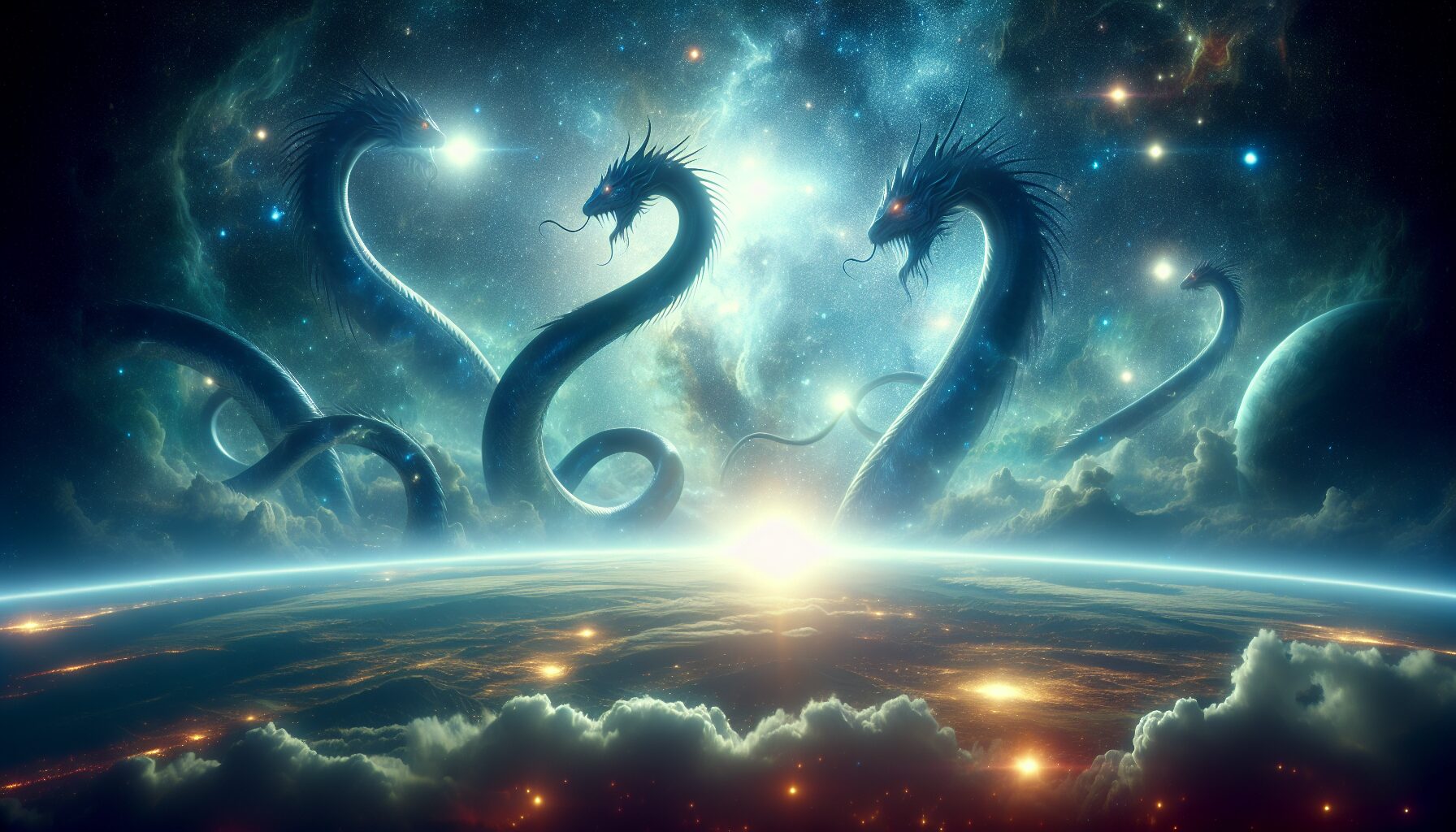
    The sky has always been a canvas for the stories and myths that humans create, and among these tales, the Star Serpents are particularly intriguing. These celestial creatures, woven into the mythologies of various cultures, stand as testimonies of humanity’s quest to understand the universe. From the swirling Milky Way to specific constellations that slither across the night sky, serpents have transcended their terrestrial origins to become cosmic icons.

    Origins of Star Serpents in Mythology

    Serpents hold a profound place in mythologies worldwide, representing both creation and destruction, wisdom and chaos. In the context of the skies, they often embody powerful stories:

    • Norse Mythology: Jörmungandr, the Midgard Serpent, is among the most famous celestial serpents, feared for encircling the entirety of Earth, as described in The Prose Edda. This serpent’s cosmic role is detailed in sources such as The Prose Edda, where it is foretold that Jörmungandr will play a crucial role in Ragnarok, the end of the world.
    • Chinese Mythology: In Chinese culture, the Dragon, which is often depicted as a serpent, is not just a symbol of wisdom but also of the celestial order. The Azure Dragon, known as Qinglong, is one of the Four Symbols of Chinese mythology, representing the East and springtime.
    • Mesoamerican Mythology: The Feathered Serpent, known as Quetzalcoatl among the Aztecs and Kukulkan with the Maya, is a deity associated with the morning star, rebirth, and renewal. This serpent god is a vivid representation of the connection between the heavens and Earth, influencing both art and religious practices.

    Constellations and Celestial Patterns

    In the night sky, serpent-related imagery is abundant. Various cultures have identified celestial serpents among the stars:

    “The constellation Ophiuchus represents a man holding a snake, symbolized by the neighboring constellation Serpens. This cosmic combat is believed to be symbolic of healing and eternal struggle.” — StarDate

    • Draco: One of the most well-known serpent constellations, Draco represents the dragon killed by Hercules. This winding constellation which coils around the northern celestial pole is a source of intrigue and legend.
    • Hydra: Known as the largest constellation, Hydra represents the water serpent. In ancient Greek mythology, when Heracles killed Hydra, it became a permanent fixture in the skies, immortalized among the stars.
    • Serpens: This unique constellation is divided into two parts: Serpens Caput (Serpent’s Head) and Serpens Cauda (Serpent’s Tail), emphasizing its mystical and divided nature.

    Astronomical Significance and Cultural Impact

    While they offer a mythological perspective, celestial serpents also draw connections to astronomy and the understanding of our cosmos. The myths surrounding serpents often intertwine with real astronomical phenomena:

    • The Milky Way: Often described as a celestial river, the sprawling band of stars has been seen as a serpent or dragon in various cultures, guiding wanderers with its luminescent trail.
    • Comets and Meteors: These were sometimes interpreted as celestial serpents dashing across the sky, foretelling natural changes or omens to ancient civilizations.

    Symbolism in Art and Literature

    Artistic representations of serpents in the sky are widespread, from ancient petroglyphs to Renaissance paintings. These depictions are not mere works of art; they are interpretations of humanity’s imagination:

    • Petroglyphs and Cave Paintings: Ancient civilizations often depicted serpentine figures in relation to the stars, as evidenced by sites across Europe and the Americas.
    • Renaissance and Baroque Art: Artists of these eras utilized celestial serpents to depict stories from mythology, infused with religious and symbolic meaning, demonstrating the continued influence of these mythic creatures.
    • Modern Literature and Media: Today, the serpent remains a potent symbol in sci-fi and fantasy literature, representing the unknown and the majesty of space, as explored in works like Frank Herbert’s Dune.

    “The thing about science fiction is that it often places humanity against the backdrop of stars and celestial phenomena. Star serpents serve as metaphors for the challenges and mysteries we face.” — Frank Herbert

    Persisting Mysteries and Future Discoveries

    As we extend our gaze to newly discovered galaxies and nebulas, celestial serpents invite us to ponder their place in both ancient lore and modern understanding. Could these timeless creatures hold clues to forgotten wisdom or mysteries yet to unravel?

    The myths of star serpents remind us that stories serve as bridges between our world and the cosmos, inspiring us to explore and decipher the universe’s secrets. These mythologies may provide metaphoric insights into our challenges, reminding us of the balance between creation and chaos that serpents signify.

    Conclusion

    Whether as mythical dragons looming over a medieval sky or as serpentine studies in the slick pages of a modern science fiction novel, the imagery of star serpents beckons us to look up and beyond. They embody the eternal human pursuit of the eternal — a journey through myth, culture, and cosmos that intertwines with the stars themselves.

    Ultimately, the mythology of star serpents goes beyond mere narrative; it resonates with the profound and eternal curiosity of humans looking beyond the sky, linking stars with stories and ensuring that through every era, the serpents’ dance among the stars continues.