Tag: soul

  • Wing-Span Wisdom – Learning to stretch your soul.

    Wing-Span Wisdom – Learning to stretch your soul.


    Wing-Span Wisdom – Learning to Stretch Your Soul


    Wing-Span Wisdom – Learning to Stretch Your Soul

    In a world where we’re constantly connected, it’s easy to feel like our souls are shrinking. But what if I told you there’s a way to stretch your soul and unlock its true potential?

    The Power of Expansion

    • Embracing the Unknown: “The greatest glory in living lies not in never falling, but in rising every time we fall.” – Nelson Mandela. When we’re willing to take risks and step into the unknown, our souls expand to accommodate new experiences.
    • Letting Go: “You can’t start the next chapter of your life if you keep reading the same old book.” – Unknown. As we release what’s holding us back, our souls grow lighter and more receptive to new wisdom.
    • Being Present: “The present moment is the only moment available to us, and it is the door to all moments.” – Thich Nhat Hanh. When we’re fully engaged with the here-and-now, our souls expand to encompass the beauty and wonder of the world around us.

    “When I let go of what I am supposed to be, I become what I am meant to be.” – Unknown

    So how can you start stretching your soul? Here are a few tips:

    • Practice mindfulness: Take time each day to focus on your breath and the present moment. As you do, imagine your soul expanding like a butterfly emerging from its cocoon.
    • Embrace curiosity: Seek out new experiences, read books that challenge your perspective, and engage in conversations that make you uncomfortable.
    • Let go of attachment: Release your grip on what’s familiar and comfortable. This doesn’t mean giving up what brings you joy, but rather being open to new possibilities and perspectives.

    As we stretch our souls, we’ll find ourselves becoming more compassionate, resilient, and connected to the world around us. So go ahead, take a deep breath, and spread your wings – your soul is ready to soar!
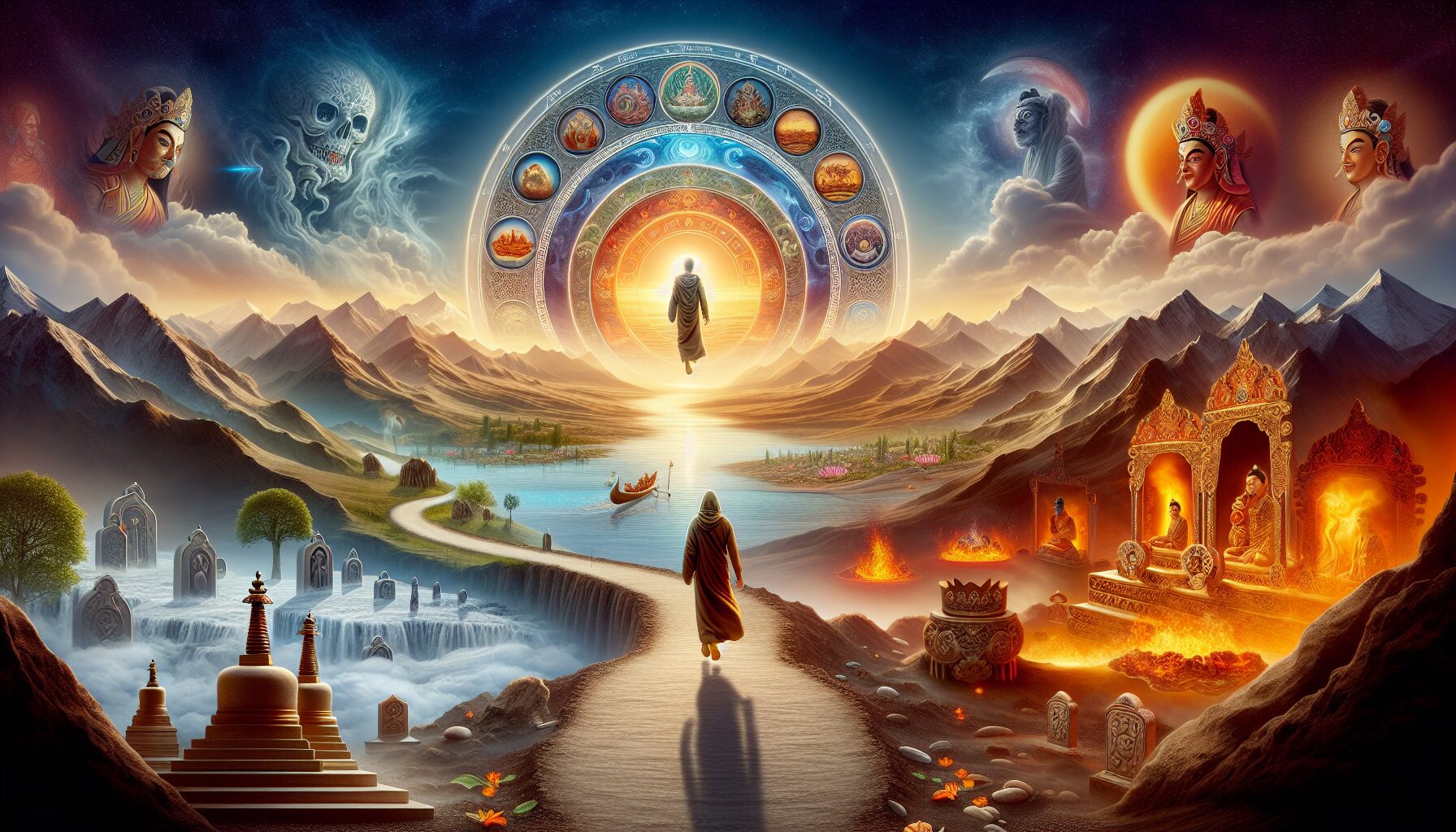

  • The Soul’s Journey – Tibetan Cosmology of Afterlife

    The Soul’s Journey – Tibetan Cosmology of Afterlife

    Tibetan cosmology presents a richly detailed map of the afterlife, offering insights into what many believe awaits beyond death. Rooted in a fusion of Buddhist teachings and ancient Bon traditions, this view is closely tied to the essential aspects of Tibetan spiritual philosophy.

    The Bardo States

    Central to Tibetan beliefs about the afterlife is the concept of the bardo. The term “bardo” translates to “in-between state” and refers to the transitional phases a soul undergoes from the moment of death until rebirth. There are traditionally three major bardo states described in the Bardo Thodol, or “The Tibetan Book of the Dead”:

    • Chikhai Bardo: The moment of death, where the individual experiences the “Clear Light of Reality.” This is a moment of profound opportunity, where the soul can recognize the true nature of the mind.
    • Chonyid Bardo: Following the initial moment of death, the soul encounters various manifestations stemming from its own mind. These visions can range from peaceful to wrathful and are believed to provide insight into one’s karma.
    • Sipa Bardo: The phase leading to rebirth. Here, based on accumulated karma and clarity of awareness, the soul is guided towards its next incarnation.

    Karma and Rebirth

    The Tibetan understanding of the afterlife is deeply interwoven with the concept of karma. As the Dalai Lama explains, “From the Buddhist perspective, the ideas of karma and rebirth form a natural extension of the evolutionary process” (Dalai Lama’s Messages).

    Each action performed in life—whether thought, word, or deed—imprints a karmic residue that influences the soul’s journey within the bardo states. Hence, one’s conduct can critically impact the conditions of rebirth, potentially leading a soul toward a higher or lower existence in its next life.

    Practical Applications

    The Tibetan approaches to death and dying are not merely theoretical. They offer practical paths for preparation and assistance for those facing death. Meditative practices, such as phowa (transference of consciousness), are employed to secure a more favorable rebirth by directing the mind’s attention at crucial moments.

    Conclusion

    The Tibetan cosmology of the afterlife provides a profound and structured vision of post-mortem existence that emphasizes personal responsibility and the potential for spiritual evolution. By understanding these processes, individuals can engage more mindfully with life, cultivating the positive conditions necessary for an auspicious continuation beyond this existence.

    “Understanding the bardo states can help us become less fearful of death and more mindful of how we live.” — Tricycle Magazine