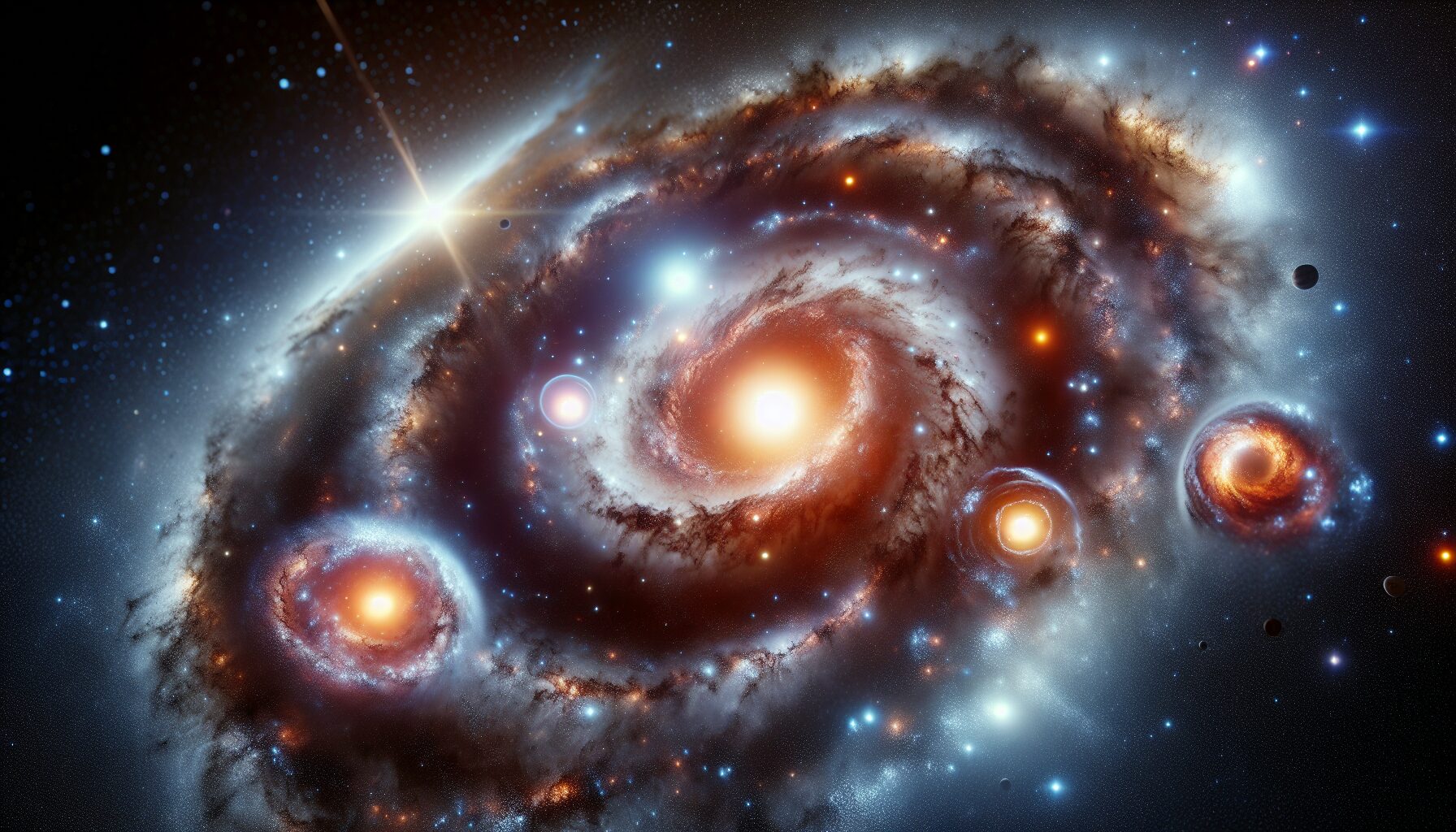
Galactic Cannibalism: When Stars Are Consumed by Other Stars
In the vast universe, the interactions between celestial bodies can sometimes result in phenomenal cosmic events. Among these intriguing phenomena, galactic cannibalism stands out as an evocative term capturing the violent and transformative processes by which galaxies consume one another. But, how often does it happen that entire stars are swallowed in this celestial banquet?
Understanding Galactic Cannibalism
At its core, galactic cannibalism refers to the process by which a larger galaxy absorbs a smaller one. This process often unfolds over billions of years and can significantly alter the structure and composition of the absorbing galaxy. But why does this happen?
- Galactic cannibalism is primarily driven by gravitational forces. As galaxies move through space, they are bound by gravity, which can pull them together, especially when they are in close proximity.
- When galaxies collide or come close enough, the gravitational pull becomes strong enough to draw stars, gas, and dust from the smaller galaxy into the larger one.
- This process leads to stellar mergers, formation of new stars, and the enrichment of the galactic halo with new materials.
Do Stars Really Get Consumed?
The term “consumed” might be a bit misleading when speaking of stars in the context of galactic cannibalism. Stars themselves are not literally devoured like food; rather, they are incorporated into the structure of the larger galaxy during the merging process. Here’s how:
- As the galaxies merge, stars from the smaller galaxy are stripped away and become part of the larger galaxy’s halo, bulge, or disk through dynamic interactions.
- Some stars may end up in newly formed tidal streams—long, thin regions of stars located on the periphery of galaxies—indicating the path of a disrupted galaxy.
- In more extreme cases, stellar collisions can occur, though they are typically rare even in densely packed galaxies.
The Evidence: Galactic Archaeology
Galactic cannibalism is not just a theoretical concept—it is an observable phenomenon. Astronomers have gathered substantial evidence through observations and simulations that illustrate how galaxies grow and evolve.
“The Milky Way is currently cannibalizing several smaller galaxies, including the Sagittarius Dwarf Spheroidal Galaxy.” – Linda Smith, a researcher at the Space Telescope Science Institute.
Some of the most compelling evidence includes:
- Stellar streams: These are trails of stars stripped from cannibalized galaxies. Observations of streams around our own Milky Way reveal ongoing mergers.
- Computer simulations: Simulations that recreate the gravitational interactions between galaxies support the existence of tidal streams and other observable features.
- Galactic bulges and halos: Many galaxies have thick halos and bulges containing older stars, indicative of past mergers and a history of cannibalism.
Impact of Galactic Cannibalism
While destructive in nature, galactic cannibalism is a pivotal force shaping the universe. The impacts are manifold:
- Star formation: The influx of gas during mergers can trigger starburst events, leading to the birth of new stars.
- Evolution: Galactic cannibalism plays a significant role in galaxy evolution, helping smaller galaxies coalesce into massive elliptical galaxies.
- Black holes: The collision of galaxies can lead to the mergers of supermassive black holes, contributing to their growth and potentially impacting galaxy dynamics.
Astronomer Kathryn Johnston states in Scientific American, “The Milky Way has the habit of tearing apart and ingesting its celestial companions, leaving recognizable traces far from its own center.”
The Future of Galactic Cannibalism
The universe continues to evolve, and with it, the dance of galaxies. Our own Milky Way is on course to merge with the Andromeda Galaxy in approximately 4.5 billion years. What can we expect?
- The resulting merger is expected to create an entirely new galaxy, often referred to as Milkomeda or Milkdromeda.
- This merger will redefine the local galactic group, creating vast tidal tails and likely sparking new waves of star formation.
- While the event will be spectacular, the vast distances between stars mean individual stellar collisions are unlikely, ensuring the Sun and solar system face little direct threat.
Conclusion
Galactic cannibalism, far from being a metaphor for cosmic destruction, represents a fundamental process of creation and transformation. Through the complex dance of gravitational attraction, galaxies evolve, merge, and transform into new cosmic structures.
As we uncover more about these processes, we gain crucial insights into the dynamic nature of the universe and our own galactic origins—reminding us of the ever-changing and interconnected cosmos we inhabit.