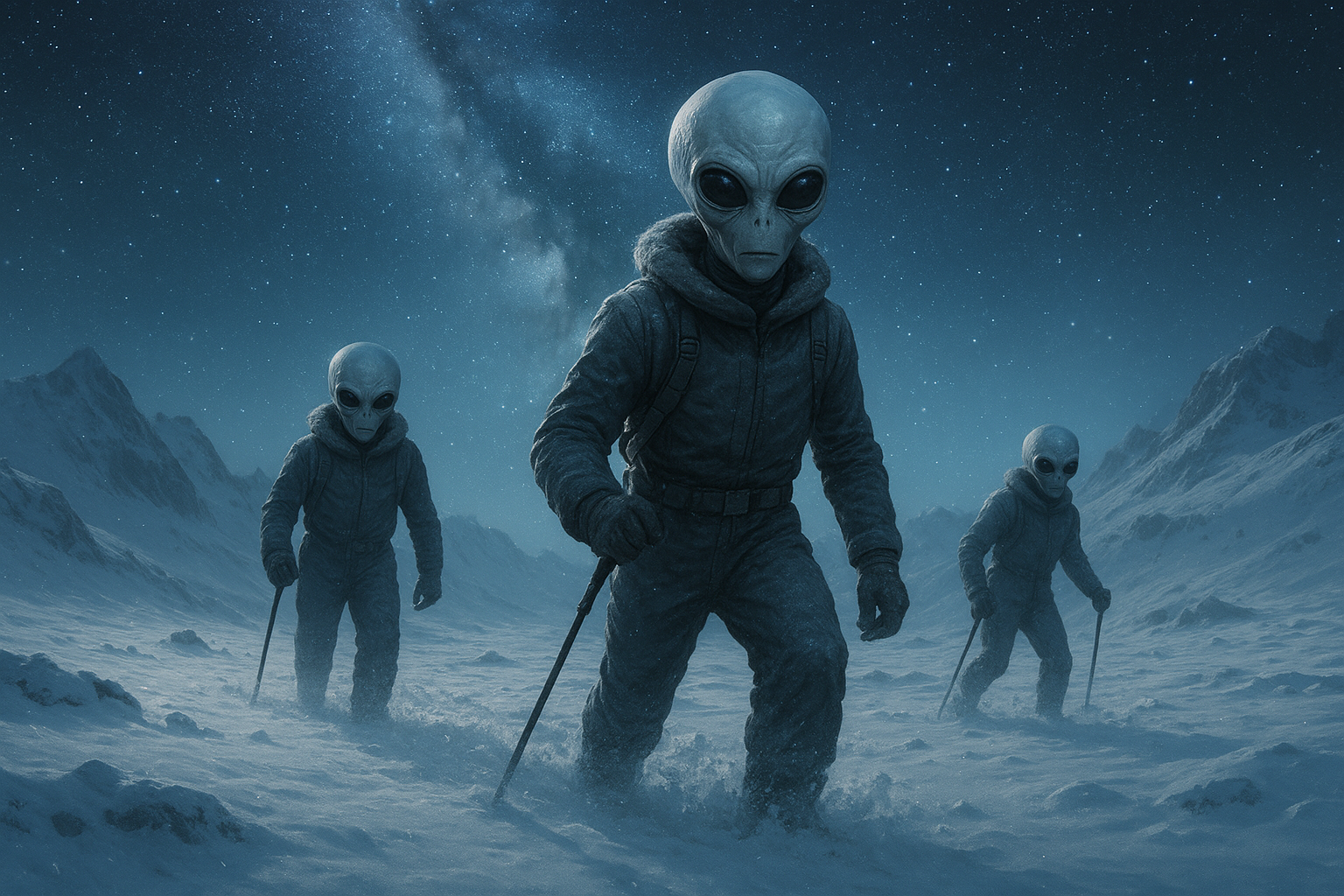
In the unfathomable expanse of the universe, where the void is punctuated by sparse worlds of unimaginable conditions, there exists the concept of the Galactic Snow Travelers. These hypothetical extraterrestrial beings have piqued the imagination of scientists and enthusiasts alike, inspired by both scientific discovery and science fiction. These imagined denizens of icy realms challenge our understanding of where life can exist and how it can adapt to extremities beyond our earthly paradigm.
The Science of Icy Exoplanets
To appreciate the possibility of life in the cold void, one must first understand the nature of icy exoplanets. These planets, which are located in the outer regions of their solar systems, are often characterized by frozen surfaces, deep subsurface oceans, or thick atmospheres rich in volatile ices. A prime example within our own solar system includes the Jovian moon Europa, which is believed to harbor a subsurface ocean beneath its icy crust.
According to NASA, “Europa is thought to have an iron core, a rocky mantle, and an ocean of salty water beneath a shell of ice,” suggesting that while the surface is inhospitable, the ocean beneath might be capable of supporting life (source).
Galactic Snow Travelers: A Thought Experiment
Imagine, if you will, a species that thrives in these frigid environments. The Galactic Snow Travelers might possess unique adaptations that allow them to live, hunt, and reproduce in the extreme cold. Here are some speculative adaptations that might make their existence possible:
- Thermal Adaptation: Much like our Earth’s extremophiles, these beings could have proteins that operate optimally at low temperatures, preventing their cells from freezing.
- Anti-Freeze Biochemistry: Similar to certain fish in Earth’s polar regions, they might have blood or fluids containing natural antifreeze compounds, allowing them to remain active in sub-zero environments.
- Energy Derived from Chemical Reactions: Rather than relying on solar energy, which is sparse in such distant worlds, they might derive energy from chemical reactions occurring beneath ice layers, akin to chemosynthesis observed in deep-sea Earth vents.
- Reflective or Insulating Skin: To minimize heat loss, their skin or scales might possess properties that reflect infrared radiation or provide excellent insulation.
Cultural and Technological Implications
While physiological adaptations are a staple of speculative biology, the cultural and technological implications of these snow travelers are equally intriguing. These beings might develop unique technologies suited to their icy homes. Consider the following possibilities:
- Ice-Based Construction: Structures built entirely from ice, utilizing the abundant material in their surroundings much like human pioneers in cold regions utilized ice and snow to build shelters.
- Thermal Manipulation Tools: Advanced tools that can manipulate heat at a molecular level, allowing them to carve ice, travel across frozen expanses, or even communicate via thermal signals.
- Cultural Significance of Ice: Ice might hold symbolic or spiritual significance, perhaps integral to their art, mythology, or even governance systems.
The Search for Cold-Life Biosignatures
The quest to discover such life is intensely linked to our search for biosignatures on icy exoplanets or moons. Scientists employ several indirect methods to detect signs of life or habitable conditions. These include:
- Spectroscopy: By examining the light absorption properties of a planet’s atmosphere, researchers can identify chemicals like methane or oxygen that might suggest biological activity.
- Seismic Measurements: On moons like Europa, measuring the ice’s response to gravitational interactions can help infer the presence of subsurface oceans.
- Robotic Explorations: Missions like Europa Clipper set to launch in the 2020s aim to investigate Jovian moons directly, searching for signs of life beneath the ice (source).
The Philosophical and Ethical Dimensions
The potential discovery of such life forms raises profound philosophical questions. What does it mean for humanity to find life that has evolved entirely separately from Earth? How would this affect our understanding of life as a universal phenomenon? Furthermore, the ethical implications of interacting with such alien life are bound to spark intense debate:
“Whether we encounter microbial life or an advanced civilization, the existence of aliens would provide crucial insights into our own place in the cosmos.” – Dr. Neil deGrasse Tyson
Would our interactions harm these pristine environments or potentially threaten their existence? The considerations are complex and require humanity to tread carefully in our pursuit of knowledge.
Conclusion
The idea of Galactic Snow Travelers challenges the imagination and stretches our understanding of life’s adaptability. While still a product of speculative fiction and science, it inspires a reevaluation of life’s potential distribution throughout the universe. As we step closer to exploring these frozen frontiers, the prospect of discovering life in the cold void remains a tantalizing question that might redefine what it means to be alive.
In a universe as vast and varied as ours, the concept of Galactic Snow Travelers reminds us that life might find a way in the most unexpected of places, waiting quietly beneath an icy surface, dreaming of stars.
