Tag: ufos

  • UFO Myths – Extraterrestrial Stories in Culture

    UFO Myths – Extraterrestrial Stories in Culture

    UFO Myths: Extraterrestrial Stories in Culture

    For centuries, unidentified flying objects (UFOs) have captivated the human imagination. Whether seen as vessels piloted by otherworldly beings or as symbols of impending doom, UFOs feature prominently in many cultural narratives and myths. This fascination transcends generations and borders, reflecting humanity’s enduring quest to understand the unknown.

    A Brief History of UFO Sightings

    The intrigue surrounding UFOs is not a contemporary phenomenon. Historical accounts suggest that strange aerial phenomena have been recorded for millennia. The ancient Egyptians, for instance, have depictions that some interpret as potential UFO sightings. According to the Tulli Papyrus, an Egyptian document dating back to the 18th Dynasty, pharaohs supposedly witnessed fiery discs in the sky.

    In more modern times, one of the earliest and most famous UFO sightings occurred in 1947 when a private pilot named Kenneth Arnold reported seeing nine high-speed crescent-shaped objects flying near Mount Rainier in Washington State. His descriptions helped coin the term “flying saucers” and marked the beginning of the U.S.’s fascination with UFOs.

    The Rise of Ufology

    With increasing reports of UFO sightings in the mid-20th century, the study of these phenomena—otherwise known as ufology—gained prominence. Scientific exploration, along with rampant media coverage, fueled public interest. However, skepticism remains prevalent in the scientific community.

    “The search for extraterrestrial intelligence is a legitimate scientific pursuit,” says Dr. Jill Tarter, co-founder of the SETI Institute, “but interpreting UFO sightings as evidence of alien spacecraft is fraught with complications.”

    UFOs in Popular Culture

    Extraterrestrial stories have ingrained themselves into cultural narratives, driven by literature, film, and art. Iconic movies like Close Encounters of the Third Kind and E.T. the Extra-Terrestrial portray aliens as curious explorers, extending a hand in friendship rather than conquest. Contrastingly, films like Independence Day depict aliens through a more menacing lens, as invaders intent on Earth’s domination.

    Television and literature further broaden the dialogue around UFOs. Shows such as The X-Files explore government conspiracies and alien abductions, heightening intrigue around potential extraterrestrial life. The combination of suspense and speculative science fiction continues to fascinate audiences worldwide, making UFOs a staple in pop culture.

    The Social Impact of Extraterrestrial Myths

    UFO stories often reveal more about society’s fears and desires than about life beyond Earth. These narratives frequently reflect prevailing anxieties about technology, government overreach, and existential threats. As Dr. David Clarke, a folklore expert, notes, “UFO sightings often occur during periods of social stress or transformation. They provide a canvas on which fears can be painted through the language of myth.”

    • Technological Anxiety: As technological innovation accelerates, the gap between human understanding and technological impact can foster fear. UFOs personify these concerns, often depicted as highly advanced machines beyond human comprehension.
    • Government Distrust: The secrecy and mystery surrounding official responses to UFOs fuel conspiracy theories. Notable events like the Roswell UFO incident contribute to suspicions about government cover-ups.
    • Existential Reflection: UFOs prompt contemplation of humanity’s place in the cosmos. Are we alone, or are there other intelligences exploring the universe? Such contemplation lifts the mundane into a broader cosmic narrative.

    The Continuous Allure of the Unknown

    As discussions about UFOs persist in scientific and popular discourse, they signify humanity’s relentless curiosity and our drive to explore the unknown. While the overarching scientific consensus remains skeptical of alien visitations, the narrative of UFOs extends an invitation to imagine, speculate, and probe the mysteries of the universe.

    The stories embedded in UFO myths continue to serve a dual purpose: fueling scientific inquiry and enriching our cultural fabric with tales of the fantastic. As we advance into the future, one thing is certain: the sky will always captivate, inspire, and challenge our understanding of what lies beyond.
  • Alien Sigils – UFOs as Occult Symbols

    Alien Sigils – UFOs as Occult Symbols

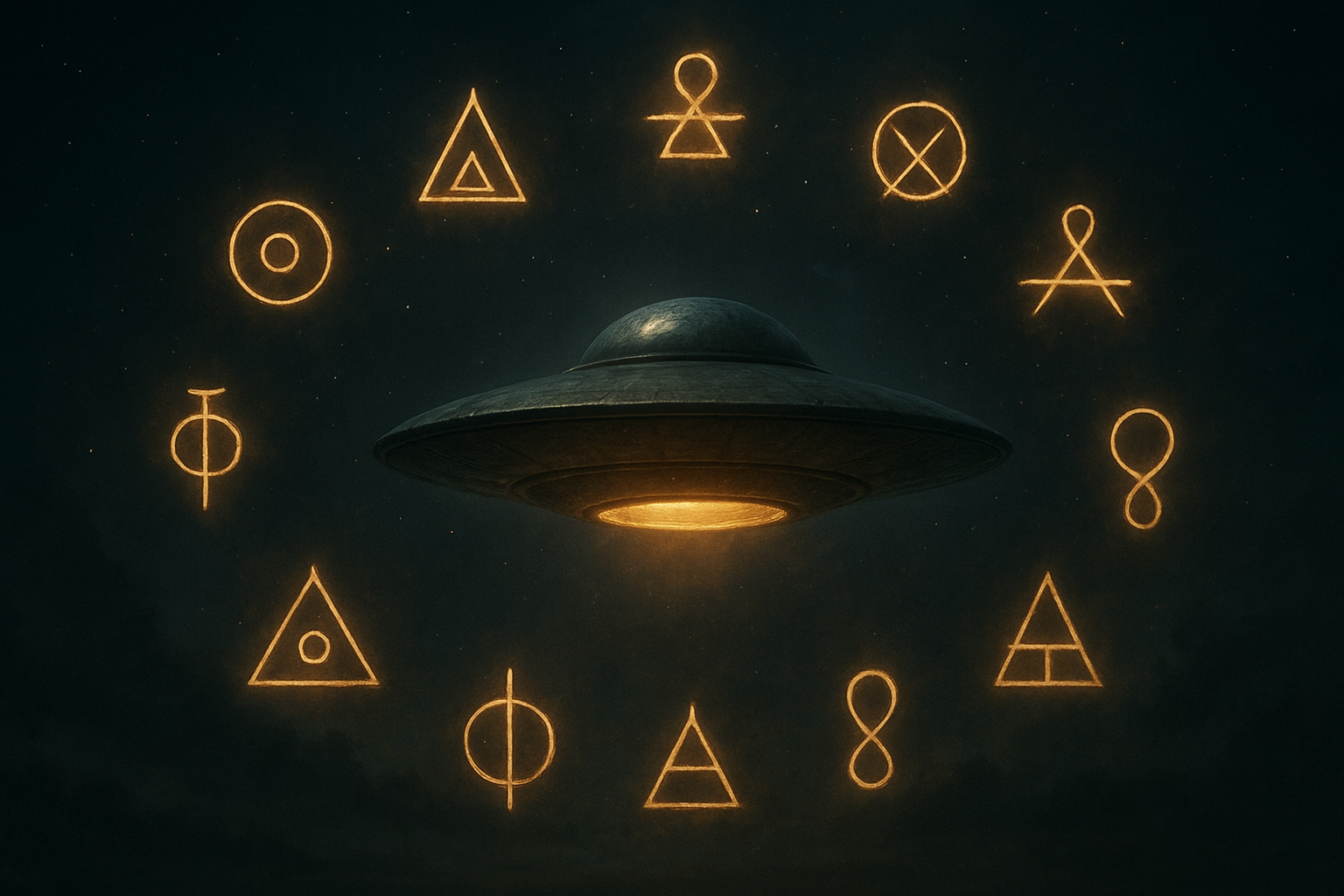
    The fascination with UFOs has transcended beyond the realms of science fiction and conspiracy theories into the multifaceted world of the occult. The intersection of extraterrestrial encounters and mystical symbols forms a unique cultural tapestry where UFOs are not just unexplained flying objects but are perceived as sacred or occult symbols—or sigils—evoking communication with otherworldly realms.

    The term sigil generally refers to a symbol considered to have magical power. In the context of UFOs, enthusiasts and researchers have begun to explore how these arial phenomena might represent or communicate unknown energies and potential messages. This idea is presented in various works linking the appearances of UFOs to ritualistic and spiritual events. As noted by author Jacques Vallée, “UFOs are essentially a response from the unknown, with symbols that inhabit our consciousness as both a challenge and an enigma.”

    There is historical precedence for interpreting unusual signs in the sky as omens or messages from the divine. Throughout ancient history, celestial phenomena have often been cataloged as direct communications from gods or symbols of impending change. Translating this historical lens to modern UFOs opens the door for a variety of interpretations:

    • Occult Practitioners: Some practitioners see UFOs as modern-day archetypes or sigils emerging from collective consciousness. These sightings challenge logical perceptions, serving as a conduit for expanded introspection and spiritual transformation.
    • Synchronicity: Just as Carl Jung explored the concept of synchronicity, UFOs can serve as synchronistic beacons that defy logical explanation and require interpreting the symbols enfolded within their appearances. As Jung described, “It is the intersecting moment of meaning between inner and outer experience.”
    • Magical Thinking: Aligning UFOs with sigils introduces the idea that witnessing an unexplained aerial phenomenon might be an unintentional invocation—a magical call to comprehend a realm that humans do not yet understand.

    Viewing UFOs as occult symbols and sigils invites a redefinition of their traditional meanings. Rather than simply perceiving UFOs as potential evidence of extraterrestrial life—or dismissing them as hoaxes or misidentified earthly aircraft—these concepts allow one to explore the consciousness connection between humanity’s inner world and the universe’s vast mysteries.

    Ultimately, alien sigils challenge observers to ponder the nature of reality itself, exploring spaces that bridge science, spirituality, and the enduring human quest for understanding. By embracing the possibility that UFOs may act as cosmic sigils, we uncover new ways of interpreting age-old questions about our place in the universe.

  • UFO Dreams – Encounters Between Worlds

    UFO Dreams – Encounters Between Worlds

    Unfolding across azure skies and stretching through the stardust depths of the cosmos, UFO encounters have long captured our imagination, motivating countless to ponder the existence of extraterrestrial life. Whether seen as vessels of invading aliens or symbols of dreams and fears, these unidentified flying objects have become a staple of modern mythology. This article delves into the dreams and realities of UFOs, examining the evidence, the experiences of witnesses, and the broader cultural implications of these enigmatic encounters.

    The History and Evolution of UFO Encounters

    The mystique of UFOs is not uniquely modern; legends of flying ships and otherworldly beings date back to antiquity. The term “flying saucer” entered popular culture following the 1947 sighting by pilot Kenneth Arnold near Mount Rainier, Washington. Arnold’s account described “nine bright saucer-like objects” darting across the skies, which led to a media frenzy and birthed the UFO phenomenon as we know it today.

    “The discs were there and I could see them. I could not, however, find anything in my mind which would substantiate such a phenomenon.” – Kenneth Arnold

    Despite official investigations, including the U.S. Air Force’s Project Blue Book which ran from 1952 to 1969, no conclusive explanation was reached, leaving these aerial enigmas steeped in mystery.

    Notable Encounters and Testimonies

    Across the globe, enthusiasts and skeptics alike have been intrigued by numerous well-documented UFO encounters. Some of the most compelling stories include:

    • Roswell Incident (1947): Perhaps the most famous UFO event, it occurred in Roswell, New Mexico, where an alleged UFO crash landing was reported. While the U.S. military asserted it was merely a weather balloon, conspiracy theories about aliens and secretive government cover-ups persist.
    • Rendlesham Forest Incident (1980): Known as the “British Roswell,” military personnel reported unexplained lights near a Royal Air Force station in Suffolk, England. Amid bizarre sightings and radiation anomalies, the incident remains a mystery.
    • Phoenix Lights (1997): Witnessed by thousands across Arizona, this formation of lights moved silently across the sky for several hours. Despite investigative efforts, explanations have ranged from military exercises to extraterrestrial visitors.

    “It was mesmerizing and could not be explained by conventional aircraft or natural phenomena.” – Witness account, Phoenix Lights

    The Science and Skepticism of UFOs

    While sightings continue to intrigue and baffle, the scientific community maintains a healthy dose of skepticism. The majority of UFO cases often find mundane explanations, ranging from atmospheric phenomena to misidentified aircraft. Dr. Carl Sagan, an astronomer and a champion for scientific inquiry, emphasized the importance of scrutiny, famously stating:

    “Extraordinary claims require extraordinary evidence.”

    Despite this skepticism, organizations such as SETI (Search for Extraterrestrial Intelligence) dedicate efforts towards understanding our cosmos and the potential for intelligent life beyond Earth.

    Cultural and Psychological Implications

    UFOs represent a fascinating intersection of culture, psychology, and the unknown. They inspire fear, wonder, and awe, tapping into our primal instincts and the desire to connect with the beyond. Dr. Jung, in his work “Flying Saucers: A Modern Myth of Things Seen in the Skies,” explored the psychological aspects, suggesting that flying saucers could manifest collective unconscious projections.

    UFOs have permeated popular culture, influencing cinema, literature, and art, from classics like E.T. the Extra-Terrestrial to recent series such as The X-Files. These cultural artifacts reflect humanity’s eternal struggle to understand its place in the universe, serving as both entertainment and philosophical musings.

    Unexplained Phenomena or Extraterrestrial Contacts?

    The debate over UFOs remains contentious, caught between rational skepticism and unexplained phenomena. Could these be harbingers of extraterrestrial contacts, or are they manifestations of human hopes and fears? As long as the skies allow glimpses of the unfamiliar, stories of UFOs will endure, fueling our dreams of encounters between worlds.

    Ultimately, while each testimony adds weight to the discussion and every incident is an invitation to question the limits of what we know, the enigma of UFOs compels us to look beyond our world, to both the cosmos and within ourselves.

    For those enthralled by the mystery, the search for answers continues, reminding us that in the vastness of the universe, the possibilities are as boundless as our imaginations.

  • The Death of the UFO Era – From Myth to Silence

    The Death of the UFO Era – From Myth to Silence

    The 20th century was abuzz with tales of unidentified flying objects (UFOs), capturing the imagination of millions worldwide. From alleged sightings and government cover-ups to mysterious abductions, UFOs were a cultural phenomenon that straddled the line between reality and myth. However, in recent years, the clamor surrounding these celestial enigmas has dwindled into an almost eerie silence.

    The Zenith of UFO Mania

    Post-World War II America witnessed an explosion in UFO sightings. The infamous Roswell incident in 1947 kickstarted a frenzy, as rumors of crashed alien spacecraft inundated the media. This period marked the golden age of UFOs, where films, books, and TV shows perpetuated the mystery and intrigue of extraterrestrial life.

    “The fascination with UFOs in the 1950s and 60s encapsulated the fears and hopes of a generation teetering on the brink of atomic age horizon discovery.”

    — National Geographic

    The Shift in Perception

    With the advent of advanced technology, what was once inexplicable started becoming all too explicable. Drones, satellites, and advanced military jets filled our skies, demystifying many phenomena that were previously attributed to UFOs. The age of information brought rational explanations to purported extraterrestrial events.

    In addition, organizations such as NASA and SETI (Search for Extraterrestrial Intelligence) delve into the cosmos with scientific rigor, searching for life with telescopes and data analysis rather than tales and conjecture.

    Government Disclosure and Growing Apathy

    In a surprising twist, once-classified information began to surface with the U.S. government’s release of the Pentagon UFO videos in 2020. However, instead of reigniting the fervor of past decades, it was met with a collective shrug.

    “The lack of excitement or fear over official confirmations of ‘unidentified aerial phenomena’ points to a growing public desensitization to the unknown.”

    — Forbes

    From Myth to Silence

    The death of the UFO era appears not with a bang but with a whimper. The myth of UFOs has slowly dissolved into silence, overshadowed by the realities of technological advancement and scientific discourse. In contemporary society, the fascination with UFOs has waned, leaving room for new mysteries to capture our collective curiosity.

    As we advance, perhaps our species will find its myths and fantastical desires once again, but for now, the era of UFOs is quietly closing.

  • UFOs as Death Omens – Portents of the Sky

    UFOs as Death Omens – Portents of the Sky

    The sight of unexplained phenomena in the sky has long captivated human imagination and curiosity. These sightings, often described as unidentified flying objects (UFOs), not only fascinate but also instill fear and wonder. Throughout history, many cultures have regarded these mysterious skyward occurrences as omens, particularly foretelling death or disaster. But where does this belief originate, and how has it evolved over time?

    Historical Context and Folklore

    Historically, strange lights and aerial phenomena have been recorded in various parts of the world, often associated with significant events. Ancient texts, like those from the Roman and Chinese civilizations, document instances where unusual objects in the sky preceded critical occurrences. According to Roman historian Titus Livius, during the consulship of Gnaeus Octavius and Gaius Scribonius, “a phantom navy was seen shining in the sky” before the defeat of the Roman armies.

    “In the Withered Hill was the dwelling-place of the spirits. They said that the spirits would come down in their ships and set fire to the world.” – Arthur George, Mythology and Folklore of the Ermte Region

    Modern Encounters and Interpretations

    In more recent times, UFO sightings have continued to be linked with ominous predictions. The 20th century saw a surge in these sightings, coinciding with times of conflict and social upheaval. The infamous “[Phoenix Lights](https://www.history.com/news/the-phoenix-lights-20-years-later)” event in 1997, which involved a series of widely sighted UFOs over Arizona, has been interpreted by some as a prelude to significant geopolitical and environmental changes.

    Modern interpretations often blend ancient beliefs with contemporary fears, associating UFO activity with apocalyptic themes prevalent in popular media. UFOs have become fixed symbols in our cultural imagination, often viewed as harbingers of doom in films and literature.

    Psychological and Cultural Influences

    The human mind has always sought to find patterns in chaos. As such, when unidentified phenomena appear, it is often tempting to link them with significant life events, such as death. Carl Jung suggested that UFOs could be projections of our collective unconscious—a representation of the psyche grappling with uncertainty in the world.

    “The disks do not behave in accordance with physical laws, but as though they were weightless, or even had their own remote control.” – Carl Jung, Flying Saucers: A Modern Myth of Things Seen in the Skies

    Conclusion

    Whether seen as signs of impending doom or as mere curiosities, UFOs have occupied a unique place in our cultural narrative. While some see them as objectively mysterious, others interpret them through the lens of fear and reverence, grounded in ancient beliefs. As we continue to explore the skies and seek understanding, the narratives surrounding UFOs as death omens will likely persist, echoing humanity’s age-old intrigue with the unknown.