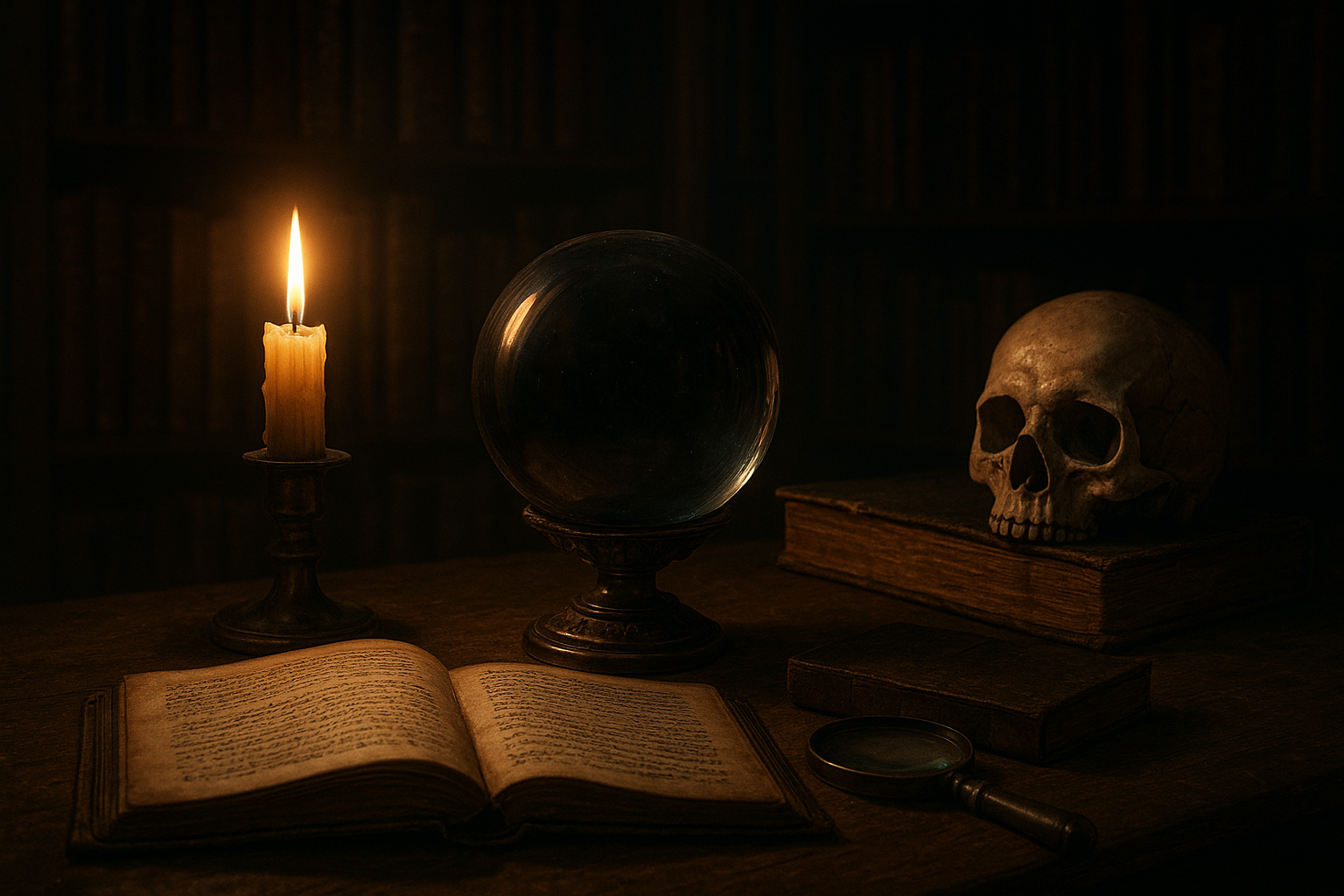
Arcane Enigmas: Mystery of the Unknowable
Throughout history, humanity’s quest for knowledge has been punctuated by encounters with the inexplicable. These arcane enigmas captivate our imagination, challenging our understanding and inviting us to explore the boundaries of the mysterious and the unknown.
The Nature of Mysteries
At the heart of every mystery lies uncertainty—a void that tantalizes and terrifies in equal measure. Mystical phenomena, unsolved historical events, and cryptic codes lure us because they represent the interface of the known and the unknown. To delve into these enigmas is to embrace the uncertainty of human experience.
“The most beautiful experience we can have is the mysterious. It is the fundamental emotion that stands at the cradle of true art and true science.” — Albert Einstein
- Phenomena Beyond Comprehension: Mysteries like the Bermuda Triangle have baffled scientists for decades. Despite modern technology, no conclusive explanation has been offered for the numerous disappearances that occur in this area.
- Historical Puzzles: The lost city of Atlantis remains one of the greatest unsolved mysteries. First mentioned by Plato, its existence is debated as either mythical or a historical place that was drowned by the sea.
- Cryptic Languages: The Voynich Manuscript is an illustrated codex written in an unknown writing system, which has defied all attempts at interpretation and sparked numerous theories about its content and origins.
Psychological Allure of the Enigmatic
What is it about mysteries that captivates the human psyche? Our brains are wired to seek patterns and meaning, leading us on a relentless search for answers. Psychologists suggest that this drive is rooted in our evolutionary past, where solving mysteries was directly linked to survival.
According to a study by Professor Daniel Kahneman, author of Thinking, Fast and Slow, humans exhibit a cognitive bias toward uncertainty. This makes mysteries particularly compelling, as they engage our innate curiosity and reward our brain’s pleasure centers when pursuits yield answers.
“Curiosity is, in great and generous minds, the first passion and the last.” — Samuel Johnson
Mysteries in Science
Science has contributed to our understanding of many mysteries but has also hit formidable walls when confronted with certain phenomena. Quantum mechanics, for instance, defies the classic understanding of physics, leading to continua of new questions and theories.
- Dark Matter and Dark Energy: Comprising about 95% of the universe’s mass-energy content, dark matter and dark energy remain among the greatest scientific mysteries. Despite extensive research, their true nature is still unknown.
- The Origins of Consciousness: The mystery of consciousness—how brain processes result in subjective experiences—continues to perplex scientists and philosophers alike. Some argue it defies all existing scientific paradigms.
Einstein’s pursuit of a unified theory, one that could mathematically describe the fundamental forces of nature, reflects the profound sense of wonder and the enduring allure of the unknowable in science.
Interpreting the Unknowable
Throughout cultures past and present, the unknowable has often been personified through myths, religious beliefs, and the arts. These interpretations serve as a collective narrative to give shape to the abstract and the daunting.
- Mythological Figures: Gods and supernatural beings have been born from the mysteries humans couldn’t explain. Ancient stories of creation, destruction, love, and war reflect attempts to understand the cosmos and human nature.
- Religious Concepts: Concepts such as karma, fate, and ultimate salvation reflect humanity’s quest to find meaning amidst uncertainty.
- Art and Literature: From Dante’s Divine Comedy to the surrealism of Salvador Dalí, artists have long sought to explore existential mysteries, weaving layers of meaning through images and words.
These interpretative tools are not mere escapism but signify deep human engagement with mystery as a means to explore and reflect upon our place in the universe.
Navigating the Mystery
To navigate the mystery of the unknowable, it is crucial to embrace both rational inquiry and creative imagination. While science and reason provide tools to probe and question, the arts invite an exploration that transcends empirical evidence. This dual approach allows for a fuller understanding of the mysteries that lie at the edges of human knowledge.
“The possession of knowledge does not kill the sense of wonder and mystery. There is always more mystery.” — Anaïs Nin
Ultimately, our appreciation of these arcane enigmas enhances our understandings of both self and world, encouraging a profound respect for the mysteries that persist. The unknowable may remain elusive, but it is this dance with mystery that defines much of the human odyssey.
As we forge ahead into new realms of exploration, let us remember that, as Ralph Waldo Emerson eloquently stated, “All life is an experiment. The more experiments you make the better.” It is through embracing both success and uncertainty that we truly come to discover the wonders of our reality.