Tag: world
-

The Nocturnal Eye – Observing the World Beyond Daylight
The mysteries of the night sky have long captivated human imagination. Since the dawn of civilization, people have looked up at the cosmos, pondering the countless stars shimmering like scattered diamonds on a velvet canvas. Yet, Earth’s night offers an array of enigmas beyond the celestial. The nocturnal world, teeming with life and phenomena unseen during daylight, presents a rich tapestry worthy of exploration.
The Biological Symphony of the Night
Nighttime unveils a distinct world of creatures that thrive in darkness. These nocturnal beings have adapted uniquely to life without light, using highly evolved senses such as enhanced hearing and night vision. Owls, for example, are equipped with exceptional auditory abilities, enabling them to hunt with precision. According to a study by the Royal Society Publishing, the owl’s silent flight and acute sense of hearing give them an edge in the nocturnal landscape.
Bats, another quintessential night dweller, navigate through echolocation, emitting calls that bounce off objects, revealing their surroundings. According to the American Association for the Advancement of Science, this form of biological sonar is so precise that some bats can detect textures and sizes of objects they encounter.
Ethereal Light of the Night
While the absence of sunlight defines night, it doesn’t imply darkness in absolute terms. The moon and stars provide a subtle luminescence, but the nocturnal world boasts its sources of light. Bioluminescence is a natural wonder where organisms like fireflies and certain deep-sea creatures produce light. This phenomenon, explained by researchers at Oxford Academic, involves chemical reactions within these organisms, often for attracting mates or deterring predators.
Moreover, the night sky occasionally becomes a stage for spectacular light displays known as auroras. These occur when charged particles from the sun collide with Earth’s atmosphere, leading to shimmering curtains of green, red, and purple. The National Geographic delineates the science behind these awe-inspiring displays, illustrating how Earth’s magnetic poles harness solar particles to paint the sky.
Human Perception and the Night
The human relationship with night has evolved significantly over centuries. From early fire-lit evenings to modern artificial lighting, our capacity to conquer the dark has grown. However, this has not come without consequences. Light pollution, a glaring by-product of modern society, obscures our view of the stars and impacts nocturnal wildlife.
Documented by the International Dark-Sky Association, light pollution disrupts natural ecosystems, confuses animal navigation and affects hormonal cycles, making it an ecological concern. “The ability to see the Milky Way is a heritage we should strive to preserve for future generations,” states Dr. John Barentine, an advocate for night sky preservation.
Technological Eyes in the Dark
Our quest to unveil the secrets of the nocturnal world extends into technology. Night vision devices, developed initially for military use, now aid in wildlife observation and exploration. Using infrared technology, these devices translate invisible light into visible images, granting humans the power to see in the dark.
Furthermore, space telescopes such as the Hubble have revolutionized our understanding of the night sky. By observing at various wavelengths, including those invisible to the naked eye, these telescopes reveal the universe’s hidden textures and phenomena, from distant galaxies to nebulae. Research published by the Hubble Space Telescope expands our cosmic comprehension, showcasing the vibrant tapestry of the cosmos.
Emotion and Inspiration: How the Night Articulates the Human Soul
Nights have always inspired artists, philosophers, and scientists alike. The starry firmament encourages contemplation and reflection, a thematic constant in art and literature. Van Gogh’s The Starry Night, painted during his stay in an asylum, remains an enduring testament to the emotional power of the night.
Reflecting on the allure of darkness, author Neil Gaiman eloquently encapsulates the human fascination with the night sky: “The night is also a kingdom. It’s not only that great musings and ideas are born out of this darkness, but also that in the night we encounter mysteries that stir our imagination” (Neil Gaiman).
The Future of Observing the Nocturnal World
As technology advances, our capacity to explore and understand the night will only expand. Innovations in satellite technology, deep-space exploration, and microscopic assessments of nocturnal creatures promise to unlock new chapters in our understanding of the world after dusk.
The quest continues, driven by an age-old wonder and a modern curiosity. In the words of the astronomer Carl Sagan: “Somewhere, something incredible is waiting to be known.” This voyage into the nocturnal realm exemplifies our intrinsic desire to explore beyond our daily experiences, opening our eyes to a universe suffused with unseen beauty and mystery beyond daylight.
“Night conceals a world lit by the beauty of stars and governed by a different rhythm of life,” recognizes astronomer Jane Houston. “In embracing the night, we embrace the unknown and expand our realm of discovery.”
The journey of the nocturnal eye invites us to uncover the layers of the world that thrive beyond the sun’s dominion—a testament to the enduring allure of darkness and its dazzling offerings.
-

Whispered Tomes – Secret Knowledge for Seekers of Shadows
Whispered Tomes: Secret Knowledge for Seekers of Shadows
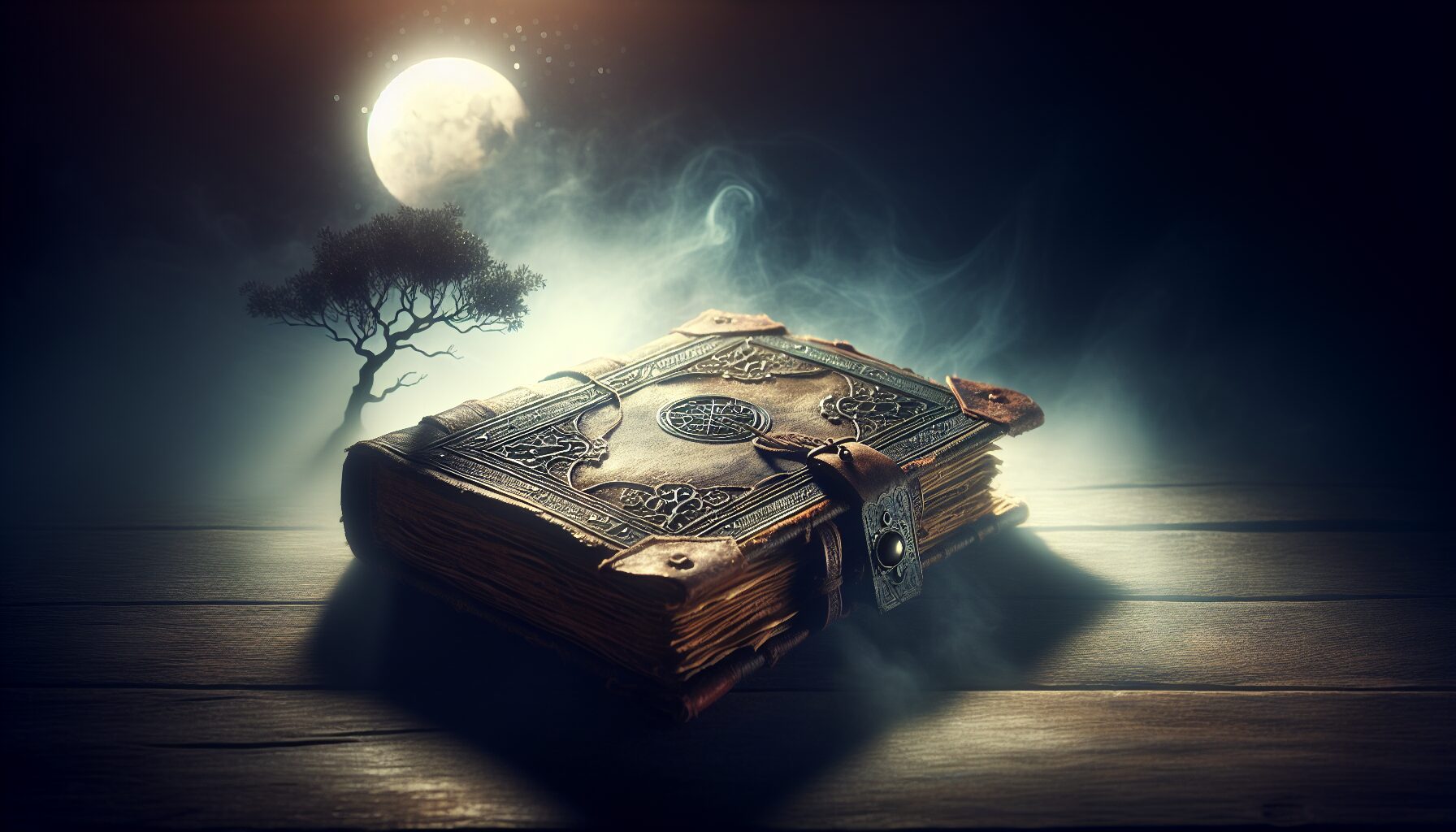
In the hidden nooks and crannies of the world, where light seldom reaches, lie the whispered tomes of ancient lore. These books, cloaked in mystery and legend, promise enlightenment to those who dare seek their wisdom. Whispered tomes have fascinated adventurers, scholars, and mystics for centuries, drawing them into a shadowy world brimming with secret knowledge.
“To find the whispered tomes is not just to discover hidden texts, but to unravel the very threads of the universe,” noted renowned occult researcher Dr. Ellora Fane in her controversial work, The Shaded Codex.
The Allure of the Unknown
These tomes often guard their secrets jealously. Bound in ancient leather and inscribed in arcane symbols, they are not for the faint-hearted. Many legends state that the words within change as the reader gains understanding, a mirror to their soul’s growth. Their allure lies not only in the knowledge they hold but the journey they inspire.
- The Book of Shadows – Often associated with witchcraft, this tome is said to contain spells and insights into the natural and supernatural worlds. Its origins are enigmatic, with each copy believed to be unique, passed through generations of devoted practitioners.
- The Codex Umbra – A mysterious manuscript believed to be written by an ancient civilization, the Codex Umbra is thought to hold secrets of time manipulation and cosmic truths.
- The Liminal Grimoire – Said to be the diary of a dreamwalker, this grimoire offers guidance to those who wish to explore the boundary between reality and dreamscapes.
The Quest for Whispered Tomes
Finding one of these tomes is considered a quest in itself. Rumors swirl around forgotten libraries and hidden vaults protected by age-old guardians. Recently, a group of explorers claimed to have discovered a new section of the Vatican Apostolic Archive, hinting at unprecedented access to ancient texts yet to be read by modern eyes.
The quest for whispered tomes is not just about the acquisition of rare books but an exploration of what lies beyond the veil of ordinary understanding. It challenges seekers to look beyond the obvious, to question the known world, and to embrace the uncertainties of the shadowy unknown.
In the words of William Somerset Maugham, “The greatest truths are too important to be new,” and so whispering tomes continue to tempt seekers with the promise of ancient wisdom.
To those who venture into the shadows, these tomes stand as beacons of enlightenment and a reminder that the world still holds mysteries waiting to be unfolded.
-

The Silent Choir – Mystical Echoes of Forgotten Spirits
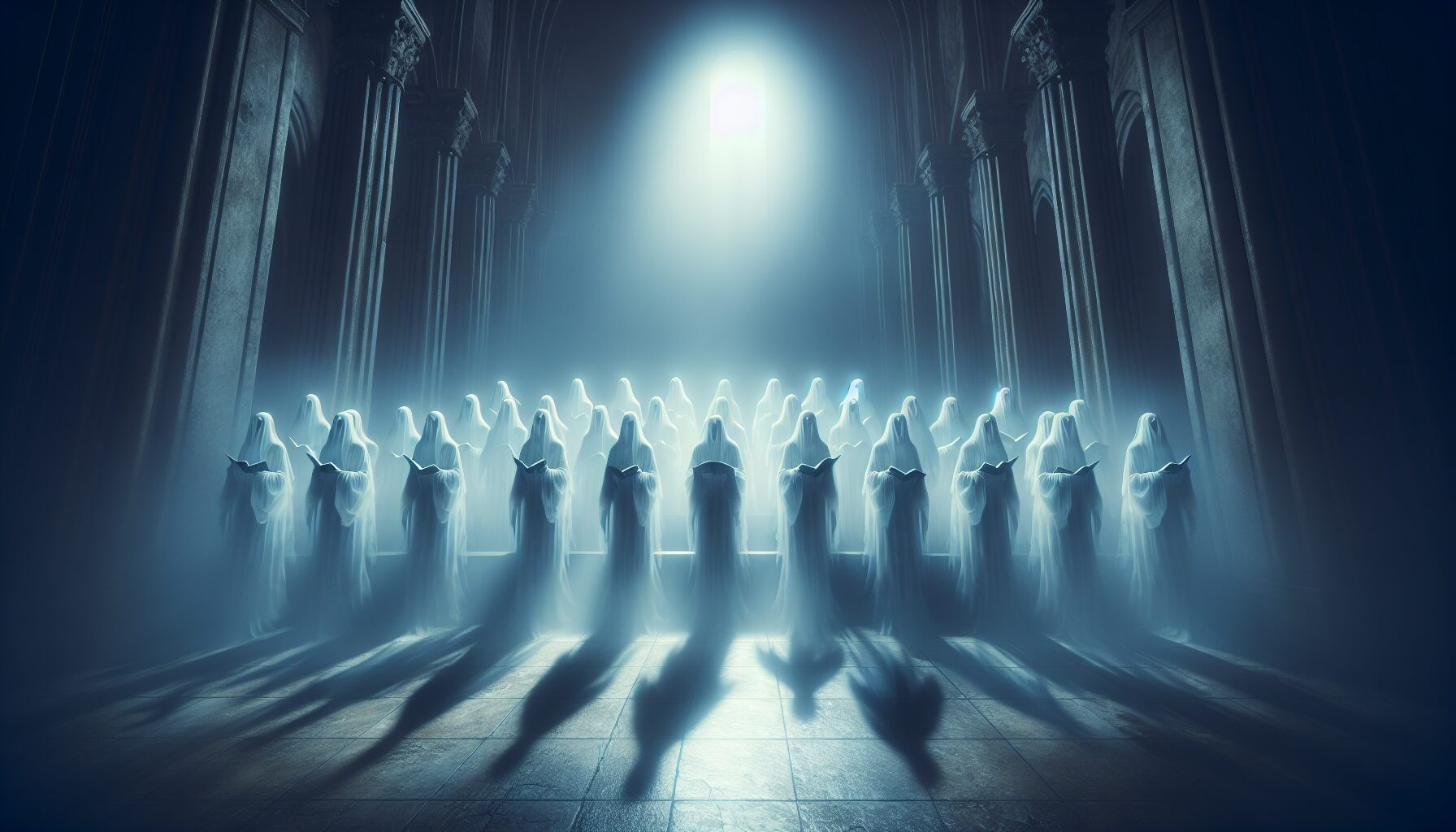
In the depths of time and memory, where the veil between this world and the next grows thin, whispers of ancient souls create a symphony of echoes. This ethereal harmony, known as The Silent Choir, speaks to those attuned to the mystical side of existence, offering insights into forgotten histories and spiritual truths.
Origins of the Silent Choir
The Silent Choir is a concept found in various cultural traditions around the world, each with its unique interpretation. Some believe these echoes are the voices of ancestors guiding the living, while others view them as cosmic harmonies that sustain the universe. Despite their cultural differences, these traditions share a common belief in the power of soundless voices to influence the physical and spiritual realms.
In ancient Celtic lore, the Druids were believed to communicate with the spirits of the land through The Silent Choir. They taught that these whispers carried the wisdom of nature, accessible to those who cultivated deep stillness and reverence. Similarly, in the indigenous spiritual practices of North America, the concept of the spirit voice is present, where ancestral spirits imbue the land with sacred energy and guidance.
The Science Behind the Echoes
The idea of hearing echoes of the past might initially seem far-fetched. However, emerging studies in the field of psychoacoustics suggest that sound and memory are intricately linked. According to Dr. Chris Kyriakakis of the University of Southern California, “The brain can recreate auditory environments, making it possible to hear non-existent sounds based on memory or expectation” (Journal of Acoustics).
This scientific perspective doesn’t negate the mystical aspects, but rather provides a framework for understanding how individuals might perceive these spectral symphonies. It suggests a genuine connection between the physiological and metaphysical experiences of these echoes.
Experiencing the Silent Choir
For those who seek to hear The Silent Choir, the practice of deep listening is crucial. This involves more than merely hearing; it requires an open heart and a reflective mind. Below are steps to begin your journey:
- Create Stillness: Find a quiet place, free from disturbances, where you can focus your mind and senses.
- Mindful Breathing: Inhale and exhale slowly, allowing your breath to guide you into a meditative state.
- Attuned Awareness: Pay attention to the subtlest sounds, the faintest whispers, and the silence in between.
- Reflective Contemplation: Consider what these echoes, or the absence thereof, might be conveying about your spiritual path.
As you deepen your practice, you may begin to discern patterns or messages within the silence—insights into past experiences or intuitive guidance about current decisions.
The Impact of the Silent Choir
The Silent Choir is revered not only for its spiritual messages but also for its healing properties. Listening to these mystical echoes can foster emotional resilience, reduce stress, and promote a deeper connection with one’s self and the universe. A study by Harvard Medical School suggests that meditation practices, similar to those described, significantly enhance psychological well-being (Harvard Health Publishing).
Practitioners often report a sense of unity with the universe, finding peace in the affirmation that they are a part of something greater—a timeless choir of souls singing in harmony.
Conclusion
In a world dominated by noise and distraction, The Silent Choir offers a sanctuary of serenity. These mystical echoes, whether understood through spiritual narratives or scientific inquiry, testify to the rich tapestry of human experience that transcends the material world. By listening deeply, we honor the voices of the past, bringing their wisdom into the present to guide our future.
“Silence is a source of great strength.”
— Lao TzuLet us embrace the silence, listen to its secrets, and join the ceaseless choir of the forgotten spirits.
-

The Last Pilgrim: Journeys in the Between
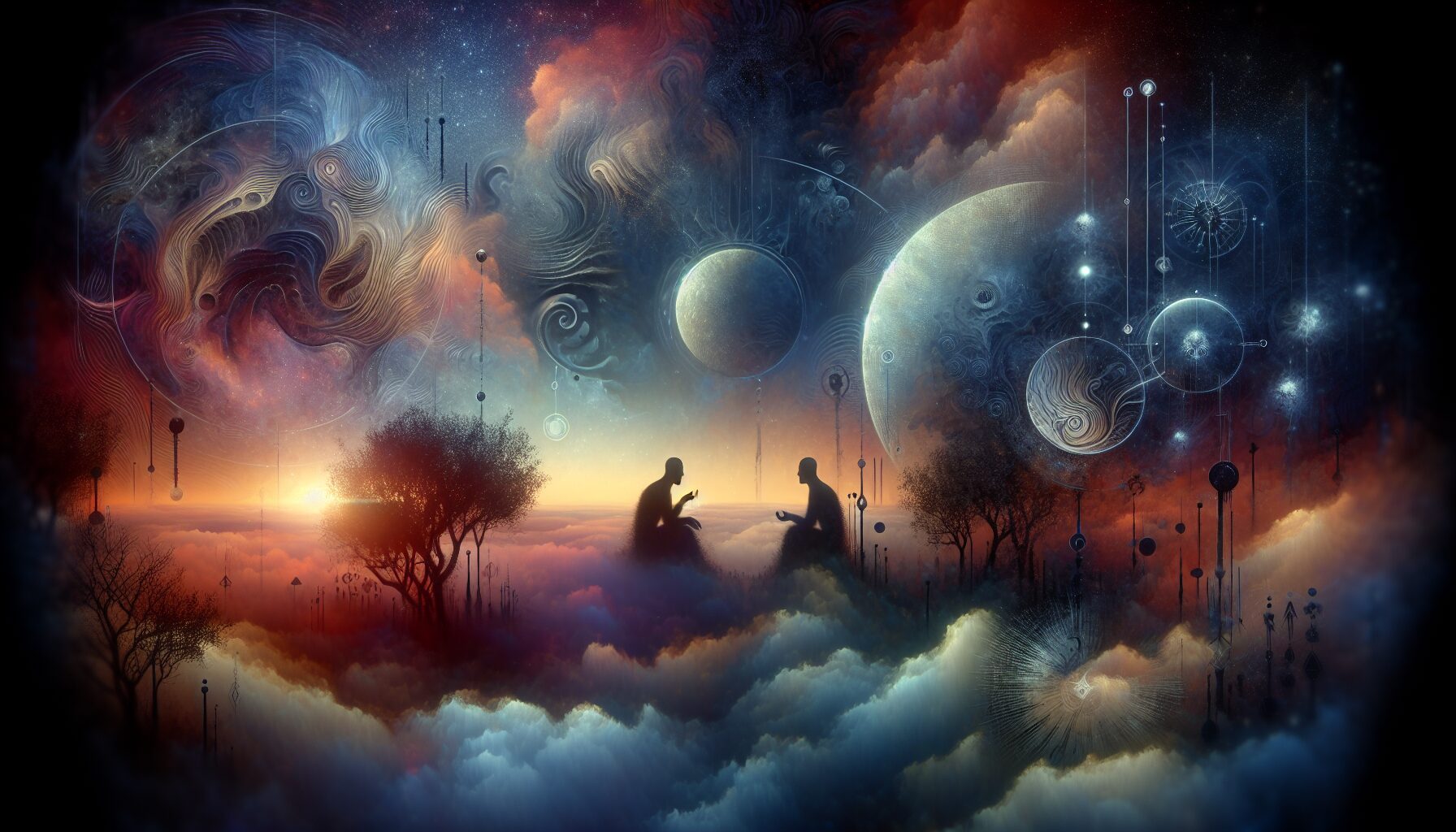
In a world where the realms of the material and ethereal intertwine, there exists a solitary figure known as The Last Pilgrim. Her journeys traverse landscapes unseen by most, bearing tales of the “in-between”—a realm where echoes of ancient worlds and whispered promises of futures yet to come converge.
“The real voyage of discovery consists not in seeking new landscapes, but in having new eyes.” — Marcel Proust
The Last Pilgrim’s journey is not one of mere physical landscapes, but a deep dive into the intricacies of time and existence. Her path meanders through places that exist only in the peripheries of human understanding, blurring the lines between what is real and imagined. Here, she finds herself engaged in dialogues with history, offering us glimpses into the narratives long forgotten by the incessant march of time.
The Path Less Traveled
Her pilgrimage is defined by a deep connection to the concept of the “between”—an existential study of that which binds then to now, and the tangible to the ephemeral. It’s a path less trodden, marked by her introspective musings and quiet resolve. Her quest is respectfully narrated by fellow traveler and scholar, John Willoughby, who once wrote:
“In the company of The Last Pilgrim, one discovers that the journey is as much an exploration of the self as it is of the world at large.” — John Willoughby
Encounters Along the Way
During her travels, The Last Pilgrim encounters various spectral figures and echoes of civilization. They offer her wisdom and riddles, contributing to a collection of stories and insights she carries with her. Each interaction enriches her understanding of the liminal spaces where the boundaries of worlds fade and overlap.
- Ancient voices: The whispers of those long gone guide her, sharing the secrets of their era.
- Timeless Landscapes: She wanders through spaces that seem suspended in time, untouched by modernity’s relentless grip.
- Symbolic Mysteries: Along her path, she deciphers symbols and omens that point towards universal truths.
The Last Pilgrim’s journey is one of courage and solitude, capturing the imagination of all who hear her tales. As she ventures into the unknown, she invites us to reconsider our perception of reality and embrace the mystique of the in-between.
Her saga reminds us that there is more to the world than meets the eye; and perhaps, like her, we are all pilgrims navigating unseen journeys.
-

Nightmare Anthology: Fiction and Poetry
Throughout the annals of literature, nightmares have been a compelling source of inspiration for both fiction and poetry. These haunting dreams tap into the deepest recesses of the human psyche, revealing truths and fears that might otherwise remain hidden. The anthology of nightmares, explored through creative expression, is a treasure trove for both writers and readers alike.
The Allure of Nightmares
What is it about nightmares that captivate writers? In essence, nightmares allow a direct exploration of our most profound fears and anxieties. As poet Sylvia Plath once noted:
“I am terrified by this dark thing that sleeps in me; all day I feel its soft, feathery turnings, its malignity.”
Nightmares provide a fertile ground for Plath’s lyrical expression of internal conflicts, serving as a mirror reflecting the darker aspects of the human condition. For many poets and authors, the act of writing about nightmares offers a cathartic release, a way to confront and understand the incomprehensible.
Fiction Rooted in Darkness
Nightmares have long provided fodder for some of the most haunting fiction. Consider the works of renowned authors like Stephen King and Edgar Allan Poe, who have woven suspenseful tales that draw deeply from the realm of nightmares. King’s It and Poe’s The Tell-Tale Heart both illustrate how fear can become an entity within itself, making the imaginary feel all too real.
- Stephen King: Masterfully crafts narratives where nightmares blur into the waking world, challenging the boundary between fiction and reality.
- Edgar Allan Poe: Penetrates the soul with tales of madness and dread, drawing his readers into the depths of his characters’ tortured minds.
The Poetic Nightmare
Painters of language, poets often use nightmares to delve into themes of existential dread, death, and the inexplicable. Consider this excerpt from T.S. Eliot’s The Hollow Men:
“This is the way the world ends, not with a bang but a whimper.”
Eliot taps into the nightmare of existential despair, illustrating how our deepest fears often lie in quietude rather than chaos. These poetic explorations serve to illuminate, challenge, and ultimately enrich the human experience.
Conclusion
The anthology of nightmares in fiction and poetry is ever-growing, allowing readers to explore the depths of fear and imagination. As we continue to grapple with the unknown, the nightmarish visions conjured by writers will remain a powerful tool in the literary world, offering insights into our most primal emotions.
For more exploration into the world of nightmares in literature, delve into the works of Sylvia Plath, T.S. Eliot, and Stephen King.
-

Ashes to Ink: Writing Exercises on Ephemerality
In a world where permanence is often mistaken for progress, the concept of ephemerality offers a paradoxical sense of beauty and urgency. The art of writing, with its innate ability to capture fleeting moments, plays a pivotal role in understanding and embracing this fleeting nature. Ashes to Ink: Writing Exercises on Ephemerality explores how writers can harness impermanence to create compelling narratives.
The Beauty of Ephemeral Moments
Ephemeral moments are those that exist only briefly, offering a glimpse into the transient nature of life. By focusing on the transient, writers can cultivate a sensitivity that translates into more profound and immediate storytelling. As the poet Walt Whitman once penned in Leaves of Grass, “The powerful play goes on, and you may contribute a verse.”
To begin embracing ephemerality through writing, consider these exercises:
Writing Exercise 1: Capturing Fleeting Moments
Take a walk outside with a notepad. Observe everything around you and write down ten fleeting moments that catch your attention. It could be a child’s laughter, leaves rustling in the wind, or a brief encounter between strangers.
- Objective: Train your mind to notice the subtle, often overlooked details of life.
- Outcome: A collection of vivid observations that can serve as inspiration for scenes or stories.
“The most beautiful things in the world cannot be seen or touched, they are felt with the heart.” — Antoine de Saint-Exupéry
Writing Exercise 2: The Impermanent Narrative
Craft a short story that spans a few minutes in real time. This story should focus on character interactions that are brief yet impactful. Develop characters who, like shooting stars, leave an imprint despite their short presence in the narrative.
- Objective: Explore minimal storytelling while maintaining depth and emotional resonance.
- Outcome: A succinct and powerful narrative that underscores the idea that even the briefest interactions can be significant.
Writing Exercise 3: The Ephemeral Self
Write a diary entry from the perspective of a person living in a future where memories last only 24 hours. Explore how this affects their relationships, aspirations, and identity. What do they choose to document, and why?
- Objective: Delve into the concept of selfhood and memory in a world where nothing is permanent.
- Outcome: A reflective piece that questions the core of identity and the essence of being.
Writing Exercise 4: Haiku and the Art of Brevity
The haiku is a form of Japanese poetry known for its ability to convey profound meaning in a few words. Write a series of haikus based on moments you’ve observed or experienced. Each haiku should capture the essence of its subject in three lines.
- Objective: Master the ability to distill larger concepts into concise expressions.
- Outcome: A collection of haikus that reflect the raw and immediate beauty of the ephemeral.
Reflection on Writing Ephemerality
Embracing ephemerality in writing is not just about acknowledging the impermanent; it’s about cultivating an awareness that enriches the narrative texture. As Joan Didion once said, in The Year of Magical Thinking, “Life changes in the instant. The ordinary instant.” Writing exercises that focus on the ephemeral enable writers to capture these ordinary instants, transforming them into extraordinary literature.
By integrating these practices into your writing routine, you’ll hone your ability to write with greater immediacy and emotional impact, ultimately leading readers to live more fully in the present moment. This approach elevates writing into an act of discovery rather than recollection.
The Role of Technology in Ephemeral Writing
In the digital age, the notion of ephemerality has taken on new dimensions. Social media platforms like Snapchat and Instagram emphasize content that fades, prompting a shift in how stories are shared and consumed. Despite this, the essence remains: using transience as a narrative device to evoke immediacy and intimacy.
For writers, technology provides tools to experiment with ephemeral storytelling. Consider these digital adaptations:
- Microblogging: Use platforms that support short, impactful messages. Craft a series of tweets that together form a cohesive, ephemeral narrative.
- Interactive Stories: Develop stories through platforms like Tap or Episode that encourage reader interaction, creating a bond that highlights the transient nature of the narrative.
Conclusion: Ashes to Ink
Ephemeral writing is about transforming the impermanent into lasting impressions. By focusing on the fleeting, writers can create windows into the present, enriching their storytelling with layers of immediacy and emotional truth. Embrace the challenge of writing with ashes, and let your ink leave an indelible mark on the hearts and minds of your readers.
The poetic journey from ashes to ink is both personal and universal—a tryst with time, capturing the transient beauty of our ephemeral world, one word at a time.