Author: editor

  • The Vanishing Point – Existential Reflections on Time and Space

    The Vanishing Point – Existential Reflections on Time and Space

    The Vanishing Point: Existential Reflections on Time and Space

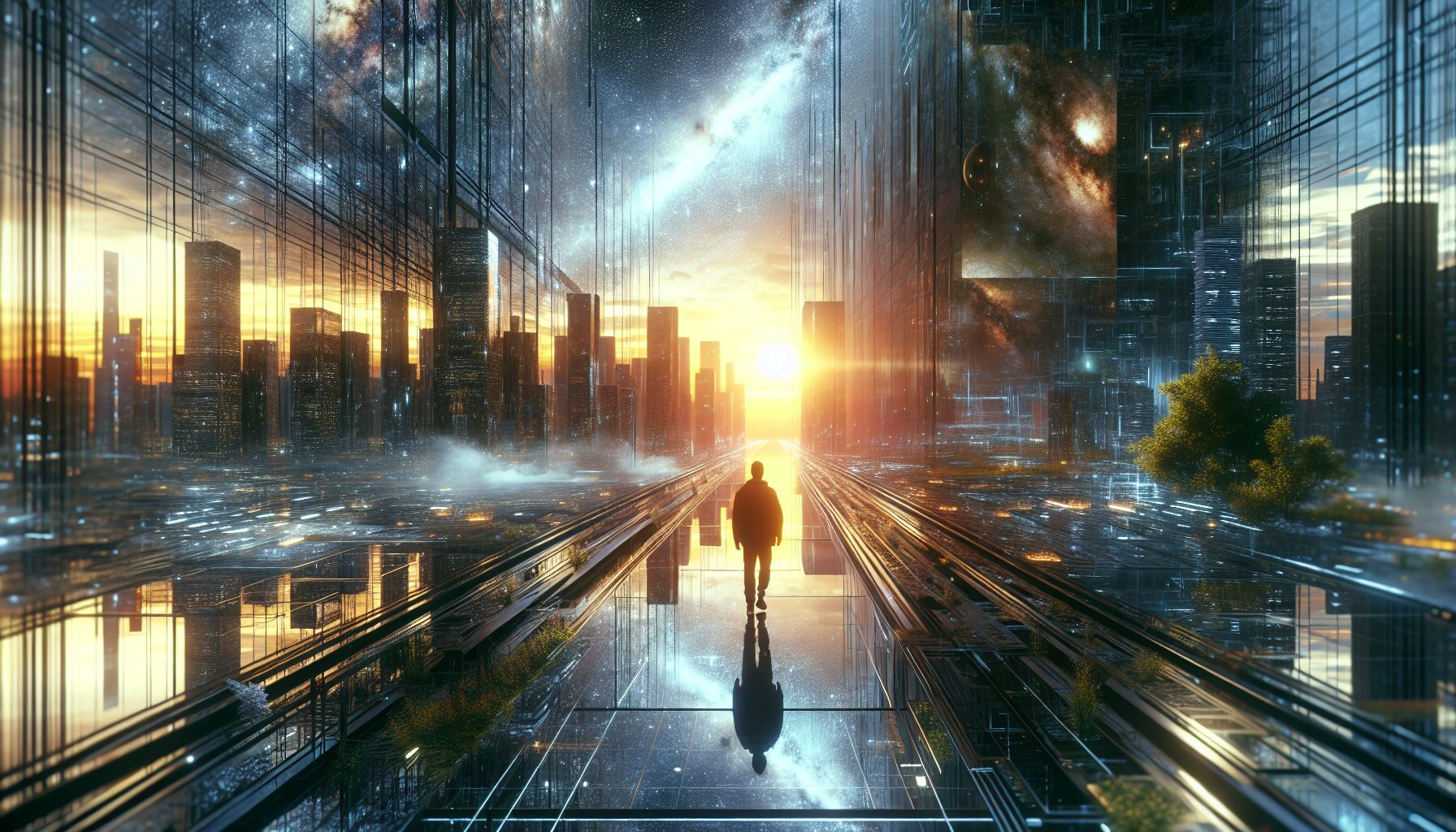
    The concept of the vanishing point bridges the realms of art and philosophy, offering contemplation on existence through the lenses of time and space. In art, the vanishing point is where lines converge, granting the illusion of depth on a flat surface. In existence, it prompts reflection on our journey through time and the spaces we inhabit.

    The Convergence of Lines: Perspective in Time

    Understanding time and space often begins with understanding how we perceive reality. Just as artists use perspective to create depth, our perception shapes the way we experience existence. The vanishing point, in this context, symbolizes a future moment, a time yet to come where all of our actions and decisions converge.

    “Time is what prevents everything from happening at once.” – Ray Cummings

    Time is linear in human perception, constantly moving forward. Yet, philosophers like Henri Bergson argue that time is a continuous flow, better understood as duration rather than a series of discrete points. Our focus on future “vanishing points” may lead us to neglect the present, the true canvas on which we paint our lives.

    Spaces We Inhabit: A Canvas of Experiences

    The spaces through which we move influence how we perceive time. Urban environments with their bustling rhythms skew our perception, making days seem longer due to the density of experiences packed into them. Conversely, natural spaces can stretch time, allowing moments of stillness and reflection.

    • Urban Spaces: The fast-paced life demands that we focus on future goals, the next vanishing point on our horizon.
    • Natural Spaces: These environments encourage us to embrace the present moment, offering a respite from the relentless march towards the future.

    In philosophical discussions, space is not just the physical distance between objects but also the environment where events unfold. The space we choose to inhabit, like the brushstrokes on a canvas, defines our experiences and shapes our personal narratives.

    The Existential Question: What Awaits at the Vanishing Point?

    The idea of a vanishing point in life prompts existential questions about purpose and destiny. If all lines of our life converge at a single point in the future, what lies there? Is it fulfillment, as suggested by Taoist philosophies, or merely an illusion akin to the artistic trickery on canvas?

    Jean-Paul Sartre claimed that “existence precedes essence,” positing that we must create meaning in our own lives. In this view, the vanishing point is not predetermined, but something we construct through our choices and actions.

    “Man is condemned to be free; because once thrown into the world, he is responsible for everything he does.” – Jean-Paul Sartre

    Navigating the Ephemeral Journey

    To ponder time and space is to engage with the ephemeral nature of our journey. We strive to exert control, to direct our narrative towards a meaningful vanishing point. Yet, we are often faced with uncertainty, akin to navigating uncharted waters, relying on the stars above as guides.

    • Mindfulness: Embracing the present moment through mindfulness can anchor us amidst the chaos of future ambitions.
    • Reflection: Regular reflection allows for a recalibration of our trajectories, ensuring our actions align with our innermost values.

    In the end, the vanishing point is both a concrete goal and an illusion, a reminder to live intentionally in both the present and future dimensions of our existence. Our understanding of time and space is part of a larger philosophical endeavor to grasp our place in the universe. As we traverse the vast landscapes of life, let the vanishing points not just shape our paths but also enrich our experiences along the way.

    This exploration encourages us to look beyond the simplicity of lines on paper, challenging us to see time and space as interconnected, continuously shaping our understanding of reality. For further reading on the philosophical implications of space-time, explore the Encyclopedia Britannica’s comprehensive guide.


  • Gothic Horizons – Dark Aesthetics in Contemporary Culture

    Gothic Horizons – Dark Aesthetics in Contemporary Culture

    Gothic Horizons: Dark Aesthetics in Contemporary Culture

    From the eerie allure of Edgar Allan Poe to the shadowy elegance of modern fashion runways, the Gothic aesthetic has permeated contemporary culture far beyond its literary origins. This darkly romantic and often morose style offers a unique perspective on the beauty found in the unconventional, providing a rich tapestry of creativity in art, fashion, music, and beyond.

    The Historical Roots of Gothic Aesthetics

    The Gothic aesthetic originally emerged in the 18th and 19th centuries. It was a reaction to the Enlightenment’s rationalism, an artistic movement that embraced the mysterious and the supernatural. Gothic literature, characterized by its dark settings and themes of decay and terror, served as a precursor to today’s dark aesthetics.

    “Female Gothic…is a fiction that reveals a woman’s collision with a male society, particularly one where women are looked upon as second-class citizens.” – Ellen Moers

    The Gothic has evolved over centuries, manifesting in various forms such as architecture, literature, fashion, and film. The architectural grandeur of pointed arches and vaulted ceilings is mirrored in the romantic yet macabre worlds imagined by authors and filmmakers, creating an enduring affection for the dark and mysterious.

    Gothic Influences in Modern Fashion

    In contemporary fashion, the Gothic aesthetic is characterized by a preference for dark colors, intricate patterns, and a blend of modern and historical styles. Designers such as Alexander McQueen and Rick Owens have popularized Gothic elements in their collections, combining ethereal beauty with a somber, often theatrical flair.

    • Alexander McQueen: Known for his hauntingly beautiful collections that often incorporate Victorian influences, McQueen uses Gothic motifs to challenge conventional beauty standards.
    • Rick Owens: Renowned for his minimalist Gothic approach, Owens mixes sleek lines with dark, muted tones to create a contemporary yet timeless appeal.

    These designers have helped cement Gothic fashion as a symbol of individuality and nonconformity, appealing to those who find beauty in darkness.

    Gothic Music and its Cultural Resonance

    Music has also played a crucial role in the evolution of the Gothic aesthetic. From the moody post-punk sounds of bands like The Cure to the ethereal gloom of Bauhaus and Siouxsie and the Banshees, the music encapsulates the introspective and often melancholic spirit of the Gothic sensibility.

    “Goth is an evocative, ever-evolving cultural movement that has kept a powerful allure for four decades.” – The Guardian

    This musical genre, often associated with themes of alienation and existential reflection, resonates with audiences seeking emotional depth and authenticity in a world that often seems superficial and disconnected.

    Gothic Cinema: Visual Storytelling in Shadow and Light

    The influence of the Gothic extends into cinema, where filmmakers have utilized its thematic richness and visual drama to craft haunting stories.

    • Tim Burton: Known for his unique visual style, Burton draws on Gothic elements to create whimsical yet somber narratives. Films like “Edward Scissorhands” and “Sleepy Hollow” illustrate his distinctive approach to Gothic storytelling.
    • Guillermo del Toro: With masterpieces like “Crimson Peak” and “Pan’s Labyrinth”, del Toro blends Gothic horror with fairy tale elements to explore themes of love, loss, and the supernatural.

    These directors showcase how Gothic cinema captivates audiences by weaving intricate stories that balance beauty, fear, and longing.

    The Enduring Power of Gothic Aesthetics

    The Gothic aesthetic continues to influence contemporary culture, inviting exploration and reinterpretation. Its appeal lies in its ability to offer a sense of comfort in the macabre and to evoke beauty in spaces where others might see only darkness.

    As society evolves, so too does the Gothic. Its presence in fashion, music, and film ensures that it remains a dynamic and meaningful element of artistic expression. Through its embrace of the shadows, the Gothic offers a unique lens through which to view the nuances of the human experience.

    The Gothic horizon is one of mystery, elegance, and endless possibility, continually transforming and shaping contemporary culture in its indelible, dark beauty.

  • Death and Reverie – Meditations on Mortality and Meaning

    Death and Reverie – Meditations on Mortality and Meaning

    Death and Reverie: Meditations on Mortality and Meaning

    Throughout history, humans have grappled with the enigma of death. Reveries on mortality have been a profound part of philosophical, religious, and literary traditions. By meditating on mortality, civilizations have sought to understand life better and to find meaning. In this article, we will delve into the diverse ways in which cultures have approached the inevitability of death and the existential reflections that arise from it.

    The Philosophical Perspective

    Philosophers across ages have pondered the nature and implications of death. Socrates, who claimed, “The unexamined life is not worth living,” approached death as an opportunity to achieve a more profound understanding of life. According to the Internet Encyclopedia of Philosophy, Socrates viewed death not as an end, but as a transition to a potentially greater existence.

    Echoing Socratic thought, Epicurus proposed that death should not be feared. He famously stated, “Death does not concern us, because as long as we exist, death is not here. And when it does come, we no longer exist.” This philosophy, as detailed in Stanford Encyclopedia of Philosophy, suggests that fearing something that cannot affect us while alive is unreasonable.

    Religious Interpretations

    Religious perspectives on death are as varied as they are ancient, providing comfort and understanding to countless people.

    • Christianity: For Christians, death is viewed as a passage to eternal life. In the words of John 11:25-26, “Jesus said to her, ‘I am the resurrection and the life. The one who believes in me will live, even though they die; and whoever lives by believing in me will never die.’” This perspective offers a sense of continuity and hope to believers.
    • Buddhism: Buddhism teaches that life and death are part of a cycle of suffering and rebirth known as samsara. As cited in Tricycle: The Buddhist Review, the objective is to break free from this cycle through enlightenment.
    • Hinduism: Hindus similarly believe in the cyclical nature of death and rebirth. The concept of karma plays a crucial role, where actions in one life determine the circumstances of the next. The Bhagavad Gita emphasizes that the soul is eternal and indestructible, transcending physical demise.

    The Literary Outlook

    Literature provides a vast canvas for meditation on mortality. Writers and poets have long been preoccupied with death, often expressing their ideas and fears in poignant prose and verse.

    William Shakespeare’s works, for instance, are replete with reflections on life and death. In Hamlet, he ponders, “To be, or not to be: that is the question.” This soliloquy is a quintessential meditation on existence and cessation, reflected in The Shakespeare Birthplace Trust.

    Emily Dickinson, with her succinct and reflective verse, offers a different perspective. In her poem Because I could not stop for Death, she personifies death in a gentle, almost welcoming manner, suggesting an inevitable journey rather than an abrupt end.

    The Modern Meditation on Mortality

    In contemporary times, the discussion surrounding death is increasingly open and multidisciplinary. The advent of psychology and neuroscience has contributed immensely to understanding how humans process the concept of mortality.

    Death acceptance has become an essential part of positive psychology. Proponents like Irvin Yalom highlight the therapeutic potential of confronting mortality. According to his book, Staring at the Sun, rather than avoiding death, embracing its inevitability can lead to a more authentic life. As Yalom stipulates, reflecting on death allows individuals to shun trivial pursuits and prioritize genuine relationships and aspirations.

    Conclusion

    “He not busy being born is busy dying.” – Bob Dylan

    Bob Dylan’s iconic lyrics encapsulate the urgency of life in the face of death. Meditating on mortality need not invoke despair; rather, it can be a tool for pursuing wholeheartedly what matters most. By examining the myriad ways different cultures and thinkers have approached death, we uncover the universal quest for meaning, which, paradoxically, enriches life with profound clarity.

  • Twilight Rituals – Practices for the Modern Occultist

    Twilight Rituals – Practices for the Modern Occultist

    As the sun sets and the shadows lengthen, many modern occultists find this liminal time ideal for engaging in rituals that bridge the mystical and the mundane. Twilight, a time of transition, carries ancestral memories of practices repeated throughout history. Here, we delve into some contemporary twilight rituals that continue to inspire and connect practitioners with their spiritual paths.

    Understanding the Significance of Twilight

    Twilight signifies a magical in-between time; neither fully day nor night. It has always represented a gateway between worlds, a time ripe for reflection and introspection. As Marie-Louis von Franz, a Swiss psychologist and scholar of Jungian psychology, once remarked, “Twilight is that place between where one thing becomes another, and anything is possible.” (Source)

    Popular Twilight Rituals

    • Shadow Work Meditation: This practice is about delving into one’s subconscious to acknowledge and heal hidden aspects of the self. As shadows blend in during twilight, practitioners sit in meditative states, often outdoors, to merge and reconcile their darker sides.
    • Elemental Invocation: In this ritual, practitioners call upon the four elements—earth, water, air, and fire—during twilight. This can involve lighting candles for fire, pouring water for the element of water, standing barefoot on grass for earth, and taking deep breaths for air, typically in an open space where the fading light can be embraced.
    • Creating a Sigil: Sigil magic involves creating an abstract symbol that holds personal meaning or intent. With twilight’s fading light, many find it conducive to focus and silently meditate on these symbols, infusing them with purpose and intention.

    The Role of Community in Modern Practices

    The sense of community and shared experience can greatly enhance individual practices. Many occultists participate in group rituals, often conducted during twilight to harness collective energy. These gatherings may include exchanging knowledge, performing group spells, or simply being present with others who share similar beliefs. As noted by Dion Fortune, a prominent occultist, “Magic is the art of changing consciousness at will,” a process that can be amplified in communal settings. (Source)

    Conclusion

    Twilight rituals offer a profound way for modern practitioners to bridge the old and the new, the mystical and the tangible. Whether practiced in solitude or community, these rituals remain a testament to the enduring human quest for spiritual connection and transformation.

  • The Silent Choir – Mystical Echoes of Forgotten Spirits

    The Silent Choir – Mystical Echoes of Forgotten Spirits

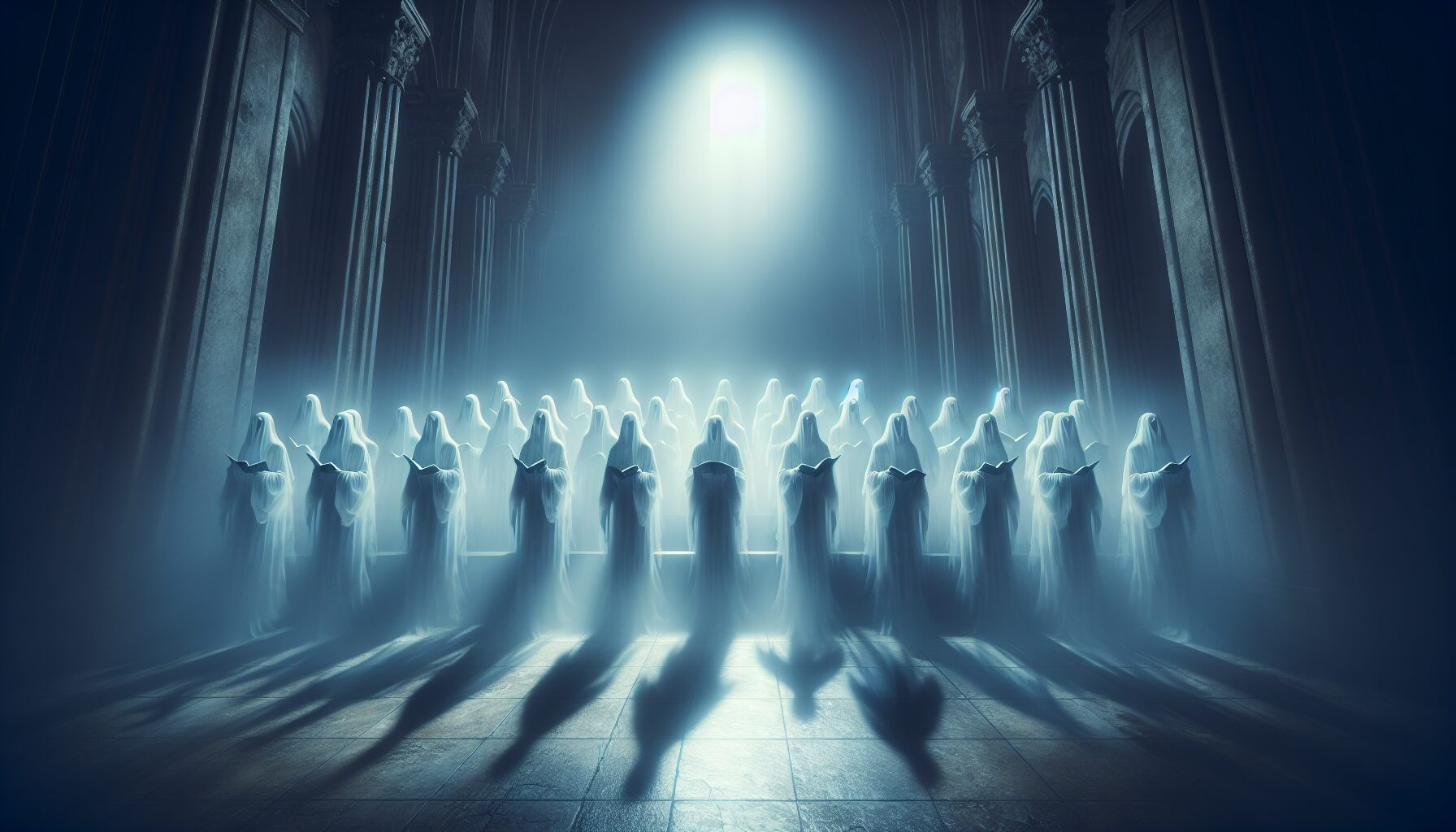
    In the depths of time and memory, where the veil between this world and the next grows thin, whispers of ancient souls create a symphony of echoes. This ethereal harmony, known as The Silent Choir, speaks to those attuned to the mystical side of existence, offering insights into forgotten histories and spiritual truths.

    Origins of the Silent Choir

    The Silent Choir is a concept found in various cultural traditions around the world, each with its unique interpretation. Some believe these echoes are the voices of ancestors guiding the living, while others view them as cosmic harmonies that sustain the universe. Despite their cultural differences, these traditions share a common belief in the power of soundless voices to influence the physical and spiritual realms.

    In ancient Celtic lore, the Druids were believed to communicate with the spirits of the land through The Silent Choir. They taught that these whispers carried the wisdom of nature, accessible to those who cultivated deep stillness and reverence. Similarly, in the indigenous spiritual practices of North America, the concept of the spirit voice is present, where ancestral spirits imbue the land with sacred energy and guidance.

    The Science Behind the Echoes

    The idea of hearing echoes of the past might initially seem far-fetched. However, emerging studies in the field of psychoacoustics suggest that sound and memory are intricately linked. According to Dr. Chris Kyriakakis of the University of Southern California, “The brain can recreate auditory environments, making it possible to hear non-existent sounds based on memory or expectation” (Journal of Acoustics).

    This scientific perspective doesn’t negate the mystical aspects, but rather provides a framework for understanding how individuals might perceive these spectral symphonies. It suggests a genuine connection between the physiological and metaphysical experiences of these echoes.

    Experiencing the Silent Choir

    For those who seek to hear The Silent Choir, the practice of deep listening is crucial. This involves more than merely hearing; it requires an open heart and a reflective mind. Below are steps to begin your journey:

    • Create Stillness: Find a quiet place, free from disturbances, where you can focus your mind and senses.
    • Mindful Breathing: Inhale and exhale slowly, allowing your breath to guide you into a meditative state.
    • Attuned Awareness: Pay attention to the subtlest sounds, the faintest whispers, and the silence in between.
    • Reflective Contemplation: Consider what these echoes, or the absence thereof, might be conveying about your spiritual path.

    As you deepen your practice, you may begin to discern patterns or messages within the silence—insights into past experiences or intuitive guidance about current decisions.

    The Impact of the Silent Choir

    The Silent Choir is revered not only for its spiritual messages but also for its healing properties. Listening to these mystical echoes can foster emotional resilience, reduce stress, and promote a deeper connection with one’s self and the universe. A study by Harvard Medical School suggests that meditation practices, similar to those described, significantly enhance psychological well-being (Harvard Health Publishing).

    Practitioners often report a sense of unity with the universe, finding peace in the affirmation that they are a part of something greater—a timeless choir of souls singing in harmony.

    Conclusion

    In a world dominated by noise and distraction, The Silent Choir offers a sanctuary of serenity. These mystical echoes, whether understood through spiritual narratives or scientific inquiry, testify to the rich tapestry of human experience that transcends the material world. By listening deeply, we honor the voices of the past, bringing their wisdom into the present to guide our future.

    “Silence is a source of great strength.”

    — Lao Tzu

    Let us embrace the silence, listen to its secrets, and join the ceaseless choir of the forgotten spirits.

  • Shadows of the Soul – Exploring the Darkness Within

    Shadows of the Soul – Exploring the Darkness Within

    Shadows of the Soul: Exploring the Darkness Within

    The human psyche is a complex interplay of light and dark, a tapestry woven with threads of both benevolent and malevolent tendencies. The concept of the ‘shadow’—a term popularized by Swiss psychiatrist Carl Jung—represents the unconscious and repressed aspects of the personality. Delving into our shadows can be an unsettling yet enlightening journey. This exploration prompts self-awareness and the potential for profound personal growth.

    The Origins of the Shadow

    Carl Jung introduced the term ‘shadow’ to define the unconscious parts of the psyche that an individual disowns or is unaware of. According to Jung, “the shadow personifies everything that the subject refuses to acknowledge about himself.” (Good Therapy).

    The shadow consists of all qualities—both negative and positive—that are not recognized as part of one’s conscious identity. This might include socially undesirable traits such as greed, envy, or anger, as well as repressed talents and instincts. As Jung states in Psychology and Religion: West and East, “Everyone carries a shadow, and the less it is embodied in the individual’s conscious life, the blacker and denser it is.”

    Confronting the Shadow

    Engaging with the shadow is a crucial aspect of personal growth and self-discovery. This process, often referred to as shadow work, involves recognizing and integrating these hidden aspects. By confronting the shadow, individuals have the opportunity to reclaim those parts of themselves that have been cast into darkness.

    • Self-Reflection: The first step in shadow work involves honest self-reflection. This might involve journaling, meditation, or therapy, avenues through which one can identify repressed emotions and traits.
    • Acknowledgment: Recognizing the presence of the shadow without judgment is critical. Acceptance creates the space for transformation and healing.
    • Integration: The ultimate goal of shadow work is to integrate these aspects into the conscious self, leading to wholeness and authenticity.

    American psychologist Robert A. Johnson in his book Owning Your Own Shadow: Understanding the Dark Side of the Psyche articulates this idea beautifully: “To honor and accept one’s own shadow is a profound religious discipline. It is whole making—and that is the meaning of holiness.”

    The Benefits of Embracing the Shadow

    While delving into one’s darker aspects can be daunting, the rewards are manifold. Here are several benefits of this transformative process:

    • Enhanced Self-Awareness: By acknowledging the parts of ourselves we’ve ignored or denied, we develop a deeper understanding of our behaviors and motivations.
    • Emotional Healing: Shadow work allows suppressed emotions to surface, enabling the healing of old wounds and traumas.
    • Improved Relationships: As we accept our flaws, we cultivate compassion and empathy, not only for ourselves but for others as well, fostering healthier relationships.
    • Personal Growth: By integrating the shadow, we unlock greater creativity, intuition, and personal power, paving the way for a more fulfilled and purposeful life.

    Shadows in Cultural and Historical Context

    The idea of confronting one’s inner darkness is not confined to modern psychology. Throughout history, various cultures have acknowledged the shadow through myth, art, and literature.

    Consider the tale of Dr. Jekyll and Mr. Hyde by Robert Louis Stevenson, which explores the duality of human nature and the struggle between societal norms and primal instincts. Similarly, many religious texts feature stories of conflict between light and darkness, good and evil, illustrating the universal recognition of the shadow.

    “We must be careful; the darkness always passes over the light!” —Elie Wiesel, speaking on the importance of acknowledging both sides of human nature.

    In art, the chiaroscuro technique—contrasting light and dark—symbolizes the interplay of these forces, offering insight into the artist’s psychological landscapes. More contemporary examples can be found in various film and television narratives that explore the complexity of moral ambiguity, through characters that subvert hero and villain archetypes.

    Shadows as a Creative Force

    Many artists, writers, and creators have drawn from their shadows to fuel their work. The shadow can act as a muse, offering a rich well of inspiration that shapes creative expression.

    Novelist and philosopher Albert Camus wrote of his struggle with the absurdity and darkness of life, yet used these themes to fuel his existential narratives. In music, artists like Nina Simone and Kurt Cobain channeled their inner turmoil to create works that resonate deeply with audiences. Their art offers catharsis not only for themselves but also for their listeners.

    The Ethical Implications of Ignoring the Shadow

    Ignoring our shadows can lead to the projection of these denied parts onto others, forming biased perceptions and judgments. This phenomenon can affect societies at large, contributing to systemic issues such as discrimination, conflict, and misunderstanding.

    Acknowledging shadow elements within cultural and societal frameworks can lead to greater empathy and collective healing. As Jung wisely noted, “Knowing your own darkness is the best method for dealing with the darkness of other people.” This understanding emphasizes the importance of personal shadow work as a stepping stone to broader societal harmony.

    Conclusion: Embracing the Journey

    The journey into the shadows of the soul requires courage and resilience. It asks for a sincere commitment to explore the less desirable facets of our nature, promising transformation and reconciliation. As individuals begin to integrate these shadow elements, they cultivate a more authentic self and pave the way for a more harmonious existence with the world around them.

    Ultimately, the shadow is not an enemy to be vanquished but a rich layer of the self to be embraced. By welcoming the darkness within, we allow the light to shine even brighter, encouraging a fuller and more nuanced understanding of the human condition.

  • The Hollow Archive: Cataloging Absence

    The Hollow Archive: Cataloging Absence

    In the world of archival science, the process of cataloging deals not only with what is present but also with what is absent. This is where the concept of the “hollow archive” comes in—a collection where the most significant entries are often the gaps themselves.

    Understanding the Concept

    The notion of the hollow archive challenges traditional ideas about records and documentation. Instead of an exhaustive compilation of every available resource, it acknowledges that absence holds its own kind of information. As Jacques Derrida highlighted in his infamous phrase, “there is no archive without a place of consignation, without a technique of repetition, and without a certain exteriority.” This idea suggests that the history we preserve and the gaps we encounter are equally significant in the storytelling of our past.

    The Importance of Absence

    Sometimes, absence can speak louder than presence. When historians and archivists encounter these gaps, they are often faced with questions that lead to deeper understanding. What was deemed unworthy of preservation? What narratives were excluded or repressed? These inquiries open up new avenues of research and critique, allowing for exploration into societal norms and biases over time.

    Examples in Practice

    Consider the case of the Smithsonian’s National Museum of American History and its collection practices. In their pursuit of documenting American history, they’ve come to recognize the significance of what is missing and who decides what is worthy of saving. The efforts to capture overlooked voices have led to a more inclusive and comprehensive reflection of American life.

    Challenges and Considerations

    • Bias Recognition: Understanding whose stories are missing requires a critical eye and the acknowledgment of systemic bias in archival processes.
    • Resource Allocation: Ensuring that “gaps” are strategically chosen for investigation rather than focusing disproportionately on already well-documented narratives.
    • Ethical Responsibilities: Archivists must balance the need to unearth neglected stories while respecting the privacy and intentions of the individuals related to historical events.

    The Future of Archives

    The exploration of the hollow archive represents a shift in archival paradigms—a move from static collections to dynamic inquiries into the past. As technology advances, the capacity to identify, interrogate, and fill these gaps becomes more sophisticated, allowing for a richer understanding of history’s tapestry.

    “For every photograph that ends up in an archive, countless others are lost, much like the stories they once captured,” observes Colin Pantall, showcasing the ephemeral and selective nature of our documented history.

    The journey of cataloging absence continues, holding a mirror up to society’s omissions and inspiring dialogue on the narratives worth preserving.

  • The Candle Path: Walking Nighttime Rituals

    The Candle Path: Walking Nighttime Rituals

    Nighttime rituals have been a significant part of human culture for millennia. They serve not only as a transition into the realm of sleep but also as a symbolic journey through darkness, uncertainty, and self-reflection. One such evocative ritual is the practice of walking a candle-lit path.

    The Historical Significance

    The use of candles in spiritual and meditative practices dates back to ancient times. The flame, representing both purification and enlightenment, has been a focal point in many religious and philosophical traditions. In the words of Confucius, “Better to light a candle than curse the darkness.” The candle path, therefore, is not merely about walking in the physical sense but about undertaking a journey inward, moving towards understanding and clarity.

    Creating the Path

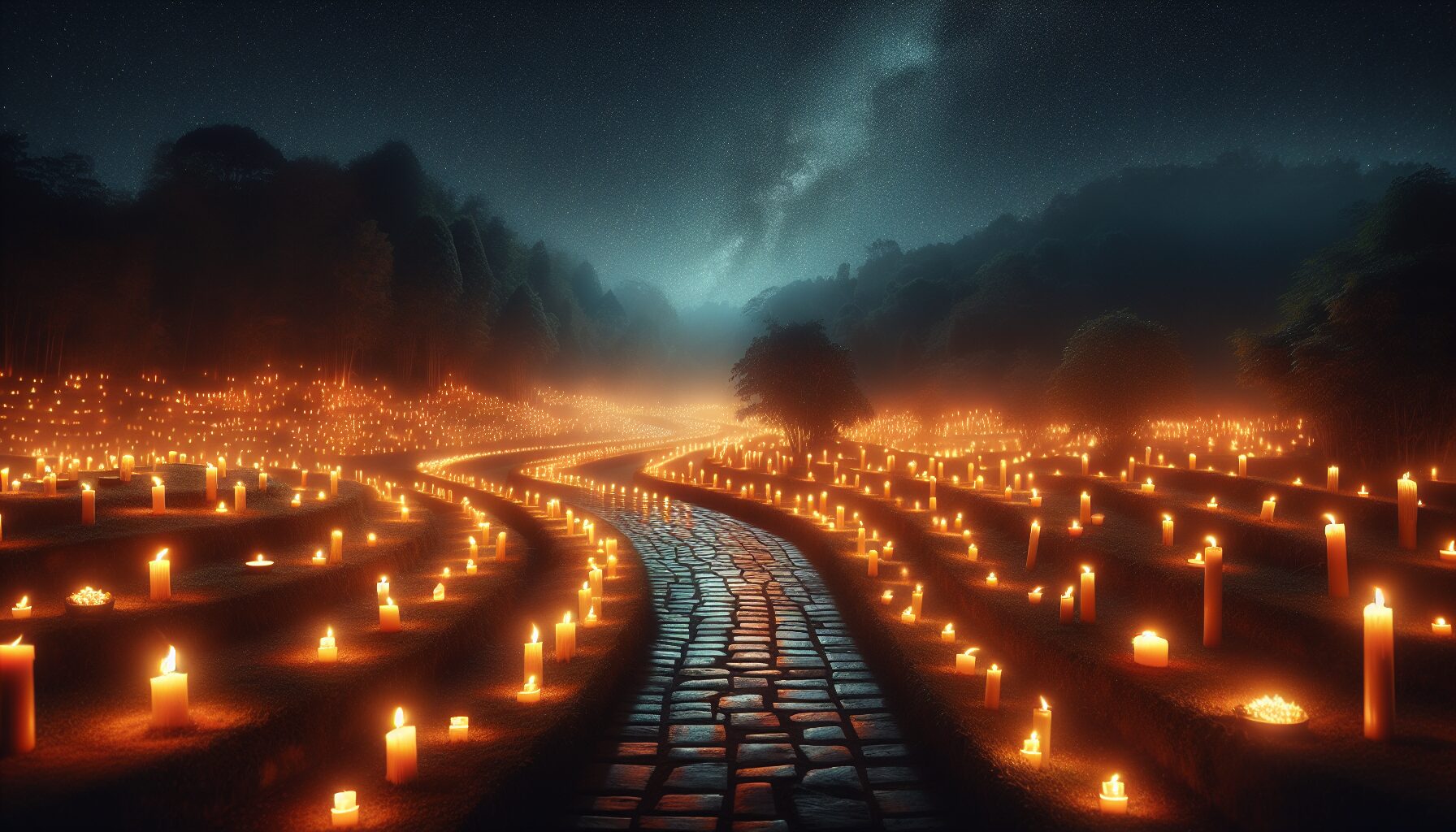
    To create a candle path for a nighttime ritual, practitioners typically line a path with candles or lanterns, allowing the flickering light to guide their steps. Here are the basic steps to create your own candle path ritual:

    • Choose a Safe Location: Ideally, the path should be outdoors, such as in a garden or park, free from flammable materials or adverse weather conditions.
    • Select Your Candles: Opt for long-burning candles or lanterns. Ensure they are stable and risk-free to minimize hazards.
    • Set Your Intention: Before lighting each candle, set a clear intention or meditate briefly to infuse the act with purpose.
    • Walk the Path: With mindful steps, walk the path reflecting on each candle as a milestone or a point of reflection in your spiritual journey.

    The Philosophical Underpinning

    The candle path ritual embodies the philosophical notion of moving from ignorance towards enlightenment. It is a personal journey, symbolic of the journey every human must undertake in search of truth. Carl Jung once stated, “Knowing your own darkness is the best method for dealing with the darkness of other people.” The candle path ritual allows individuals to confront their own inner darkness, guided and comforted by the gentle flicker of light.

    Conclusion

    Whether done alone or shared with others, the candle path ritual offers a profound experience of meditation and contemplation. These rituals serve as a gentle reminder of the light within us, always ready to guide us through the shadows. Delving into such practices may very well illuminate paths not just within our night walks, but also in the ongoing journey of life.

    For those interested in incorporating this into their spiritual practices, the candle path offers both a literal and metaphorical journey from darkness into light, emphasizing our eternal quest for illumination.

  • Echoes in the Fog: Listening for Spirits

    Echoes in the Fog: Listening for Spirits

    As the night envelops the world in its silent embrace, there is a timeless allure to the idea that we are not alone. Throughout history, tales of whispering winds and shadowy figures have fueled the belief in spirits communicating with the living. But how does one go about listening for these ethereal echoes? The key may lie in understanding both the scientific and mystical components of paranormal activities.

    The History of Spiritual Communication

    The concept of communicating with spirits is hardly new. Ancient cultures often held rituals to commune with their ancestors. The famed Oracle of Delphi in Ancient Greece, for example, is believed to have spoken prophecies directly from the gods. More recently, the 19th-century Spiritualism movement popularized séances as a means to contact the deceased. As History.com notes, “the belief that the dead reside in a spectral realm where they can be contacted by the living did not originate in America, but came from Europe.”

    Scientific Perspectives on Spirit Voice Phenomena

    Contemporary interest in spiritual experiences often intersects with science, leading to the study of Electronic Voice Phenomena (EVP). EVP refers to sounds found on electronic recordings which are interpreted as spirit voices. Researchers, such as Konstantin Raudive, have dedicated their work to capturing these elusive sounds. His experiments in the 1960s paved the way for modern ghost hunters, utilizing technology to detect what the human ear might miss.

    What is EVP?

    • Recording Devices: EVP is typically captured using audio recording devices. Many use specially-built digital recorders or employ high-sensitivity microphones.
    • White Noise: The theory is that spirits manipulate the background sound, such as static or white noise, to form words or phrases.
    • Analysis: Once recordings are made, sound editing software helps filter and enhance these noises, sometimes revealing coherent speech.

    However, skeptics like psychologist Chris French argue that EVPs often arise from pareidolia, a “psychological tendency to find patterns in random stimuli.” According to an article by Smithsonian Magazine, our brains are adept at pattern recognition—sometimes too adept—and may lead us to interpret random sounds as familiar words.

    The Mystical Approach: Techniques and Tools

    For those more attuned to the mystical side of spiritual communication, the process often involves intuition and ritualistic practices. Here are some common methods and tools used by practitioners:

    • Séances: Conducted to create a direct connection, usually guided by a medium.
    • Spirit Boxes: Devices that scan radio frequencies to allow spirits to manipulate cuts of audio to form messages.
    • Crystal Pendulums: Used by some to receive ‘yes’ or ‘no’ answers from spirits.
    • Tibetan Singing Bowls: Create vibrations and tones thought to attract or placate spirits.

    As renowned psychic Sylvia Browne once said, “To communicate with the spirit world, one must approach it with openness and respect.” This mindset, alongside tools and technology, forms the foundation of modern ghost hunting and spiritual listening.

    Famous Cases of Spiritual Voices

    The field of paranormal investigation is rife with intriguing cases that spark both curiosity and skepticism. A notable example is the infamous Enfield Poltergeist of 1977 in London, where witnesses reported hearing disembodied voices and unexplained phenomena. This case was extensively documented by investigators Maurice Grosse and Guy Lyon Playfair, who claimed to have recorded several hours of such activities.

    “There are more things in Heaven and Earth, Horatio, than are dreamt of in your philosophy.” – William Shakespeare, Hamlet

    Conclusion: The Thin Veil Between Worlds

    History, science, and mysticism converge on the topic of spiritual communication. Whether one approaches with skepticism or belief, the desire to understand what lies beyond the veil is an enduring human quest. As technology continues to evolve, so too might our understanding of these echoes in the fog, pushing the boundaries of what we perceive to be possible.

    Thus, whether through the analytical lens of EVP or the intuitive practices of the mystical arts, listening for spirits remains a fascinating intersection of the known and unknown—a conversation as old as humankind itself.

  • The Angel’s Notebook: Sketches of Ephemeral Faith

    The Angel’s Notebook: Sketches of Ephemeral Faith

    The Angel’s Notebook: Sketches of Ephemeral Faith

    The Angel’s Notebook: Sketches of Ephemeral Faith

    The concept of faith, much like the ephemeral sketches within an angel’s notebook, is both transient and profound. It reflects a myriad of human experiences, capturing the essence of existential uncertainties and the quest for a deeper understanding of the universe. This notion of faith is not static but evolves, influenced by personal and collective experiences, societal changes, and the ever-shifting sands of time.

    The Ambivalence of Faith

    Faith, in its essence, is a belief that transcends empirical evidence and rational comprehension. It is an acceptance of the unknown, an inner conviction that stands resolute even in the face of uncertainties. As Martin Luther King Jr. aptly remarked, “Faith is taking the first step even when you don’t see the whole staircase.” This highlights faith’s inherent ambivalence—its strength lies in its vulnerability to the unknown.

    Like an angel drawing fleeting sketches, faith often manifests in intangible forms—each person experiences it uniquely. Whether through religious practice, spirituality, or personal philosophy, faith represents a commitment to a perceived truth, regardless of its indiscernibility.

    Faith and Reason: A Perennial Conflict

    “Faith indeed tells what the senses do not tell, but not the contrary of what they see. It is above them and not contrary to them.”

    Blaise Pascal

    The conflict between faith and reason has been a longstanding debate within philosophical discourse. While faith relies on a personal belief in the absence of empirical proof, reason demands evidence and logic. This dichotomy is often portrayed as a battle between two opposing forces. Yet, it is perhaps more accurately seen as a complex interplay, where both can coexist and even complement each other.

    Pascal, through his famous Pascal’s Wager, suggests that faith is a pragmatic choice amidst uncertainty, a bet that carries potential infinite rewards. Here, faith emerges as a rational decision in light of the vast unknown, suggesting a harmonious relationship between belief and logic.

    The Ephemeral Nature of Faith

    Much like the fleeting nature of a sketch, faith is often subject to change and reinterpretation. Life’s experiences continuously reshape our beliefs, challenging and refining them. The angel’s notebook is thus never complete, an ongoing work in progress, each sketch a representation of a momentary understanding.

    In moments of doubt, faith may seem to wane, mirroring the ephemeral quality that defines human existence. Yet, each challenge encountered also provides an opportunity for faith to be rediscovered and reinforced. As Viktor Frankl noted in Man’s Search for Meaning, “What is to give light must endure burning.” Through life’s trials, our faith is tested and our understanding deepened.

    Sketches of Belief in Modern Times

    In contemporary society, the nature of faith continues to evolve. The rise of secularism, advancements in science, and the increasing complexity of global cultures have influenced traditional religious practices and belief systems. However, this does not necessarily imply a decline in faith but rather a transformation of how it is expressed and perceived.

    • Many turn to personal spirituality, constructing individualized belief systems that integrate aspects of various philosophies and religions.
    • The digital age has also fostered new communities of faith, where people connect over shared beliefs in virtual spaces, bridging geographical divides.
    • Moreover, humanitarian and ecological movements have inspired a form of faith centered on communal and environmental stewardship.

    Conclusion: Embracing the Transience

    Ultimately, the sketches within the angel’s notebook remind us that faith is an ever-evolving journey. It is a personal narrative, intertwined with the collective human experience, adapting to the challenges and changes of life. In embracing the transient nature of faith, one finds not only comfort but also a profound understanding of the self and the universe.

    Thus, as each sketch is drawn and redrawn, it becomes clear that the beauty of faith lies not in its permanence but in its ability to reflect the dynamic human spirit.