Tag: could

  • Alien Ghosts – Memories of Species Long Gone

    Alien Ghosts – Memories of Species Long Gone

    Alien Ghosts: Memories of Species Long Gone

    In the vast expanse of the universe, countless star systems harbor their secrets, whispers of the past echo through time and space. While humanity has yet to discover conclusive evidence of extraterrestrial life, the concept of Alien Ghosts—the memories of species long gone—continues to captivate our imagination and scientific inquiry. This article delves into the hypothetical realm of alien ghosts, exploring how these spectral remnants might manifest, how they relate to Earth’s own extinctions, and what they can tell us about the fragility of life.

    The Ghosts of Our Past

    Understanding alien ghosts requires an examination of our own planet’s history. Earth has witnessed several mass extinctions, each reshaping the planet’s biological tapestry. From the Permian extinction’s devastation to the cataclysmic asteroid impact that ended the reign of the dinosaurs, these events serve as stark reminders of life’s vulnerability.

    Extinction-level events, whether caused by natural phenomena or potential anthropogenic effects, highlight a crucial fact: Life, regardless of its complexity, is ephemeral. As paleontologist Jack Horner suggests, “Extinction is the rule. Survival is the exception.” The idea that a civilization, no matter how advanced, could perish is not far-fetched.

    How Alien Ghosts Might Manifest

    But how might we detect these alien ghosts? The answer might lie in the concept of technosignatures—evidence of technology that survives the demise of its creators. Potential technosignatures could take many forms:

    • Ruins and Artifacts: Just as archaeologists unearth ancient relics on Earth, future space explorers may discover remnants of alien civilizations on distant planets or moons.
    • Radio Signals: Bouncing through the cosmos, radio waves can travel vast distances. If an advanced civilization communicated via radio signals, traces might still be detectable, ghosts of their presence.
    • Dyson Spheres: Proposed by physicist Freeman Dyson, these theoretical megastructures could encapsulate stars to harness their energy. A partially constructed Dyson Sphere might signify a civilization that once thrived.

    Lessons from Fermi’s Paradox

    Fermi’s Paradox, named after physicist Enrico Fermi, questions why we have not yet observed evidence of alien life, given the vast number of potentially habitable planets. This conundrum aligns with the idea of alien ghosts, as it poses the question: Could the aliens we seek already be extinct?

    Several hypotheses attempt to address Fermi’s Paradox, including the possibility that advanced civilizations self-destruct—a sobering thought that holds lessons for humanity. As noted by theoretical physicist Michio Kaku, “The real threat facing the future of humanity is not the universe, but ourselves.” If we hope to avoid the fate of becoming our own ghosts, understanding the paths and pitfalls of extinct civilizations could be vital.

    The Importance of Cosmic Archeology

    The study of alien ghosts ties into the emerging field of cosmic archeology. Just as terrestrial archaeologists decipher the history of human societies, cosmic archaeologists seek to uncover the stories of extraterrestrial civilizations. This discipline aims to explore several key questions:

    • What causes civilizations to fall? Understanding the factors that lead to the demise of advanced societies can offer insights into longevity and resilience.
    • How can we interpret alien cultural artifacts? Developing methodologies for understanding potential alien languages and symbols is a critical task.
    • What technological advancements did they achieve? Uncovering the technologies of lost civilizations could provide humanity with technological blueprints for the future.

    Humanity’s Role in Preserving Memories

    While we ponder the existence of alien ghosts, we must also consider our role in preserving our own legacy. In an era characterized by unprecedented technological advancements and existential threats, the actions we take today have long-lasting implications.

    “We are a way for the cosmos to know itself,” Carl Sagan famously said. Our quest to understand the universe and our place within it compels us to ensure that our story doesn’t become another silent echo in the vast theater of stars.

    The construction of resilient societies, the pursuit of sustainable development, and the exploration of space are all steps toward preserving the human narrative. Through such endeavors, we not only secure our future but also ensure that, should we encounter another life-bearing world, we do so as equal participants in the cosmic dance.

    Conclusion

    The allure of alien ghosts lies in their ability to reflect our own potential destinies. While they remain hypothetical, they encourage us to look to the stars not just with wonder, but with caution and responsibility. They implore us to ask critical questions about our survival and our legacy.

    As we turn our gaze skyward, let us remain vigilant stewards of our world. Let us learn from the silence of the stars and the whispers of worlds past. In doing so, we may one day encounter the echoes of another’s existence—an exchange not with ghosts but with living, thriving comrades among the stars.
  • Contact and Death – Why First Encounters Could Be Fatal

    Contact and Death – Why First Encounters Could Be Fatal

    Contact and Death: Why First Encounters Could Be Fatal

    The idea of making first contact with extraterrestrial life has long been a subject of fascination and speculation within the realms of science fiction and scientific inquiry. Yet, as we edge closer to potentially discovering or being discovered by intelligent life forms beyond Earth, scientists and ethicists are raising concerns about the potential dangers involved. These risks are not just about communication barriers or diplomatic challenges but could be as grave as involuntary annihilation. This article explores why first encounters with alien civilizations could indeed be fatal.

    The Biological Menace

    One of the most concerning aspects of first contact lies in the field of microbiology. The simplest life forms on Earth have proven over millennia to be remarkably adaptable and often deadly. Humans have faced catastrophic consequences simply by traveling across different continents, let alone planets.

    “The history of exploration is replete with examples of populations being decimated by novel pathogens, from smallpox in the Americas to the bubonic plague in Europe,” notes The Journal of Infectious Diseases. The introduction of an entirely new set of microorganisms from a distant world—or vice versa—could lead to pandemics exponentially more catastrophic than anything Earth has ever witnessed.

    The prospect of alien viruses or bacteria to which humans have no immunity could lead to rapid and uncontrollable outbreaks. Conversely, Earth-born pathogens could prove equally lethal to alien life forms with no defenses against them.

    Technological Disparity and Misunderstanding

    The technological gap between humanity and a potential extraterrestrial civilization could spell disaster. If we assume that these beings have the capability to travel across galaxies, they may possess technology far beyond our comprehension and defense capabilities. Historian David Christian, in his TED Talk “The history of our world in 18 minutes,” suggests, “In history, encounters between cultures at different levels of technology have often resulted in exploitation and domination.”

    Consider the example of European colonizers and indigenous populations. Technological advantages, along with misunderstandings and cultural insensitivity, led to the subjugation and often destruction of entire civilizations. The same principles could apply on an interstellar scale, where humanity could inadvertently provoke hostility from a technologically advanced species.

    The Kardashev Scale and Unknown Motives

    The Kardashev Scale, developed by Russian astrophysicist Nikolai Kardashev, categorizes civilizations based on their energy use and technological advancement. A Type I civilization uses energy on a planetary scale, a Type II harnesses stellar power, and a Type III civilization utilizes energy on the scale of its entire galaxy.

    Humanity has not yet achieved full Type I status, so the appearance of a Type II or III civilization could render us insignificant or obsolete from their perspective. Moreover, understanding the motives of such beings could be beyond our current cognitive and philosophical frameworks. Are they curious? Resource-hungry? Surveillance-minded? These unknowns pose significant existential risks.

    Lessons from Fiction and Science

    Fictional depictions often provide cautionary tales about first contact. Works like The War of the Worlds by H.G. Wells and movies such as Arrival explore themes of invasion, miscommunication, and the potentially destructive nature of such encounters.

    In The War of the Worlds, humans’ initial awe and curiosity quickly turn to terror as alien technology wreaks havoc across the Earth. Similarly, Arrival focuses on the complexities and potential pitfalls in communication with extraterrestrial beings. These narratives underscore the notion that scenarios involving first contact are fraught with peril.

    The Necessity of Preparedness

    Given the myriad risks associated with first contact, it is crucial for our species to prepare adequately. Organizations like SETI Institute focus not only on the search for extraterrestrial intelligence but also on preparing for possible contact scenarios. Dr. Jill Tarter of the SETI Institute emphasizes the need for international protocols: “We need a coordinated response strategy, akin to the protocols established for pandemic outbreaks or natural disasters, ensuring that any first contact event does not lead to chaos or unintended harm.”

    In Conclusion

    While the prospect of first contact with extraterrestrial life is exhilarating, it is laden with formidable risks. The dual threats of biological contamination and technological exploitation could potentially lead to existential threats. As humanity continues to progress technologically, reaching further into the cosmos, we must tread cautiously. Preparing for a multitude of scenarios and acknowledging the potential for disaster will be vital steps in ensuring that our first encounter with alien life does not also become our last.

    Building understanding, crafting robust response strategies, and fostering international cooperation may ultimately determine the differences between a mutually beneficial exchange or a tragic footnote in the saga of human exploration.

  • Alien Rituals – How Other Beings Might Face Mortality

    Alien Rituals – How Other Beings Might Face Mortality

    As humans contemplate existence beyond Earth, one intriguing question surfaces: How might alien civilizations confront the concept of death? The idea that extraterrestrial beings could have their own unique death rituals offers a fascinating lens into the diversity of life forms across the cosmos.

    On Earth, rituals surrounding death vary widely, from the ancient Egyptian embalming processes to modern-day cremations and celebrations of life ceremonies. What then, might alien cultures practice when facing mortality?

    Potential Alien Rituals

    • Energy Reconversion: Advanced civilizations might harness scientific understanding that allows them to convert the life force of the deceased back into usable energy. In this view, death becomes a practical process rather than a sorrowful departure.
    • Memory Preservation: Aliens with a networked consciousness could upload memories of the deceased into communal consciousness systems, allowing individuals to live on in collective memory. This could echo the idea of a digital afterlife that humans speculate about today.
    • Elemental Return: According to some theories, aliens may practice a ritual akin to sky burial, where the bodies are returned to nature’s elements, feeding their planet’s ecosystem in a circular life process.
    • Ritualistic Storytelling: Cultures focused on oral traditions may engage in ritualistic storytelling, retelling the lives and achievements of the deceased as an act of remembrance, potentially accompanied by communal contact with spiritual planes.

    Cultural Insights from Earth

    To imagine these alien rituals, we can draw parallels from Earth’s own traditions. The philosopher Alan Watts once said,

    “We need a mythology that will help us identify not with the individual but with the universe and with the age.”

    His words underline how cultural expression surrounding death often seeks to transcend the individual.

    In a cosmos potentially teeming with life, understanding alien approaches to death could enrich our perspective on mortality, life, and existence. As Arthur C. Clarke suggested,

    “Two possibilities exist: either we are alone in the Universe or we are not. Both are equally terrifying.”

    As we ponder this dichotomy, imagining how other beings might cope with death broadens our understanding of the possible avenues through which life itself is understood in the vast universe.

    While the idea of alien life remains speculative, thinking about how extraterrestrial life forms contemplate their mortality helps humans reflect on their own rituals and the universal quest for meaning in the face of the inevitable.

  • Life After Stars – Imagining Consciousness in a Cold Universe

    Life After Stars – Imagining Consciousness in a Cold Universe

    Life After Stars: Imagining Consciousness in a Cold Universe

    For millennia, the night sky has been a tapestry of glittering stars, each one a sun burning brightly in the immensity of the cosmos. Yet stars are not eternal; they are born, they age, and eventually, they extinguish. What, then, becomes of consciousness when the universe reaches its endgame—when the stars have all died, and the cosmos has grown cold and dark?

    The Far Future: A Cold and Dark Universe

    Astrophysicists predict a variety of fates for the universe, depending on how the laws of physics shape its destiny. Among these possibilities is the scenario known as the “heat death” of the universe. The term is somewhat misleading, as it refers not to a cataclysmic burst of energy, but rather to the gradual loss of usable energy throughout the cosmos. William Thomson, also known as Lord Kelvin, was one of the first to suggest this inevitable thermodynamic end in the 19th century:

    “The result of this doctrine is that all physical change may be represented by motion. The dissipation of mechanical energy as it transforms into thermal energy will eventually lead to the ‘heat death.’”

    At this point, stars will cease to shine, leaving behind black dwarfs—stellar remnants so cold that they no longer emit light. In such an environment, what becomes of life and consciousness? Could awareness and cognition persist in a universe devoid of stars?

    Redefining Life and Consciousness

    The stoic nature of a starless universe challenges our fundamental assumptions about life and consciousness. Traditionally, life as we know it relies on the energy provided by stars. With the absence of stellar energy, any surviving consciousness must rethink its requirements.

    Post-Biological Evolution

    • Machines and Intelligence: As humanity advances technologically, we create increasingly sophisticated machines. Could post-biological entities, like artificial intelligences, find means to sustain themselves using minimal energy? Concepts such as these have been explored in works like Ray Kurzweil’s The Singularity is Near, where technological evolution outpaces biological evolution.
    • Mathematic and Quantum Computation: Perhaps consciousness could exist as a form of computation, operating on reduced energy systems such as quantum computers. As physicist Seth Lloyd suggests, “The universe is a quantum computer,” implying that computation could potentially continue even as the universe cools. (Source).

    Energy Sources in a Starless Universe

    Even in a universe devoid of stars, some energy sources might remain. Here are potential avenues for sustaining ‘life’ or consciousness in such an environment:

    • Dark Matter and Energy Harnessing: Though mysterious, dark matter and energy comprise most of the universe’s mass and energy. Advancements in understanding how to harness these resources might provide a viable energy source to sustain consciousness.
    • Black Hole Radiation: Particles could theoretically be extracted from black holes through Hawking radiation, which might allow a near-zero-energy entity to persist. Stephen Hawking proposed this concept, suggesting that even black holes aren’t entirely permanent, as they lose mass via radiation (Source).
    • Tidal Forces: In a universe where celestial bodies interact, the gravitational effect of these interactions – or tidal forces – might be utilized as a consistent, though weak, energy source.

    Cultural and Philosophical Implications

    As we imagine life in a starless universe, we must grapple with the psychological and cultural dimensions of consciousness in such a scenario.

    Consciousness and Memory

    Would consciousness endure long after the stars have died? Alan Lightman, in his book The Accidental Universe, writes:

    “We are ephemeral creatures living in an ephemeral world. At some point, we must confront the disappearance of all things cherished.”

    This existential reflection forces us to consider how consciousness might be maintained when disconnected from the cultural touchstones of the past.

    Purpose and Meaning

    If consciousness persists post-starlight, its essence may need reevaluation. A universe without stars is one vast in its silence, demanding a redefinition of purpose absent the familiar cycles and symbols provided by stars.

    Imagining New Forms of Existence

    What we face in a universe devoid of stars is nothing short of rediscovery. From darkness come possibilities—novel forms of cognitive existence that adapt to extreme environments:

    • Virtual Realities: If consciousness is computational, then virtual worlds could be crafted to fill the void left by the physical universe, offering a refuge and a platform for continued interaction and evolution.
    • Collective Consciousness: To conserve resources, consciousness may operate communally, shared across vast distances through advanced fields or networks, overcoming individual isolation and preserving knowledge collectively.

    Conclusion

    While the concept of a universe devoid of stars is daunting, it challenges us to confront fundamental questions about the nature of life and consciousness. By imagining creative solutions and alternative existences, this bleak scenario prompts a reflection on resilience and ingenuity.

    Indeed, the true story of life after stars is unwritten. With current scientific understanding, we can only forecast hazily—but within mystery lies potential, an opportunity to reimagine consciousness thriving amid the cold and the dark.

  • Rogue Planets – Wanderers Without Home, Mirrors of Death

    Rogue Planets – Wanderers Without Home, Mirrors of Death

    In the vast, dark stretches of the universe, untethered worlds known as rogue planets drift silently, detached from the gravitational embrace of any star. These nomadic globes emerge in the cosmos like cosmic orphans, casting light on both the mysterious dynamics of planetary formation and the grim realities reflected in their solitary voyage.

    The Origin of Rogue Worlds

    Rogue planets may form in a manner similar to regular planets but undergo unique evolutionary paths. Once part of a distant solar system, these planets could have been ejected by gravitational disturbances or violent interactions with neighboring celestial bodies. According to The Astrophysical Journal, “planets can be hurled from their orbits during the formation and early evolution of planetary systems” (source).

    “Some rogue planets could have formed free-floating in space, like stars, but failed to ignite into stellar flames—never achieving that critical mass for stardom,” explains astrophysicist Mike Brown of Caltech.

    The Search for the Unseen

    Rogue planets are challenging to study due to their lack of an illuminating star. However, advancements in astronomical technology and methods, such as gravitational microlensing, have enabled scientists to catch fleeting glimpses of these mysterious travelers. A significant finding in 2011 suggested the Milky Way might harbor as many as two rogue planets for every star, highlighting their potential abundance.

    • Gravitational Microlensing: This technique involves observing the effects of a rogue planet’s gravitational pull on the light from a background star. The planet acts like a lens, magnifying the stellar light and alerting astronomers to its presence.
    • Infrared Surveys: Rogue planets emit low levels of infrared radiation, giving astronomers clues about their thermal properties and composition.

    The European Space Agency’s Gaia mission plays a critical role in these discoveries, precisely mapping the positions and motions of stars and rogue planets alike.

    Lonely Wanderers Reflecting Death

    Rogue planets offer a mirror to death in celestial terms. Stripped of their systems, they invoke a cosmic isolation that might be dwarfed only by black holes. On an astronomical scale, they represent a life extinguished—a memory of a dynamic past lost to the chaos and violence of cosmic evolution.

    Though melancholic, the rogue planets’ serene paths through space contribute richly to our understanding of life and death beyond Earth. Each wandering world might once have hosted conditions favorable to life, circles of warmth and promise transformed into frozen, unyielding giants.

    As mirrors of demise, these planets challenge our perception of survival beyond the safe havens of solar systems. They prompt existential questions: Could our Earth one day experience a rogue fate? What circumstances ensure a planet’s ultimate safety from cosmic threats?

    Hope and Survival in the Cosmos

    While rogue planets might conjure desolate images, they also speak of potential resilience and adaptation. It’s conceivable that life finds a foothold even without starlight, perhaps through geothermal processes or other unknown mechanisms. In 2020, a study published in Nature Astronomy proposed that some of these planets could host conditions amenable to life beneath thick atmospheres.

    • A potential heating mechanism might be the decay of radioactive elements, providing sufficient warmth to maintain liquid water.
    • Thick atmospheres could insulate and protect any nascent forms of life thriving unseen, deep beneath the surface.

    Indeed, the wild potential embedded within rogue planets reminds us of our need to look beyond conventional boundaries to understand life’s resilience. By casting our gaze into the dark void where these planetary vagabonds roam, we might glimpse new possibilities for existence amidst stark isolation and eternal night.

    Conclusion

    Rogue planets remain enigmatic shadows across the breadth of space, offering windows into the past’s tumult and the grim poetry of mortality. Yet they also represent the fierce persistence of worlds untethered, hinting that life could persist in formidably harsh environments.

    As our cosmic understanding deepens, these nomadic planets will no doubt continue to challenge the boundaries of our imagination. Driven by curiosity and scientific inquiry, humanity strives to illuminate these wanderers, seeking answers amid the universe’s darkest reaches.

  • Collapsing Dimensions – When Time Itself Breaks Down

    Collapsing Dimensions – When Time Itself Breaks Down

    Collapsing Dimensions: When Time Itself Breaks Down

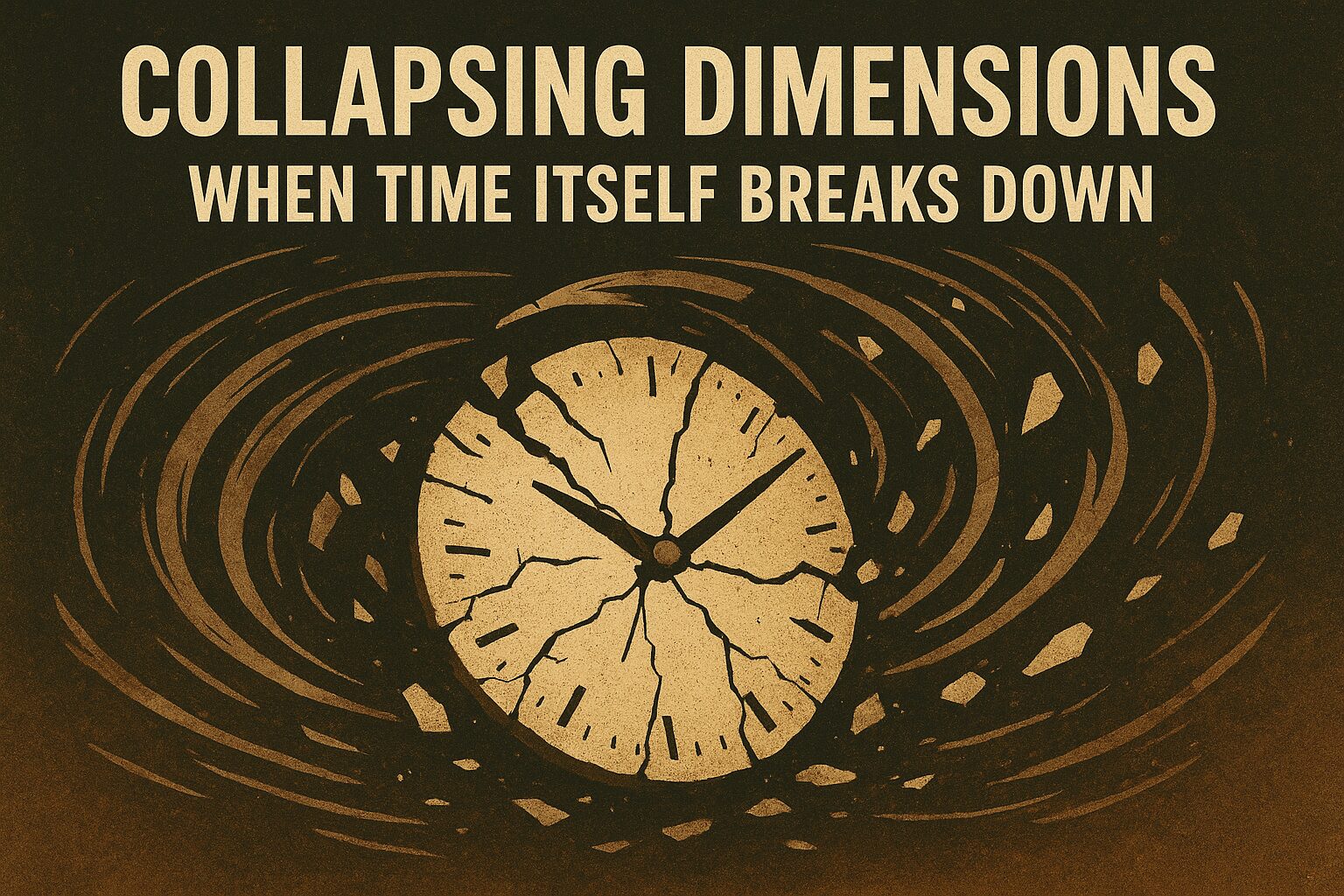
    Time, as one of the fundamental axes in our universe, governs every aspect of our reality. It marches inexorably forward, setting the rhythm for birth, growth, decay, and ultimately, death. Yet, physicists and philosophers have long pondered what happens when time itself begins to falter, potentially collapsing and breaking down. This article seeks to explore such phenomena, examining both theoretical underpinnings and their implications.

    The Nature of Time: A Brief Overview

    Time is often perceived as a constant progression, a straight line moving from past to future. Theoretical physicist Albert Einstein transformed our understanding of time with his theory of relativity, which merged time with the three spatial dimensions into a single four-dimensional continuum: spacetime. According to Einstein, time is relative and can be warped by gravity, leading to the proposition that time could potentially collapse under certain conditions.

    “The distinction between the past, present, and future is only a stubbornly persistent illusion.” — Albert Einstein

    Conceptualizing Time Collapse

    In physics, a collapse of time could be viewed metaphorically through black holes and singularities, where the usual flow of time ceases to apply. Within a singularity, the gravitational pull is so immense that it distorts spacetime to such an extent that the conventional timeline vanishes. As Stephen Hawking illustrated in his theories, at the singularity at a black hole’s core, all known laws of physics break down.

    • Singularities: In a singularity, densities become infinite, and thus, temporal dimensions no longer function as we understand.
    • Event Horizon: This is the boundary surrounding a black hole beyond which no information can escape, indicating a boundary of time as well.

    From a quantum mechanics perspective, the breakdown of time can also be theorized through the quantum theory of gravity, which seeks to reconcile general relativity with the principles of quantum mechanics.

    Speculative Scenarios: Time as a Collapsing Dimension

    Time Reversal and Entropy

    The second law of thermodynamics, asserting that entropy or disorder tends to increase over time, implies a directionality to time. Some scientists propose situations where this arrow of time could potentially reverse. For example, should the universe undergo a cyclical pattern of expansion and contraction (the “Big Bounce” theory), time might reverse its course in the contracting phase.

    “In a hotter, far-distant future, the universe might begin to behave very differently, with decreasing entropy causing time to run backward.” — Scientific American

    Parallel Universes and Dimensional Breakdowns

    Another speculative idea borrowed from the multiverse theory is that time could collapse or function differently across parallel universes. These universes might have entirely different physical laws, where time is a circle, a loop, or an entirely non-existent construct.

    • In string theory’s extra dimensions, the collapsing of time in one of these could significantly impact the entire fabric of cosmic order.
    • Quantum tunnels: Wormholes could theoretically allow for time travel or collapsing dimensions of time to fold onto themselves.

    Philosophical Implications

    The idea of time collapsing also presents numerous philosophical quandaries. Our perception of existence is intricately tied to the flow of time. If time can cease to exist or function in a fundamentally diverging manner, what implications would this have for concepts like causality, free will, and identity?

    • Causality: If future events can influence the past, the intricate dance of cause and effect dissolves into chaos.
    • Identity: Personal identity across time provides continuity to consciousness. A breakdown of time could shatter this cohesion.

    The philosopher and cognitive scientist Daniel Dennett suggests that how we reckon time is crucial to consciousness, positing that any significant alteration to time’s fabric might radically alter our self-awareness and perception of reality.

    “Our model of time is fundamental to the way we experience our consciousness and reality.” — Daniel Dennett

    Conclusion

    While the collapse of dimensions and time remains largely within the realm of theoretical physics and speculative philosophy, the very exploration of these ideas stretches our understanding of the universe and our place within it. The concept pushes the boundaries of human thought, challenging both scientists and philosophers to reevaluate the fabric of reality.

    As we continue to probe the depths of black holes, quantum fields, and potential multiverse paradigms, we edge closer to a more profound comprehension of time itself. Whether time can indeed collapse or break down remains one of the universe’s most tantalizing mysteries, urging us to explore further, think deeper, and remain curious.