Tag: faith

  • Guardian Angels or Inner Guides? A Psychological Perspective

    Guardian Angels or Inner Guides? A Psychological Perspective

    When it comes to dealing with life, most of us take a leap of faith in believing that a greater power will look after us. Some people call this belief an “Inner Guide”, while others might refer to it as a “Guardian Angel”. However, in the scientific sense, there are no concrete ways to prove the existence of either of these beliefs. Still, the truth may be found within ourselves, as every person has the ability to trust their intuition when it comes to choosing the right path. This article will explore some of the questions and answers surrounding faith and its implications in our daily lives.

    Many of us have an inner voice that speaks to us in the form of guidance, whether we call it intuition, our inner guide, or something else. Yet, there is one difference between faith in a higher power and faith in one’s own inner guidance. In the former, the voice is usually a religious or spiritual one. This is where the voice of the “Inner Guide” becomes more controversial. Many spiritual leaders claim that they can see the presence of this inner guidance. Some would say that the “Inner Guide” is their way of communicating with a higher power, but others are not so sure.

    Nevertheless, some people find it easier to trust their own inner voices over a religious one. This can help us in making difficult decisions, finding answers to problems, and in finding our own unique path in life. The concept of faith in oneself is a powerful one. This is because faith in oneself is the ultimate antidote to doubt. Doubt often comes from a lack of faith in oneself, so faith in oneself is an important step in overcoming that doubt.

    At the same time, the belief in a higher power can also come in many forms. For some, it is a deity, or a higher being such as a god or a goddess. Others see it as a belief in a “higher purpose” in life. Whatever beliefs we may hold, the concept of faith can be a powerful one. The “Inner Guide” or “Guardian Angel” can be a source of guidance in our lives, helping us to find answers to questions that we may have.
    In the end, faith in oneself is the key to unlocking the power of the “Inner Guide”. Yet, it may be that the “Inner Guide” also has something to offer us. In the end, the voice of the “Inner Guide” may be a whisper in our ears, a feeling that can come and go. It is up to each of us to decide which voice is the right one for us.

    In the end, the concept of faith can be a powerful one. Faith in oneself may be the ultimate antidote to doubt. Yet, faith in oneself may also be an important step in overcoming that doubt. At the same time, the concept of faith in a higher power may be a powerful one. The “Inner Guide” or “Guardian Angel” can be a source of guidance in our lives, helping us to find answers to questions that we may have.
  • Catholic Mysticism and the Jungian Shadow

    Catholic Mysticism and the Jungian Shadow

    In recent years, there has been a renewed interest in exploring the mystical dimensions of the Catholic faith. Scholars have increasingly recognized that, by understanding the mystical, we can gain insights into the religious dimension of the faith, particularly how it relates to contemporary life. This article will explore the connections between Catholic mysticism and the Jungian Shadow.

    The article begins by exploring the mystical dimension of the Catholic faith, which has been largely ignored in the past. It examines the nature of mystical experience in the tradition of St. John of the Cross, before moving on to consider contemporary applications of mystical theology in the works of James Hillman, John Paul II, and Eugene B. McLean. The article goes on to explore how the Jungian Shadow relates to this mystical dimension, before considering a number of contemporary mystics and their experiences.

    The article concludes by emphasizing the importance of the mystical dimension in the Catholic faith, particularly in relation to contemporary life. While the mystical dimension is often ignored or downplayed, this article argues that it has profound relevance for understanding both our own spiritual lives and our place in the world.
    User

  • Angelic Names and Their Hidden Meanings

    Angelic Names and Their Hidden Meanings

    The angels are among the most beautiful and mysterious aspects of the universe. They are celestial beings that are often depicted in paintings, sculptures, and architecture. The concept of angels is an ancient one and many cultures around the world have their own beliefs about them. Their names are often linked to the divine, and they are seen as symbols of faith and hope.

    The meaning of an angel name may be linked to the personality of the individual, their spiritual beliefs, or to their upbringing. In some cases, they may be chosen for their associations with a particular religion or culture. Angels can also be a source of inspiration and have been used to generate poetry and literature for centuries.

    The following article looks at a selection of different names and their possible meanings. Some of the meanings may be derived from spiritual traditions, while others are more common in popular culture. By looking at these meanings, one can gain a greater understanding of their own faith and spirituality.
    User

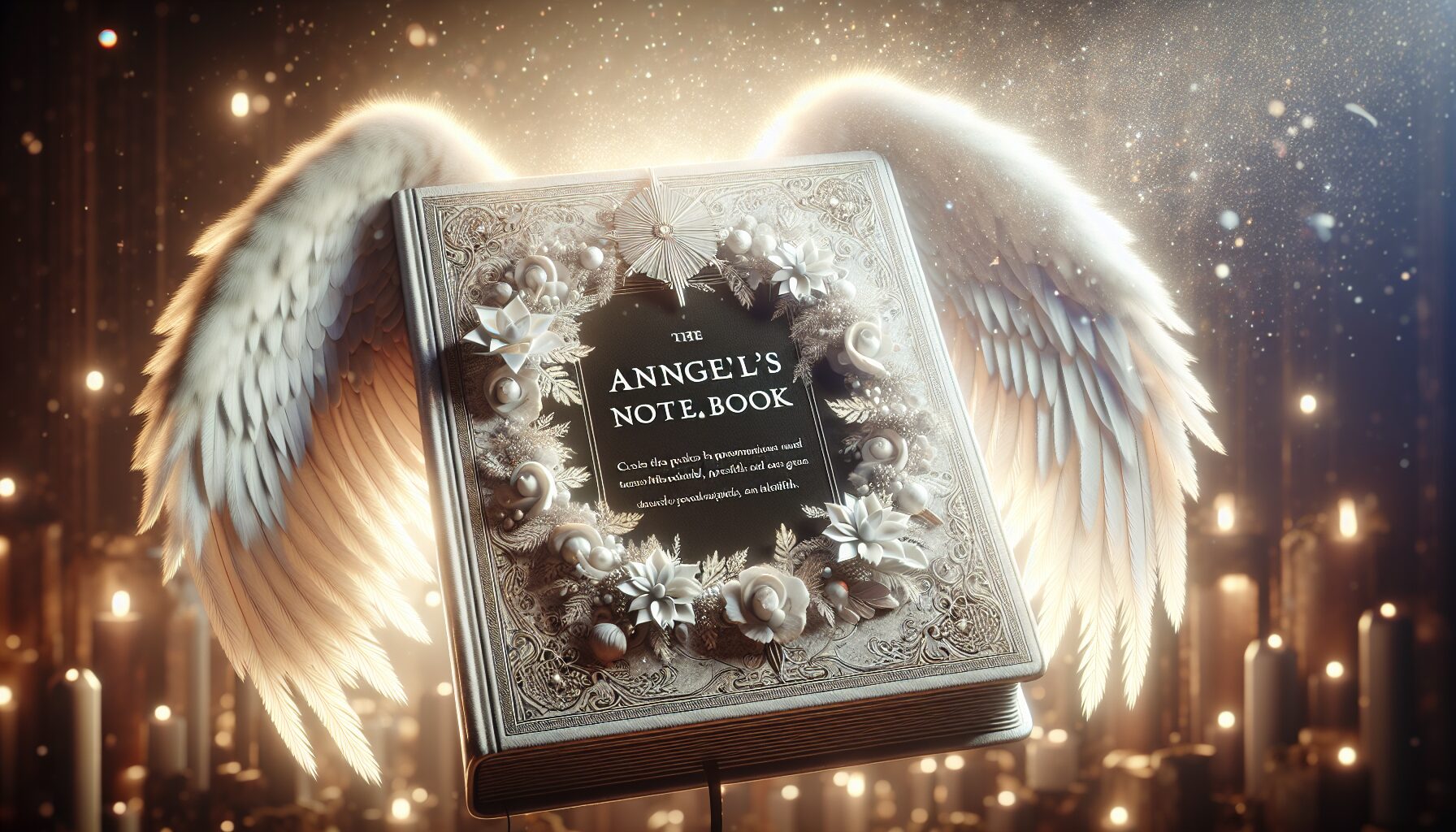
  • The Angel’s Notebook: Sketches of Ephemeral Faith

    The Angel’s Notebook: Sketches of Ephemeral Faith

    The Angel’s Notebook: Sketches of Ephemeral Faith

    The Angel’s Notebook: Sketches of Ephemeral Faith

    The concept of faith, much like the ephemeral sketches within an angel’s notebook, is both transient and profound. It reflects a myriad of human experiences, capturing the essence of existential uncertainties and the quest for a deeper understanding of the universe. This notion of faith is not static but evolves, influenced by personal and collective experiences, societal changes, and the ever-shifting sands of time.

    The Ambivalence of Faith

    Faith, in its essence, is a belief that transcends empirical evidence and rational comprehension. It is an acceptance of the unknown, an inner conviction that stands resolute even in the face of uncertainties. As Martin Luther King Jr. aptly remarked, “Faith is taking the first step even when you don’t see the whole staircase.” This highlights faith’s inherent ambivalence—its strength lies in its vulnerability to the unknown.

    Like an angel drawing fleeting sketches, faith often manifests in intangible forms—each person experiences it uniquely. Whether through religious practice, spirituality, or personal philosophy, faith represents a commitment to a perceived truth, regardless of its indiscernibility.

    Faith and Reason: A Perennial Conflict

    “Faith indeed tells what the senses do not tell, but not the contrary of what they see. It is above them and not contrary to them.”

    Blaise Pascal

    The conflict between faith and reason has been a longstanding debate within philosophical discourse. While faith relies on a personal belief in the absence of empirical proof, reason demands evidence and logic. This dichotomy is often portrayed as a battle between two opposing forces. Yet, it is perhaps more accurately seen as a complex interplay, where both can coexist and even complement each other.

    Pascal, through his famous Pascal’s Wager, suggests that faith is a pragmatic choice amidst uncertainty, a bet that carries potential infinite rewards. Here, faith emerges as a rational decision in light of the vast unknown, suggesting a harmonious relationship between belief and logic.

    The Ephemeral Nature of Faith

    Much like the fleeting nature of a sketch, faith is often subject to change and reinterpretation. Life’s experiences continuously reshape our beliefs, challenging and refining them. The angel’s notebook is thus never complete, an ongoing work in progress, each sketch a representation of a momentary understanding.

    In moments of doubt, faith may seem to wane, mirroring the ephemeral quality that defines human existence. Yet, each challenge encountered also provides an opportunity for faith to be rediscovered and reinforced. As Viktor Frankl noted in Man’s Search for Meaning, “What is to give light must endure burning.” Through life’s trials, our faith is tested and our understanding deepened.

    Sketches of Belief in Modern Times

    In contemporary society, the nature of faith continues to evolve. The rise of secularism, advancements in science, and the increasing complexity of global cultures have influenced traditional religious practices and belief systems. However, this does not necessarily imply a decline in faith but rather a transformation of how it is expressed and perceived.

    • Many turn to personal spirituality, constructing individualized belief systems that integrate aspects of various philosophies and religions.
    • The digital age has also fostered new communities of faith, where people connect over shared beliefs in virtual spaces, bridging geographical divides.
    • Moreover, humanitarian and ecological movements have inspired a form of faith centered on communal and environmental stewardship.

    Conclusion: Embracing the Transience

    Ultimately, the sketches within the angel’s notebook remind us that faith is an ever-evolving journey. It is a personal narrative, intertwined with the collective human experience, adapting to the challenges and changes of life. In embracing the transient nature of faith, one finds not only comfort but also a profound understanding of the self and the universe.

    Thus, as each sketch is drawn and redrawn, it becomes clear that the beauty of faith lies not in its permanence but in its ability to reflect the dynamic human spirit.

  • Fragments of Faith: Short Essays

    Fragments of Faith: Short Essays

    You need to be logged in to view this content. Please . Not a Member? Join Us