Tag: life

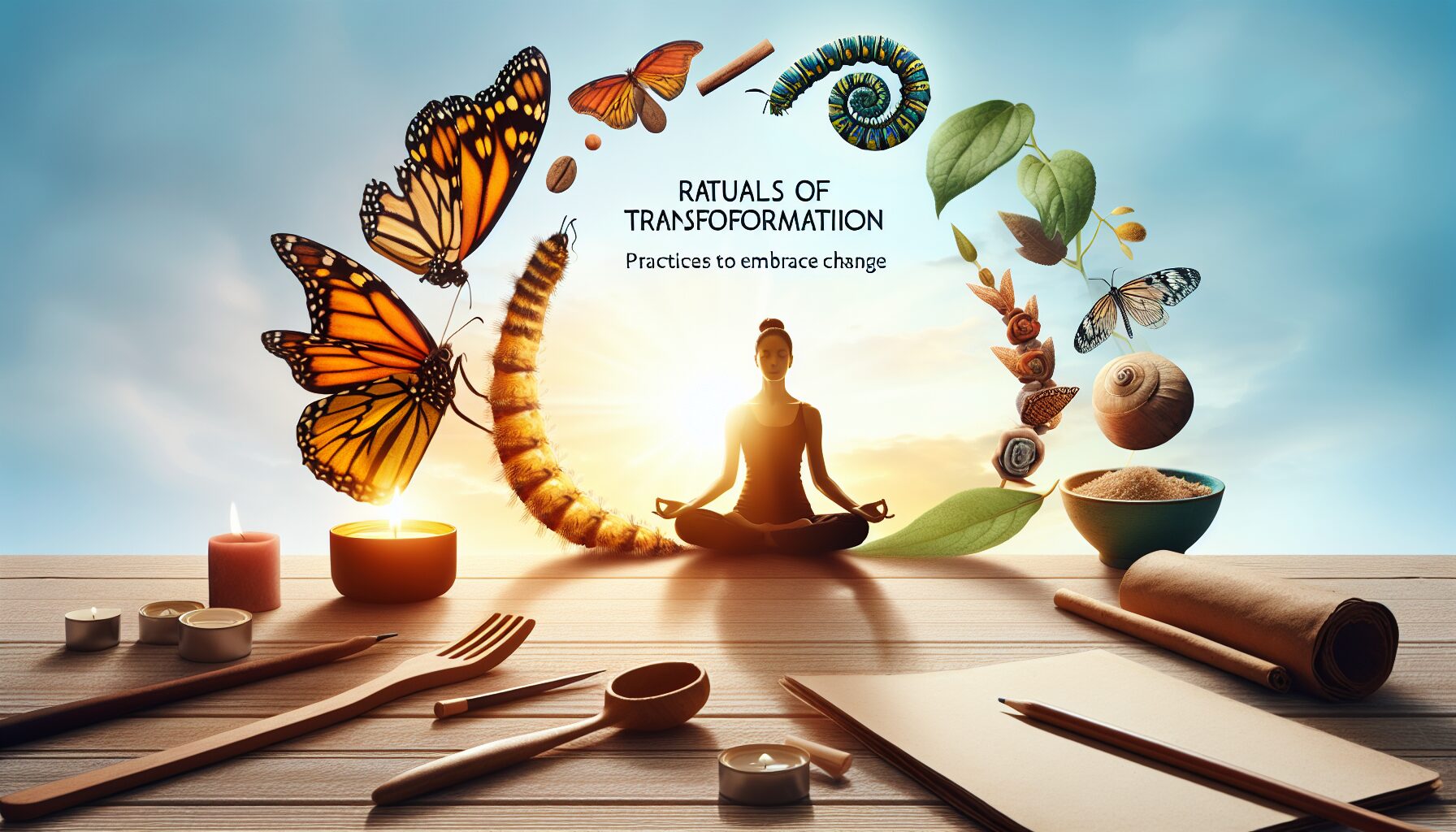
  • Rituals of Transformation – Practices to Embrace Change

    Rituals of Transformation – Practices to Embrace Change

    Throughout human history, rituals have played a vital role in helping individuals and communities transition through periods of change. Whether it’s a significant life event or a subtle personal transformation, these practices offer a structured approach to embrace new beginnings and let go of the past.

    The Power of Rituals

    Rituals provide a sense of comfort and stability amid change. They often involve symbolic actions designed to convey personal values or goals. Margaret Mead, the famous cultural anthropologist, once said,

    “Rituals are the way we carry the thoughts and traditions from one generation to another.”

    They help anchor us, creating an intentional space for reflection and growth.

    Rituals for Personal Transformation

    • Journaling: This is a personal favorite for many undergoing transformation. Set aside time each day to document your thoughts, feelings, and progress. According to a study published in the Journal of Personality and Social Psychology, journaling can lead to improved well-being and clarity during times of change.
    • Meditation: As change can bring stress and anxiety, meditation serves as a calming practice. Engaging in mindfulness can help stay grounded and focused. Mindful.org offers a wealth of resources to guide you through starting your meditation practice.
    • Burning Ceremonies: Many cultures hold burning ceremonies as a way of releasing old patterns or negative energies. By writing down thoughts or worries and literally turning them to ash, individuals can symbolically let go of the past.
    • Nature Walks: Disconnect from the hustle and bustle of daily life and reconnect with nature. Being outdoors has profound effects on mental health and can aid in the transition process.

    Community-Based Rituals

    Communal rituals often support collective change and transformation. They can be formal or informal but always bring people together to share experiences and create bonds.

    • Potlucks and Gatherings: Sharing meals and stories fosters community and belonging. You can celebrate milestones or simply be there for one another during challenging times.
    • Seasonal Ceremonies: Many cultures hold events to mark the changing of the seasons. These ceremonies remind us that change is natural and cycle-based, offering opportunities to set new intentions.
    • Group Meditation or Yoga: Engaging in shared meditation or yoga practices amplifies the transformative energies and promotes a sense of common purpose and support.

    Global Rituals of Change

    Certain rituals have gained widespread recognition for their effectiveness in facilitating change.

    • Vision Quests: Originating from Indigenous cultures, vision quests involve a period of solitude in nature meant for reflection and gaining insight about one’s path forward.
    • Rites of Passage: Cultures worldwide celebrate passages from one stage of life to another with elaborate rituals. Whether it’s a bar mitzvah, a quinceañera, or graduation, these rites play an essential role in acknowledging transformation.
    • Fasting or Cleansing Rituals: Used by many religions and spiritual practices, fasting or cleansing can purify the body and mind, aligning them for new insights and directions.

    Embracing the Unknown with Grace

    Facing change is never easy, but rituals offer a structured way to navigate the unknown. As Joseph Campbell noted in his exploration of the hero’s journey,

    “The cave you fear to enter holds the treasure you seek.”

    By embracing rituals, we aren’t just marking a momentary shift; we are stepping forward with intention and courage.

    These practices, whether personal or communal, allow us to process transitions effectively. By honoring these sacred actions, we become attuned to the rhythms of life, embracing its inherent changes with grace and wisdom. As the Navajo say,

    “Bless the way as you walk the path.”

    To dive deeper into building and incorporating rituals into your own life, consider exploring resources at Rituals.com or joining community circles that focus on healing and transformation.

    In conclusion, although change can be daunting, approaching it through transformative rituals provides grounding and support. As we navigate the many changes life presents, these practices offer a potent reminder of our resilience and capacity for growth.


  • Shadows in Time – Meditations on Mortality and Legacy

    Shadows in Time – Meditations on Mortality and Legacy

    Shadows in Time – Meditations on Mortality and Legacy

    Shadows in Time – Meditations on Mortality and Legacy

    In the grand dance of the cosmos, human life is but a fleeting shadow. As we traverse the stages of existence, the twin specters of mortality and legacy cast their inescapable silhouettes. While our physical presence is transient, our impact abides much longer, echoing through time in ways both profound and minute.

    “The life of the dead is placed in the memory of the living.” — Marcus Tullius Cicero

    This reflection from Cicero underscores the essence of legacy. Our deeds, words, and actions live on in the stories that are told about us and by us. They form a narrative tapestry that intertwines with those of others, creating a collective history—a shared memory that defies the passage of time.

    Navigating Mortality

    • Understanding mortality is not merely an acceptance of life’s end, but an embrace of life’s potential.
    • It encourages us to live more fully, with greater intentionality and purpose.
    • Mortality invites us to prioritize what truly matters, to forge connections, and to seek joy in the present moment.

    Crafting a Legacy

    • A legacy is not just what we accomplish, but also the values we impart and the lives we touch.
    • Acts of kindness, mentorship, and love are enduring markers of our presence in the world.
    • To build a meaningful legacy is to contribute to something larger than ourselves, to have a lasting impact.

    In reflecting on our place in the world’s tapestry, we find solace and purpose. The shadows of mortality and legacy, instead of haunting us, inspire us. They remind us that though our physical journey is finite, the imprint we leave is eternal.

    “Carve your name on hearts, not tombstones. A legacy is etched into the minds of others and the stories they share about you.” — Shannon Alder

    As we walk our path, let us consider how our shadows will dance in the memories of generations to come, for therein lies the truest measure of our lives.

  • Veils of Mortality – Contemplating Life and Death

    Veils of Mortality – Contemplating Life and Death

    In the inevitability of life’s journey, one finds themselves facing the daunting concept of mortality. The mysterious veil that separates life from death incites both fear and fascination, prompting humankind to ponder the essence of existence and the legacy we leave behind. Throughout history, philosophers, scholars, and artists have sought to explore and understand this duality that defines our being.

    The Philosophical Perspective

    Philosophy has long debated the nature of life and death, with thinkers like Socrates suggesting that philosophy itself is a preparation for dying. Socrates, in Phaedo, famously proposed:

    “To fear death, my friends, is only to think ourselves wise, without being wise: for it is to think that we know what we do not know.”

    His argument hints at the limits of human understanding, urging us to view death not as an end, but as a continuum of existence beyond our current comprehension.

    Later, existentialists like Jean-Paul Sartre confronted death with a stark realism. Sartre declared,

    “Death is a part of my being, as inevitable as life itself.”

    In this outlook, death becomes an implicit force that shapes our choices, instilling a profound responsibility to live authentically. For existentialists, acknowledging mortality is key to understanding purpose and forging a life true to oneself.

    The Cultural Enigma

    Across cultures, rituals surrounding life and death reveal a diverse mosaic of beliefs and customs. In Mexican culture, Dia de los Muertos is a celebration that honors deceased loved ones, emphasizing the cyclical nature of life and death. This vibrant festival, as described by Caitlin Doughty in her book From Here to Eternity, highlights the belief that the dead can return to share in revelry with the living, breaking the somber taboo often associated with passing.

    In contrast, the Tibetan Buddhist Bardo Thodol, commonly known as the Tibetan Book of the Dead, provides guidance for the deceased as they transition through the Bardo, the state between death and rebirth. This text underscores the spiritual perspective that life flows into death and beyond, transcending the physical world.

    The Psychological Dimension

    Psychologists approach death awareness from a different angle, investigating its influence on behavior and mental health. The Terror Management Theory (TMT) posits that we manage our existential dread by clinging to cultural beliefs and individual self-esteem as buffers. A study conducted by Greenberg et al. suggested that reminders of mortality can bolster identity and culture, thereby improving individuals’ mental resilience.

    This knowledge fosters a more comprehensive understanding of how death awareness can have both negative and positive psychological effects, urging us to consider how we channel our energy and influence the world around us.

    Artistic Interpretations

    Art, in its myriad forms, often reflects humanity’s grappling with mortality. The delicate balance between life and death is captured poignantly in Edvard Munch’s painting The Dance of Life, where figures twirl on the brink of oblivion, capturing a dynamic tension between joy and the inevitable conclusion.

    Literature, too, provides a canvas for contemplation. In William Shakespeare’s Hamlet, the titular character quips in his famous soliloquy,

    “To be, or not to be: that is the question.”

    Through Hamlet’s existential musings, Shakespeare interrogates the value of life and the relief—or potential torment—death may bring.

    Conclusion

    As we peel back the veils of mortality, one truth emerges: life and death are intertwined, each defining the other. To contemplate mortality is to engage with the fundamental truths of our existence and to seek a deeper understanding of what it means to live.

    The fear of the unknown can be daunting, yet it is within this fear that the potential for profound insight and compassion lies. By embracing the transience of life, perhaps we find the courage to live more fully, to love more deeply, and to leave our mark in the ephemeral sands of time.

  • The Obscure Mind – Dark Philosophy for Modern Thinkers

    The Obscure Mind – Dark Philosophy for Modern Thinkers

    In the midst of 21st century’s light-speed technological advancements and glittering positivity, there exists a shadowy corner of thought known as dark philosophy. It is an arena where thinkers grapple with the limitations of human existence, the meaninglessness of life, and the inevitability of death. For those brave enough to venture into the depths of the obscure mind, dark philosophy offers a unique perspective often overlooked by mainstream philosophical ideals.

    Understanding Dark Philosophy

    Dark philosophy, at its core, challenges the very essence of what it means to live a fulfilling life. It grapples with themes such as nihilism, existentialism, and pessimism. While these concepts might seem bleak or even daunting, they provide a much-needed counterbalance to the relentless pursuit of happiness and optimism that pervades modern society. Here are some fundamental aspects:

    • Nihilism: Originating from Latin nihil meaning “nothing”, nihilism posits the belief that life is without objective meaning, purpose, or intrinsic value. Prominent philosopher Friedrich Nietzsche, known for declaring “God is dead,” believed that life should be lived for the moment as there is no universal moral system.
    • Existentialism: Thinkers like Jean-Paul Sartre and Albert Camus explored how individuals must find meaning within themselves, rejecting predetermined definitions imposed by society. Sartre famously stated, “Man is condemned to be free,” emphasizing personal responsibility in creating one’s own purpose.
    • Pessimism: As a philosophical attitude, it generally suggests that the perceived world is fundamentally flawed and fraught with suffering. German philosopher Arthur Schopenhauer argued that human desires are inherently unattainable, leading to frustration and disillusionment.

    The Modern Resonance of Dark Philosophy

    In today’s fast-paced world, dark philosophy resonates with many who feel disillusioned by conventional measures of success and happiness. Here are reasons why this school of thought appeals to modern thinkers:

    “We love life, not because we are used to living but because we are used to loving.” – Friedrich Nietzsche

    • Rejection of Superficiality: As society becomes increasingly materialistic, dark philosophy offers an escape by emphasizing deeper, often uncomfortable truths over fleeting pleasures and superficial achievements.
    • Understanding Suffering: By confronting suffering rather than avoiding it, individuals can attain resilience and profound insight. For instance, Camus’ notion of the ‘absurd’ illustrates the inherent contradictions in human existence which, when embraced, empowers individuals to live authentically.
    • A Sense of Liberation: The acceptance of life’s inherent meaninglessness grants a freeing sense that allows one to explore possibilities unfettered by societal expectations. As philosopher Lars Svendsen notes, “Meaning has become a matter of choice,” giving individuals the power to define their existence.

    Challenges and Misconceptions

    Despite its avant-garde appeal, dark philosophy faces numerous challenges and misconceptions:

    • Misperceived as Cynical: Many dismiss dark philosophy as cynical or nihilistic, overlooking its potential to evoke positive thinking through acceptance and personal empowerment.
    • Emotional Strain: Confronting one’s darkest thoughts can be emotionally taxing, leading some to retreat into denial or despair rather than acknowledging and working through existential anxieties.
    • Intellectual Elitism: The often complex and challenging nature of dark philosophical texts may be perceived as exclusive or inaccessible, alienating those unfamiliar with its intricacies.

    Dark Philosophy in Action

    For those intrigued by dark philosophy’s allure, practical application is key. Here’s how one might integrate its principles into daily life:

    • Embrace Solitude: Set aside time for introspection and solitude to explore your thoughts and feelings without external influence.
    • Meditative Practices: Employ mindfulness and meditation techniques to foster acceptance of life’s unpredictability and transience.
    • Creative Outlets: Use art, writing, or music as means to express and process complex emotions stirred by dark philosophical themes.

    Ultimately, dark philosophy challenges us to face the shadows within ourselves and the world around us, offering an unflinching examination of human nature and existence. For the modern thinker, it is a call to authenticity, resilience, and profound reflection—a path less traveled, yet rich with transformative potential.

    “The world breaks everyone, and afterward, some are strong at the broken places.” – Ernest Hemingway

    While embracing the ideas of dark philosophy may not lead to conventional happiness, it opens up a realm of possibility that allows for deep personal growth and a raw, unvarnished appreciation of life.

  • Ash and Spirit – Transformation Through Mortality

    Ash and Spirit – Transformation Through Mortality

    Ash and Spirit – Transformation Through Mortality

    Ash and Spirit – Transformation Through Mortality

    Throughout history, humans have been deeply fascinated by the concepts of mortality and the spiritual transformation that many believe accompanies our physical end. The juxtaposition of ash and spirit embodies this profound connection between life’s ephemeral nature and the enduring mysteries of the afterlife. This idea has found expression in numerous cultural, religious, and philosophical traditions around the globe.

    The Symbolism of Ash

    Ash, primarily the residue of fire, symbolizes both destruction and purification. In Hindu spirituality, sacred ash (vibhuti) is often used as a symbol of the transitory nature of life. According to Hindu beliefs, applying ash on the body reminds individuals of the ephemeral nature of worldly pleasures and attachments.

    “From dust you came, and to dust you shall return.” — Biblical saying

    This iconic biblical sentiment underscores that life, ultimately, returns to its simplest earthly form. Ash is often seen as a stark reminder of mortality, yet it can equally represent renewal, as it enriches the soil and fosters new life.

    Spirit and the Idea of Transformation

    While ash reminds us of physical mortality, the concept of the spirit introduces the possibility of life beyond death. Many religious traditions suggest that the transformation through mortality is not an end but a metamorphosis into a higher form of existence. This transformation can be seen as a journey, a path toward understanding that transcends earthly limitations and gains significance in profound spiritual growth.

    Traditions Across Cultures

    • Ancient Egyptian Beliefs: The Egyptians believed in a vivid conception of the afterlife where the spirit (ka) would embark on a journey to the afterworld. This belief was so profound that immense resources were devoted to building grand tombs to ensure the ka’s safe passage.
    • Buddhist Perspective: Buddhists view life as a cycle of birth, death, and rebirth, with the ultimate goal of reaching Nirvana. Death is not an end but a transition to another phase in the journey towards enlightenment.
    • Native American Views: Many Native American tribes hold the belief that death is part of a natural cycle, with the spirit living on after the body’s death, transforming into forms that become part of the cosmic harmony.

    Philosophical Contemplations on Mortality

    Philosophy has long grappled with the concept of mortality. Existentialists, like Jean-Paul Sartre, have explored the meaning and consequences of death. Sartre’s existential philosophy views death as the ultimate freedom, where individuals face their true essence without the masks imposed by societal roles.

    “Death is not the opposite of life, but a part of it.” — Haruki Murakami

    Haruki Murakami, a contemporary literary figure, illustrates death as an integrated aspect of life rather than its conclusion. This view promotes the idea that understanding and accepting one’s mortality enriches the appreciation of life’s fragile beauty.

    Transformation Through Personal Mortality

    It is often in the face of mortality that individuals undergo profound transformations. Personal experiences with loss and the contemplation of one’s mortality can catalyze deep spiritual and personal growth. Such transformations can lead to a greater appreciation of life, stronger relationships, and a pursuit of meaningful connections with the world.

    A Sacred Transition

    Several rituals around the world help in the personal transformation following a loss. These rituals serve as a medium to honor the departed and as a catalyst for the living to deepen their understanding and acceptance of death’s role in the tapestry of life.

    • Dia de los Muertos: In Mexican culture, the Day of the Dead is a vibrant celebration that remembers and honors the deceased. It fosters a sense of connection and continuity between the living and the dead, emphasizing that death is but another stage of life.
    • Samhain: Celebrated by ancient Celts, Samhain marks the end of the harvest season and heralds the darker half of the year. It’s a time when the boundary between the worlds is thin, allowing spirits to pass through and reminding the living of the cycle of life and death.
    • Japanese Obon: A festival to honor the spirits of one’s ancestors, Obon is a reflective time allowing families to pay respects and receive visits from their departed loved ones, creating an enduring spiritual bond.

    Scientific Perspectives and Transformations

    Modern science, while often regarded as separate from spiritual and religious beliefs, also explores mortality and transformation. The field of Thanatology, the study of death and practices associated with it, considers the biological and psychological aspects of death, alongside its impact on the living. Some scientists explore the potential for life after death in the realm of quantum physics, although solid evidence remains elusive.

    In his book Death/Summer Interrupted, Stephen Cave refers to these scientific explorations as part of humanity’s continuous journey to understand, cope with, and transcend mortality.

    Conclusion

    The journey from ash to spirit is a narrative as old as humanity itself, a story that echoes across cultures and beliefs. Through understanding and embracing our mortality, we uncover moments of profound spiritual clarity and transformation. In the face of death, we often find the essence of what it means to truly live.

    Transformations through mortality, whether viewed through the lens of spiritual traditions, philosophical inquiry, or scientific exploration, enrich our lives and encourage a deeper appreciation for the mystical cycle of life.

  • Twilight Archetypes – Mythcore Symbols for Modern Life

    Twilight Archetypes – Mythcore Symbols for Modern Life

    In an era where the lines between the digital and tangible worlds blur, the rise of mythcore offers a fascinating look into how ancient symbols continue to permeate modern consciousness. Twilight archetypes, those shadowy figures and mythic motifs, are enjoying a renaissance, capturing the imagination of a generation seeking depth and meaning.

    The Power of Archetypes

    Archetypes are universally understood symbols or behavior patterns that recur in stories across different cultures and eras. They serve as a bridge between the conscious mind and the collective unconscious, as posited by Carl Jung. According to Jung, “Who looks outside, dreams; who looks inside, awakes” (source: Carl Jung). In this context, archetypes invite us to explore our inner worlds, connecting us with universal human experiences.

    Key Mythcore Symbols

    • The Wanderer: Embodying both curiosity and restlessness, the wanderer seeks to embrace the journey itself. In mythcore, this archetype symbolizes a perpetual quest for knowledge and self-discovery, encouraging us to venture beyond our familiar boundaries.
    • The Shadow: Often depicted as the antagonist in stories, the shadow represents our repressed fears and desires. Today, embracing the shadow helps us confront personal and societal issues that need transformation.
    • The Muse: A source of inspiration and creativity, the muse archetype reminds us of the beauty and unpredictability of life. As more individuals pursue creative ventures, the muse becomes an essential symbol in our narratives.

    Relevance in Modern Culture

    Mythcore as a movement has found its place in artistic expressions, fashion, and digital culture. Platforms like Instagram and Pinterest are replete with imagery that draws on these archetypes, creating a sense of nostalgic yet contemporary mythos. This aesthetic embraces a world where past and present effortlessly coexist, allowing people to craft new identities that resonate with ancient motifs.

    “Myths are public dreams, dreams are private myths.” — Joseph Campbell

    As Joseph Campbell elucidated, these symbols guide us in understanding the shared psychological and cultural frameworks that shape our personal and collective narratives. In a world yearning for meaning, twilight archetypes offer a pathway to engage with our rich mythological past in the modern context.

    Conclusion

    Twilight archetypes and mythcore symbols serve as a toolkit for navigating contemporary life. By engaging with these timeless motifs, we not only connect with our historical roots but also find new ways to articulate our evolving identities. As the mythcore movement reinforces, the ancient and the modern are not disparate; they are facets of the same, ever-turning wheel of human experience.

  • Ash and Light – Dualities of Mortality and Transcendence

    Ash and Light – Dualities of Mortality and Transcendence

    You need to be logged in to view this content. Please . Not a Member? Join Us
  • Twilight Philosophy – Dark Reflections on Life and Meaning

    Twilight Philosophy – Dark Reflections on Life and Meaning

    You need to be logged in to view this content. Please . Not a Member? Join Us
  • Decay and Beauty – Finding Aesthetics in the Ephemeral

    Decay and Beauty – Finding Aesthetics in the Ephemeral

    You need to be logged in to view this content. Please . Not a Member? Join Us
  • Angels and Ash – Symbolism of Death and Renewal

    Angels and Ash – Symbolism of Death and Renewal

    You need to be logged in to view this content. Please . Not a Member? Join Us