Tag: such
-
The Hidden Texts – Unearthing Forgotten Philosophical Works
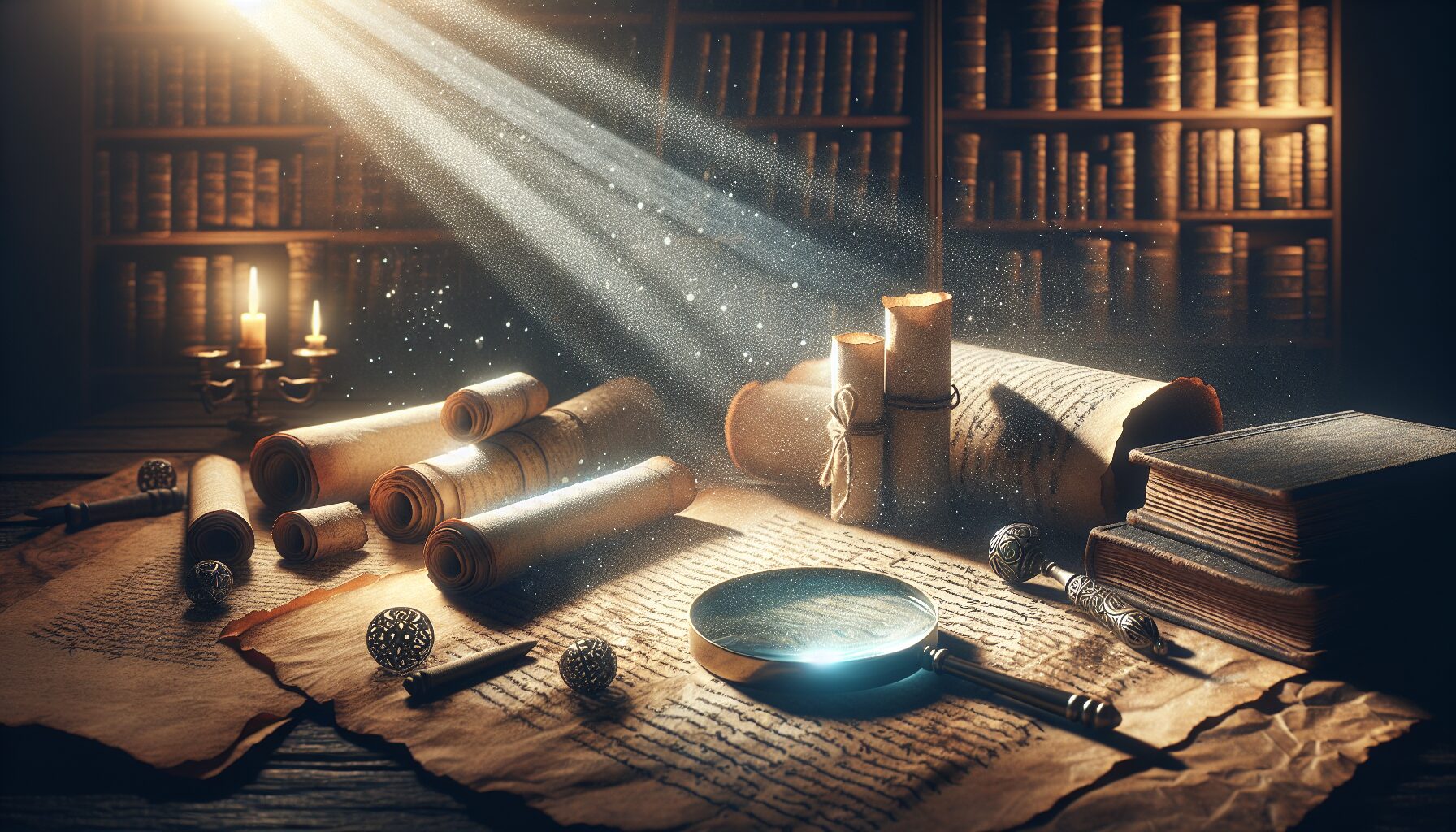
The annals of philosophy are rich and varied, yet not all contributions have basked in the public’s consciousness. Many philosophical works have lingered in obscurity, overshadowed by more celebrated counterparts. However, the tides are changing, and scholars are now diligently unearthing these forgotten texts, shedding light on their profound contributions to human thought.
Unveiling the Obscured
One such work includes the writings of Hypatia of Alexandria, a renowned philosopher, astronomer, and mathematician who thrived during the decline of the Roman Empire. While much of her work was lost due to tumultuous times, recent scholarly efforts have pieced together fragments from references in the writings of her contemporaries, such as Socrates Scholasticus.
“Reserve your right to think, for even to think wrongly is better than not to think at all.” – Hypatia
Hypatia’s emphasis on scientific rigor and philosophical inquiry is finding newfound appreciation in modern academics, making her a venerated figure in the history of ideas.
Rediscovering Eastern Philosophers
The philosophical contributions of the East have long been underrepresented in mainstream discourse. However, a surge in interest has brought to light works such as those of Avicenna. His renowned text, The Book of Healing, offers a compendium of his thoughts on logic, ethics, and metaphysics. Avicenna’s ideas laid the groundwork for many Western thinkers, influencing figures such as Thomas Aquinas.
“The knowledge of anything, since all things have causes, is not acquired or complete unless it is known by its causes.” – Avicenna
Avicenna’s influence underscores the interconnectedness of philosophical thought across cultures and eras.
The Power of Translation and Technology
Recent technological advances and translation projects have played a crucial role in bringing forgotten texts back to life. Organizations like Stanford’s Encyclopedia of Philosophy and the Internet Encyclopedia of Philosophy continue to broaden the horizon by making these works more accessible to a broader audience.
As we continue to unearth these hidden texts, we find that they often challenge the traditional narratives. This renewed interest is not merely academic curiosity; it is an invitation to re-evaluate and expand our understanding of the philosophical landscape, adding depth and diversity to conversations that shape contemporary thought.
In doing so, we not only honor the legacies of these thinkers but also enrich our own ongoing philosophical journey.
-
The Clockwork Spirit: Time and the Supernatural
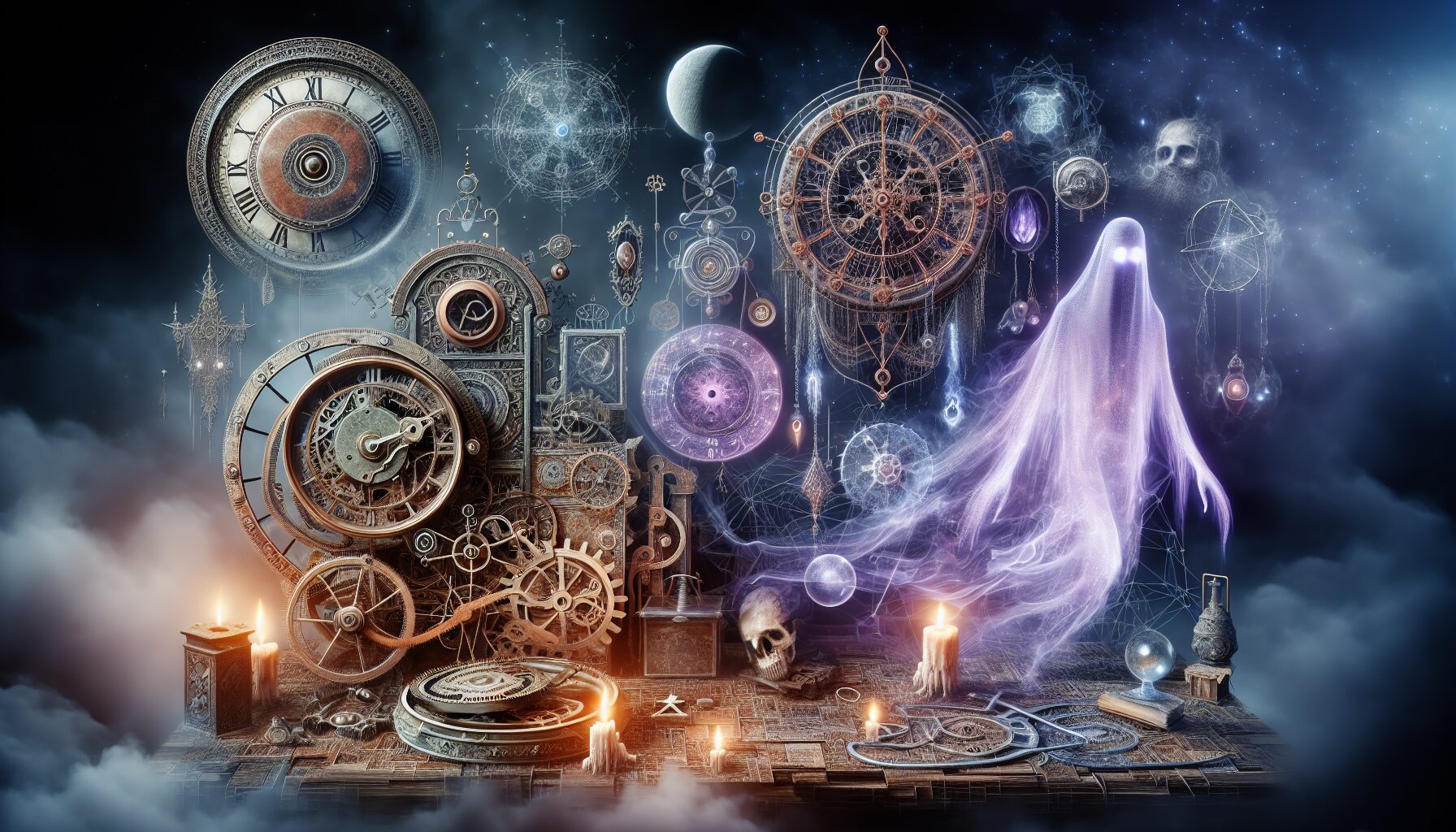
The intricate dance between time and the supernatural has captured the human imagination for centuries. From the echoes of ghostly footsteps in abandoned mansions to clocks that stop at the precise moment of death, tales of time intertwining with the supernatural continue to haunt and fascinate. This article delves into the many ways these two enigmatic forces have intersected throughout history and explores why they hold such a powerful grip on our collective consciousness.
The Ancient Roots of Time and the Supernatural
The connection between time and the supernatural can be traced back to ancient civilizations. The Egyptians, for instance, revered the afterlife and the concept of eternity, thus intertwining their funeral rites with celestial time as observed through the stars. The Great Pyramids themselves are believed to be aligned with the cardinal points and celestial bodies, serving as conduits between life, death, and the cosmos.
In ancient Greece, philosophers like Pythagoras and Plato theorized about time stretching beyond human mortality. Plato’s concept of the “timeless soul” suggested that our innermost essence is not confined to the linear progression of time—a notion that still resonates with many contemporary spiritual philosophies.
Timeless Legends and Folklore
Throughout history, folklore has been rich with stories where time plays a pivotal role in supernatural occurrences. Rip Van Winkle, a story written by Washington Irving, describes a man who falls asleep in the mountains for 20 years, waking up to a world that has moved on without him. This tale underscores the anxiety about time’s relentless march and its capacity to leave individuals stranded between different eras.
Many cultures have legends of time slipping or bending under the influence of the supernatural. The Faerie folk of Celtic mythology, for example, are believed to inhabit lands where time flows differently, allowing them to abduct humans who return only to find that decades have passed in the real world. Similarly, ghost stories often feature clocks stopping at the exact moment of a significant event, suggesting a reality where temporality is distorted by otherworldly forces.
The Victorian Era: A Time of Spiritual Exploration
The 19th century was a period of increased interest in supernatural phenomena, heavily influenced by the spiritualist movement. Victorians were fascinated by the idea of cycling between life and death, a theme mirrored in their literature. Charles Dickens’ A Christmas Carol is a quintessential example, where Scrooge experiences a nightmarish journey through time guided by spirits.
The growing popularity of seances during this era also revealed a longing to communicate across time with spirits. Mediums claimed the ability to bring forth voices from the past, igniting debates about the permeability of time and its boundaries.
Scientific Perspectives on Time and the Paranormal
In modern times, science has also investigated the concept of time in relation to supernatural phenomena. Albert Einstein’s theory of relativity revolutionized understanding by suggesting time is flexible, capable of being warped by speed and gravity. Some theorists propose that paranormal events might be explained by disruptions in the space-time continuum—places where the fabric of reality is temporarily altered, allowing glimpses into other times or dimensions.
“The only reason for time is so that everything doesn’t happen at once.” — Albert Einstein
While such ideas remain largely speculative, they open fascinating possibilities for why some individuals claim to witness ghosts or experience time slips. Could it be that these phenomena are not just figments of the imagination but reflections of Einstein’s theories in action?
Time-Haunted Places
Certain locations around the world are reputed to be hotspots where supernatural occurrences involving time are frequently reported. The Winchester Mystery House in California is one such place, with its labyrinth of unfinished rooms and staircases leading to nowhere, allegedly haunted by spirits trapped in time.
In England, the Ancient Ram Inn is notorious for being one of the most haunted buildings in the country, with stories of time anomalies and encounters with historical apparitions. These places add to the allure that time can be manipulated—or even disturbed—by supernatural forces.
Cultural Reflections in Modern Media
Today’s pop culture continues to explore the relationship between time and the supernatural. Films like Interstellar and television series such as Stranger Things and Doctor Who delve into time’s mysterious nature and its intersection with the beyond.
These stories often depict characters navigating timelines that rupture conventional boundaries, echoing eternal questions about our place in the universe and the nature of existence itself. Such narratives resonate powerfully with audiences, providing safe spaces to contemplate the mind-bending possibilities of time and spirituality interwoven.
A Never-Ending Fascination
Whether viewed through the lens of historical mythology, philosophical inquiry, or scientific hypothesis, the bond between time and the supernatural captivates human imagination across cultures and epochs. Our fascination with these themes reflects a broader quest to understand the universe, our place within it, and the ultimate mystery of existence beyond time.
As we continue to explore these questions, perhaps the answers will unfold in surprising ways, revealing that time and the supernatural are not just eerie companions in our stories but integral components of reality’s intricate design.
-
Songs of the Hollow: Sound Experiments
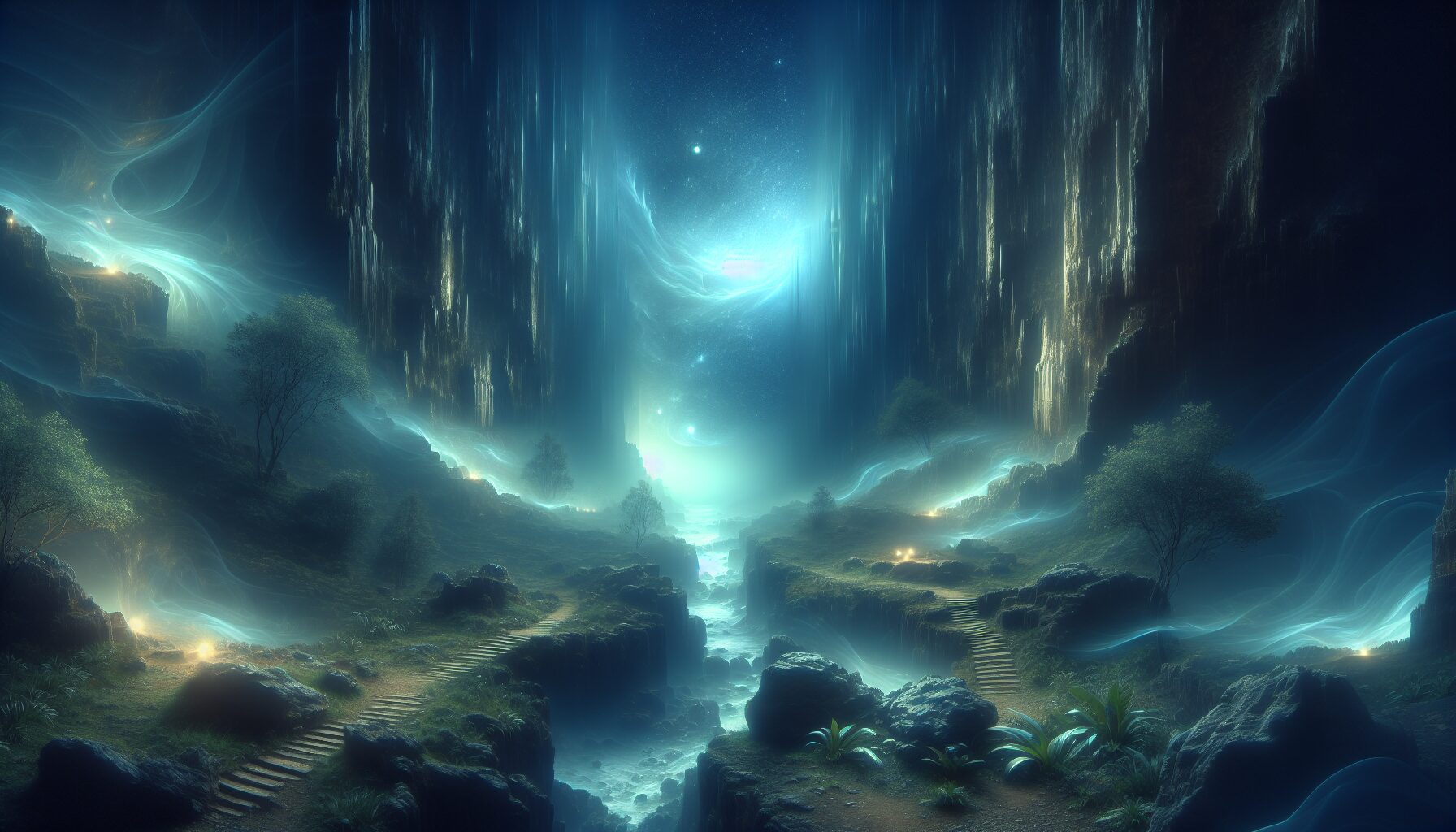
The concept of sound has always been a fundamental aspect of human culture and communication. In recent years, the exploration of sound experiments has expanded, leading to intriguing developments in the world of music and beyond. Songs of the Hollow delves deep into these aural landscapes, bringing forward innovations that challenge the conventional understanding of sound and its potential.
A New Era of Sound Exploration
Sound experiments are not new. Pioneers such as John Cage have long pushed the boundaries of what constitutes music. Cage once famously stated, “There is no such thing as an empty space or an empty time. There is always something to see, something to hear.” [source] This philosophy underlines much of the contemporary exploration into sound, where ambient noises and unconventional sources are taken as seriously as traditional instruments.
The Genesis of Songs of the Hollow
Songs of the Hollow emerges from this rich tradition of experimental sound. It was conceived not merely as a collection of songs but as an immersive experience, a sonic journey into realms that blend the natural and the synthesized.
- Organic Sounds: Nature is a central theme, with field recordings from dense forests, open plains, and remote mountaintops forming the backbone of many tracks.
- Synthesized Innovation: By marrying organic sounds with cutting-edge technology, the music produces unexpected harmonies and rhythms that challenge perceptions.
- The Role of Silence: Inspired by Cage’s ideas, silence is used not as a mere absence of sound but as a powerful tool that accentuates the music’s emotional depth.
The Instruments Beyond the Traditional
Experimentation with sound often leads artists to seek instruments beyond the traditional. Songs of the Hollow features an array of unconventional instruments, blurring lines between noise and music, nature and artifice:
- Found Objects: Everyday items, from kitchen utensils to industrial machinery, are recorded and manipulated to produce unique soundscapes.
- Digital Manipulation: The use of software to stretch, condense, and modulate recordings allows for a level of precision and creativity unparalleled in history.
- Biophonic Inputs: Utilizing natural biological sounds, such as bird calls and insect chatter, blended with human compositions.
Noteworthy Experiments in the Field
Several contemporary artists and projects demonstrate the cutting-edge frontiers of sound experimentation:
“The more one studies the harmony of the two voices of the river, the broader one’s understanding of the unity of the universe itself.” – Pauline Oliveros [source]
- Brian Eno’s Generative Music: Eno’s work in generative music, where systems are created to compose pieces dynamically, illustrates the potential of algorithmic sound experiments.
- Ryoji Ikeda’s Sound Art: Ikeda pushes the boundaries of sound and experience with immersive installations that challenge listeners’ perceptions and hearing capabilities.
- Oliveros’ Deep Listening: The practice of taking audio to a meditative, reflective level, championed by Pauline Oliveros, highlights the interplay between mindfulness and sound.
The Impact and Implications of Sound Experiments
The forays into unconventional soundscapes by Songs of the Hollow and its contemporaries have implications beyond entertainment:
- Therapeutic Benefits: Studies have shown that ambient and experimental music can aid in stress reduction and mental focus, effectively supporting therapeutic contexts.
- Environmental Awareness: By incorporating natural sounds, these experiments raise awareness about the importance of environmental preservation.
- Expanding Musical Boundaries: The redefinition of what constitutes music encourages diversity and inclusivity within the music community.
The Future of Sound Experiments
Looking forward, the trajectory of sound experiments appears promising. Technologies such as virtual reality and augmented reality are beginning to play a more substantial role in sound design, creating opportunities for even more immersive experiences.
As our understanding of neuroscience grows, the ways sound can be used to interact with the human mind will become increasingly sophisticated, opening doors to new forms of artistic and personal expression.
“Music is the shorthand of emotion.” – Leo Tolstoy [source]
Songs of the Hollow exemplifies the limitless potential of sound experiments. It demonstrates that sound—regardless of its source or structure—can be a powerful vehicle for emotion, transformation, and enlightenment. As we stand on the cusp of these new auditory frontiers, the only certainty is that sound will continue to surprise and inspire.