Tag: universe

  • The Cosmic Web – Strings of Matter Holding Empty Death

    The Cosmic Web – Strings of Matter Holding Empty Death

    The Cosmic Web: Strings of Matter Holding Empty Death

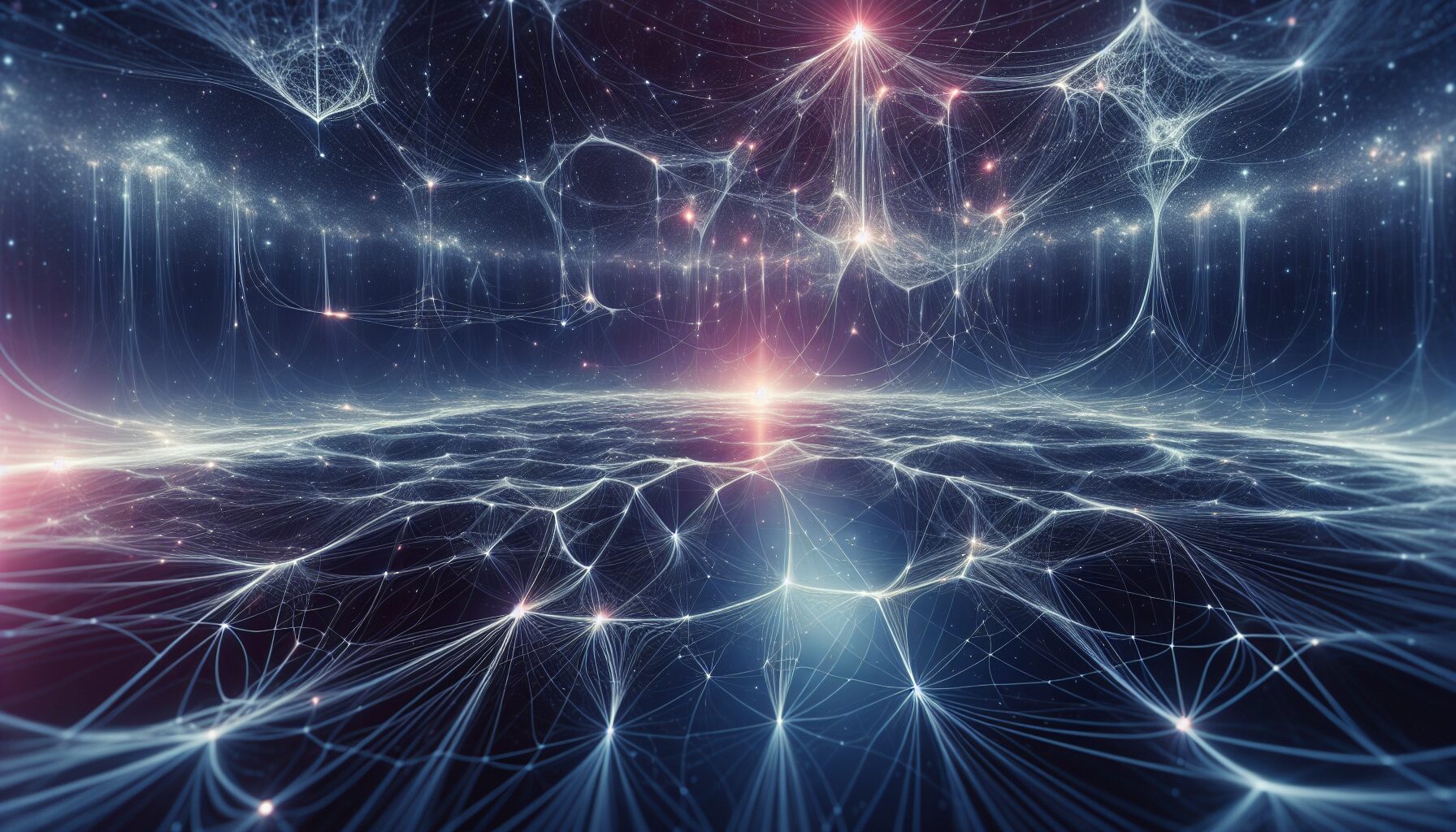
    The universe, in its vastness, often confronts us with enigmatic and complex structures that challenge our understanding of space and time. Among these mysteries, the Cosmic Web stands out as one of the most intriguing—a grand tapestry of matter weaving across the universe, connecting galaxies and galaxy clusters with tendrils of dark matter and baryonic material. This intricate network not only forms the large-scale structure of the cosmos but also holds within it the secrets of empty spaces—regions of ‘voids’ that reflect the enigmatic character of the universe’s evolution.

    The Structure of the Cosmic Web

    Scientists categorize the Cosmic Web as a colossal network comprising four main components:

    • Galaxy Filaments: These are the dense, elongated threads connecting large structures of galaxies across the universe.
    • Galaxy Clusters: At the intersections of the web are clusters, enormous gatherings of galaxies bound by gravity.
    • Walls: The broad sheets that outline the boundaries of voids and connect the filaments.
    • Voids: Vast expanses of seemingly empty space, containing fewer galaxies and matter than other regions.

    The cosmic web’s architecture arises from fluctuations in the density of matter following the Big Bang. Over billions of years, gravity amplified these fluctuations, sculpting the expansive web-like structure observed today.

    The Role of Dark Matter

    Dark matter is an essential component of the Cosmic Web. Invisible and detectable only through its gravitational effects, dark matter forms the scaffolding over which visible matter accumulates. Dr. Katie Mack, a cosmologist at North Carolina State University, explains, “The strings of the Cosmic Web are cosmic ‘superhighways’ of dark matter, calling ordinary matter to them with their gravitational pull” (Astrobites).

    Simulations such as the Millennium Simulation have visualized these structures, highlighting how the gravity of dark matter influences the distribution of galaxies and intergalactic gas within the web.

    The Mystery of Cosmic Voids

    Contrasting starkly with the dense filaments and clusters are the Cosmic Voids, which comprise a significant portion of the universe’s volume. Despite being mostly empty, cosmic voids are crucial for understanding the universe’s origin and fate. According to a study in the Astronomy & Astrophysics journal: “Cosmic voids are unique laboratories for testing models of cosmic geometry, gravitational physics, and the influence of dark energy” (A&A Journal).

    “In the absence of dark matter’s pull, the voids reveal the universe’s accelerated expansion,” adds cosmologist Dr. Sabine Hazan, emphasizing the role these empty regions play in studying dark energy.

    The Web in the Grand Design

    The Cosmic Web’s beauty lies in its ability to underline both the complexity and simplicity of the universe. On one hand, it reflects the intricate dance of gravity and relativity where immense structures emerge from minute quantum fluctuations. On the other, it is evidence of a coherent pattern that underlies the diverse array of galactic phenomena.

    Researchers at the National Institute of Astrophysics posit that studying the cosmic web not only unravels the universe’s intricate past but also guides us in predicting its future (INAF). The dynamic movements within these cosmic highways continue to shape galaxy evolution, star formation, and even influence the potential habitability of planets.

    Conclusion

    The Cosmic Web, in all its grandeur and mystery, presents an everlasting frontier for astronomical research. As technology and methodology advance, future explorations will delve deeper into these cosmic corridors, to not only map its structure but decode the phenomena it presents—from dark matter’s elusive nature to the eerie expanse of voids.

    In the words of astrophysicist Dr. Neil deGrasse Tyson, “We are part of this universe, and maybe more importantly, the universe is in us”—a sentiment that the study of the Cosmic Web deeply legitimizes, uniting all cosmic phenomena in a sublime expression of universal unity.
  • Stars as Timekeepers – Burning Until Their Own Deaths

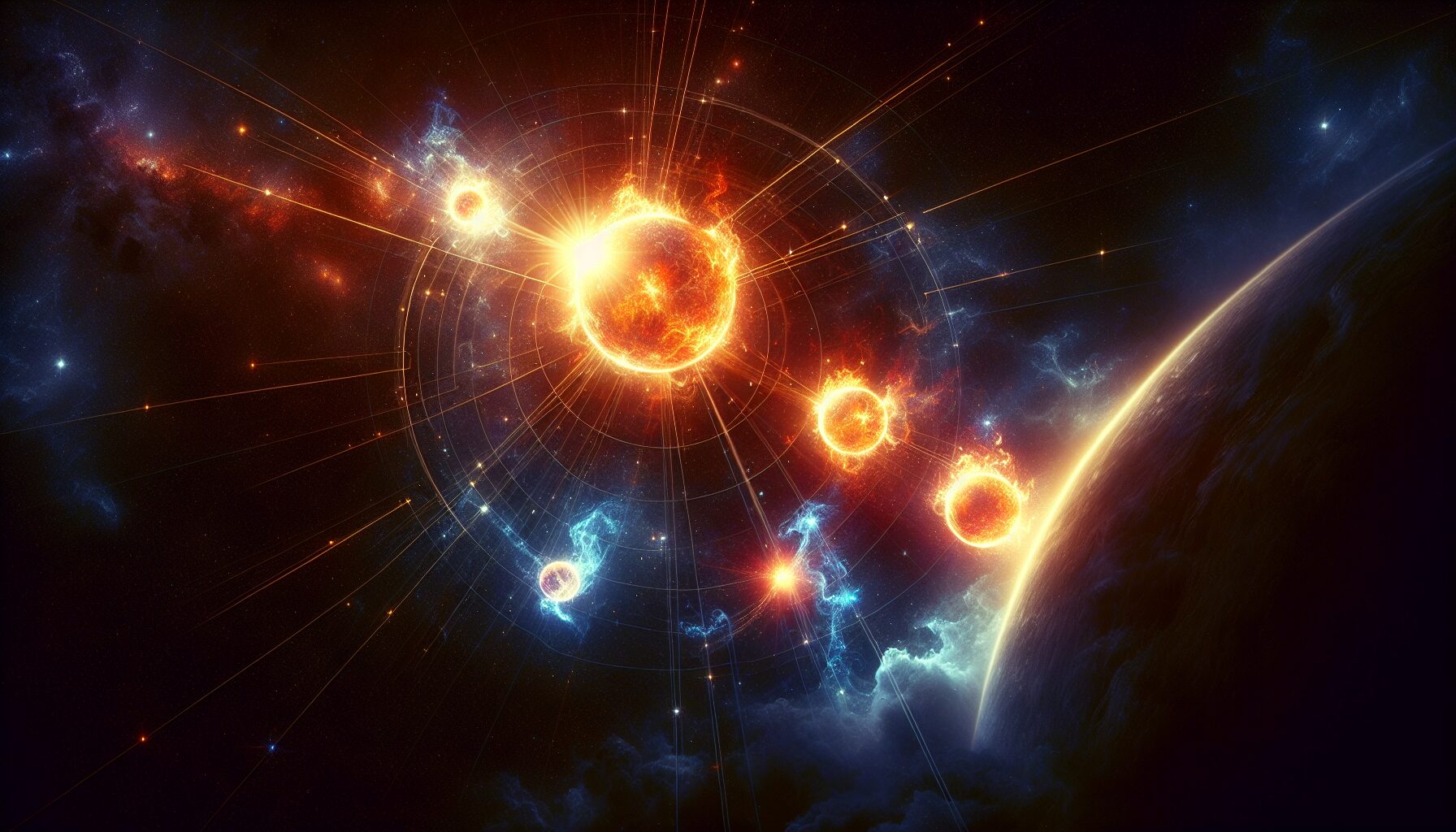
    Stars as Timekeepers – Burning Until Their Own Deaths

    Stars as Timekeepers – Burning Until Their Own Deaths

    Stars as Timekeepers – Burning Until Their Own Deaths

    Introduction

    The cosmos has always been a vast, enigmatic expanse, filled with mysteries that boggle the human mind. Among these enigmas lies the life cycle of stars—those luminous celestial bodies that have served as beacons in the night sky, guiding travelers and acting as cosmic timekeepers.

    The Role of Stars in Celestial Timekeeping

    Stars have been central to how we measure time and comprehend the universe. Since ancient civilizations, stars have governed the passage of time, marking seasons and aiding in navigation. According to NASA, “By mapping the motions and distances of stars, astronomers measure the expansion of the universe and unlock the secrets of its origin.”

    The Life Cycle of a Star

    The life cycle of a star is a testament to the dynamic, ever-changing universe. Every star begins its journey in a nebula, a vast cloud of gas and dust. Here’s an overview of the stages involved:

    • Nebula: Stars are born within nebulae. The gravitational forces within these nebulae cause the gas and dust to collapse, forming protostars.
    • Main Sequence: A star spends most of its life in this phase. Here, it fuses hydrogen into helium in its core—a process that can take billions of years.
    • Red Giant/Supergiant: As the hydrogen depletes, the core contracts, and the outer layers expand. The star becomes a red giant or supergiant, depending on its initial mass.
    • Death: A star’s death can result in various outcomes, such as a white dwarf, neutron star, or black hole, contingent upon its mass.

    The Impact of Stellar Deaths

    Each dying star contributes significantly to the cosmic tapestry. During the final phases of their lives, stars return materials to space, which later become part of new stars, planets, and even life itself. As Carl Sagan famously noted, “We are made of star stuff.” This cycle of creation and destruction is integral to the cosmic balance.

    Stars and Human Perspective on Time

    The appreciation of stars as timekeepers transcends mere scientific observation. They inspire introspection and art, inquiring about the ephemeral nature of human existence in contrast to the longevity of the stars. As astrophysicist Neil deGrasse Tyson articulates, “We are in the universe and the universe is in us.”

    “Astronomy compels the soul to look upward, and leads us from this world to another.” – Plato

    Modern Measurements and Discoveries

    The advancements in technology have augmented our understanding of stellar dynamics. Space observatories, such as the Hubble Space Telescope, have provided unprecedented insights into stellar births, evolutions, and deaths.

    Moreover, projects like the Gaia mission have been crucial in charting the positions, distances, and motions of stars, further honing our understanding of the galaxy’s structure and evolution. This, in turn, helps in measuring cosmic distances and ages with unparalleled precision.

    The Future of Star Studies

    The study of stars is far from over. Upcoming missions, including the James Webb Space Telescope, aim to delve deeper into the history and evolution of cosmic bodies. These efforts will hopefully unravel more secrets about the universe’s origins and the inevitable fates of these celestial timekeepers.

  • The Last Photon – How the Universe Will End in Absolute Darkness

    The Last Photon – How the Universe Will End in Absolute Darkness

    The fate of our universe has been a subject of intrigue and speculation among scientists and philosophers alike. From the Big Bang that marked its fiery inception, the universe has been in a state of perpetual expansion. However, what awaits at the end of this cosmic journey? According to some theories, the ultimate fate of the universe could be a vast, cold, and absolute darkness.

    A Universe in Expansion

    For centuries, humans have pondered the fundamental nature of the cosmos. The idea that the universe is consistently expanding was first proposed by Belgian astronomer Georges Lemaître in the 1920s, a notion that would later be supported by Edwin Hubble’s discovery of galaxies moving away from us in all directions. This evidence suggests that the universe is not in a static state but is dynamically evolving.

    Current observations indicate that not only is the universe expanding, but this expansion is accelerating due to a mysterious force known as dark energy. As NASA describes, dark energy constitutes about 68% of the universe, and its properties remain largely unknown. Its discovery has dramatically altered our understanding of the cosmos and the potential pathways it might traverse in the distant future.

    Theories on Cosmic Conclusion

    The potential end of the universe is a topic that has spawned multiple hypotheses among cosmologists. Here are some of the predominant theories on how the universe might conclude:

    • The Big Freeze: Also known as “heat death,” this theory posits that as the universe continues its accelerated expansion, galaxies will drift apart, stars will fade, and the universe will gradually succumb to a state of entropy. As thermodynamic energy irreversibly dissipates, the cosmos will eventually reach a uniform temperature—too cold to sustain any form of complex matter, let alone life.
    • The Big Crunch: This hypothesis is essentially the reverse of the Big Bang. If the gravitational forces of matter within the universe are strong enough, they could eventually overcome the forces of expansion, causing the universe to collapse in on itself. However, current data from WMAP (“Wilkinson Microwave Anisotropy Probe”) suggest that this outcome is less likely given the dominance of dark energy.
    • The Big Rip: According to this scenario, the relentless expansion of the universe, driven by dark energy, could reach a point where it tears apart galaxies, stars, and eventually even atoms and subatomic particles. “The universe would end in a singularity, a gravitational collapse at a single point in time,” as explained by theoretical cosmologist Robert Caldwell.

    The Last Photon and the Looming Darkness

    The advent of the “Big Freeze” or “Heat Death” would ultimately usher in the era of the last photon. This moment signifies the end of all light and energy transformation processes, where the once glorious luminescence emitted by countless stars and galaxies across the universe will be extinguished.

    “Eventually, all processes that produce photons will cease, leaving matter in a random, chaotic state. What remains is a universe that is dark, dilute, and cold.” – Lawrence Krauss, theoretical physicist and cosmologist.

    This foreseen darkness will not occur for an unimaginably long time—a span of time so vast it defies human comprehension. Yet it is a sobering reminder of the transient nature of everything in existence, from galactic clusters to the tiniest quanta of light itself.

    The Philosophical Dimension

    The concept of the universe dissolving into eternal darkness has profound philosophical implications. Many have pondered what this fate suggests about the nature of existence. Are we living in a universe indifferent to creation and destruction, or is there an underlying purpose that escapes our grasp?

    The idea of a universe ending devoid of light challenges our perceptions of meaning and our understanding of time. It raises questions about the nature of consciousness and whether our existence is merely a brief flicker in the vast timeline of the cosmos.

    For some, this realization is a clarion call to cherish the now and the wondrous beauty of the universe as it exists. For others, it is a contemplation of the scientific truths that govern our universe, and the persistent human endeavor to unravel its mysteries.

    Conclusion

    The ultimate demise of the universe in ice-cold darkness might seem a grim end to a magnificent beginning, but it is also a testament to the grandeur and complexity of cosmological phenomena. While the “last photon” heralds the end of cosmic light, it equally symbolizes a reminder of our place within this vast, ever-evolving universe. As our understanding advances, so too does our appreciation of the cosmos’ remarkable intricacies and the fleeting moments of brilliance within it.

  • Cosmic Decay – From Nuclear Fusion to Eternal Stillness

    Cosmic Decay – From Nuclear Fusion to Eternal Stillness

    Cosmic Decay: From Nuclear Fusion to Eternal Stillness

    The universe, a seemingly eternal expanse of stars, planets, and galaxies, is constantly in flux, driven by the inexorable processes of cosmic decay. Central to this majestic theatre of destruction and creation is the process of nuclear fusion, a powerful force that fuels the stars yet is destined to fade, leading the universe towards a state of eternal stillness.

    The Birth of Stars and the Role of Nuclear Fusion

    Stars are born from the gravitational collapse of gas and dust in the interstellar medium. As particles draw closer, pressure and temperature rise, eventually igniting nuclear fusion at the star’s core. This process powers the star, converting hydrogen into helium, and releasing colossal amounts of energy in the form of light and heat.

    Nuclear fusion, as noted by Dr. Steven E. Plate, an astrophysicist at Harvard-Smithsonian Center for Astrophysics, is the process that “not only provides the energy necessary for stars to shine but also synthesizes new elements, building the chemical complexity of the universe.”

    The Life Cycle of a Star

    Throughout their lives, stars balance the outward pressure of thermal radiation from fusion against the inward pull of gravity. However, this balance is not eternal. As stars exhaust their nuclear fuel, their fates diverge based on mass. Small stars fade gently into white dwarfs, while massive ones can explode violently as supernovae, creating neutron stars or black holes.

    During their endings, stars enrich the cosmos with heavier elements, a process poetically called stellar alchemy. As Carl Sagan famously said, “We are made of starstuff.” This cycle not only creates the building blocks for planets and, eventually, life but also dictates the ultimate fate of the cosmos.

    Heat Death: The Universe’s Quiet Demise

    Despite the seeming immortality of the stars, they too will succumb to the cosmic entropy that dictates the universe’s expansion. As stated by Sir Roger Penrose, a prominent mathematician and physicist, “In the far future, the universe will have expanded to the point where stars can no longer form, as the concentrations of gas and dust necessary will be too diffuse.” This concept aligns with the theory of heat death, a potential end scenario for the universe.

    In a heat-dead universe, all energy will be evenly distributed, leaving no room for the temperature differentials necessary for energy transfers—a state of uniform thermodynamic equilibrium. All processes, including life and stellar activity, would cease, entailing an eternal stillness.

    The Implications for Time and Space

    Contemplating the cessation of cosmic events impacts our understanding of time itself. If the universe achieves complete disorder, will time, defined by change and events, hold any meaning?

    “Time is what keeps everything from happening at once,” mused the physicist John Archibald Wheeler, yet in a universe of stillness, this essential distinction blurs.

    As astrophysicist Brian Cox explains, “The universe appears from our vantage point to be a place that is moving from order to disorder… In the fullness of time, it will evolve to a place that is pure disorder.”

    Beyond Eternity: The Potential for Renewal

    While the heat death scenario paints a bleak picture, some theories suggest possible outcomes where the cosmic story is not one of finite decay. Theorists speculate about potential cycles of cosmic collapse and rebirth, akin to a “Big Bounce” following a Big Crunch.

    Moreover, quantum mechanics introduces uncertainties, including the emergence of new structures from apparent vacuums as posited by Heisenberg’s principle. These concepts infer that even at the universe’s end, there could be opportunities for rebirth amidst the decay.

    Ultimately, the story of cosmic decay, from nuclear fusion to a potential stillness, encapsulates both the grandiosity and transience of existence. Each star’s life and death echo the cosmic dance of creation and dissolution, a fleeting act within the vast play of the universe.

    While our understanding continues to evolve, engaging with these profound cosmic narratives reminds us of our own temporality and connection to the cosmos. As the universe unfolds in its inevitable journey towards entropy or rebirth, humanity’s quest to understand these mysteries endures, perpetually lighting the dark with curiosity and wonder.

  • The Inevitable Silence – How Space Mirrors Our Own Mortality

    The Inevitable Silence – How Space Mirrors Our Own Mortality

    As humanity stands at the brink of a new era in space exploration, the cosmos appears not just as a frontier of scientific discovery, but also as a vast, silent mirror reflecting our deepest existential questions. Space, in its staggering emptiness, compels us to confront the inevitability of our own mortality.

    Infinity and Isolation

    The universe, with its expansive and seemingly infinite nature, holds a mirror to our own finite existence. The realization of our mortality becomes stark against the backdrop of the cosmos. Astrophysicist Neil deGrasse Tyson once noted, “We are not special because we are at the end; we are special because we recognize that we are statistically insignificant, right?

    This perspective reveals two profound realities:

    • The Immense Scale of the Universe: Our Earth, the cradle of human life, is but a speck in the vastness of space. The awareness of billions of galaxies, each containing billions of stars, induces a humbling sense of our own minuscule presence.
    • Cosmic Timelessness: While humans measure time in years and decades, the cosmos operates on a scale of billions of years. Stars are born, live, and die, creating a cycle of cosmic life and death that stretches far beyond human history.

    The Silent Witness

    Space is often referred to as a void, a realm of silence. This silence, however, is not mere emptiness. It amplifies the quiet truths about existence.

    “In the silence of the stars, in the profundity of the void, we confront the great quietude of the universe.”
    – Carl Sagan

    The notion of a silent universe harmonizes with the inevitability of our silence in death. This silence resonates with several aspects of existential thought:

    • The Transience of Life: Like the stars, we come from stardust and return to the cosmos, emphasizing the transient nature of life.
    • The Search for Meaning: The universe’s silence invites introspection, prompting questions about the purpose and meaning of existence in a universe indifferent to our struggles.

    Society’s Reflection

    The space we observe serves as a backdrop for societal reflections on life and death. As we grasp the layers of understanding in the cosmos, there are lessons to be learned:

    • Unity in Mortality: Regardless of our differences, the inevitability of death unites us; similarly, the universe encompasses us all, offering a sense of collective belonging.
    • Technological Aspirations: Space exploration reflects our desire to transcend earthly limits, a metaphorical defiance against the boundaries of human life.

    Technology has made strides in exploring our solar neighborhood. Projects helmed by pioneers like Elon Musk envision humanity as a multi-planetary species, potentially extending human life beyond Earth. As Musk himself iterated, “I think it’s important to have a future that is inspiring and appealing. There should be things that you look forward to…I think being a multi-planet species is one of those things.”

    Continued Exploration

    Yet, even as we expand our horizons, the existential juxtaposition of life and cosmic quietude continues. Exploring how these realms interact, humanity’s expedition into space becomes a metaphor for a greater journey:

    • The Pursuit of Knowledge: Every mission, every telescope, falls in the footsteps of philosophers and astronomers who have sought to unravel cosmic mysteries.
    • The Impermanence of Understanding: As our knowledge about the universe grows, so too does our understanding of life’s impermanence, recognizing that each answer provides more questions.

    Conclusion: Embracing Cosmic Mortality

    In Cosmos: A Personal Voyage, Sagan captured the wonder and depth of pondering life’s great questions, reminding us that looking into the universe is tantamount to looking into ourselves. Thus, the stark, eternal silence of space mirrors our own impermanent presence. It is through this silence and our quest to pierce it that we find purpose, meaning, and solace in the face of our own mortality.

    Ultimately, as space explorers, scholars, and dreamers, the cosmos teaches us a valuable, enduring lesson; in the depths of silence, we learn to listen to the whispers of our own existence.

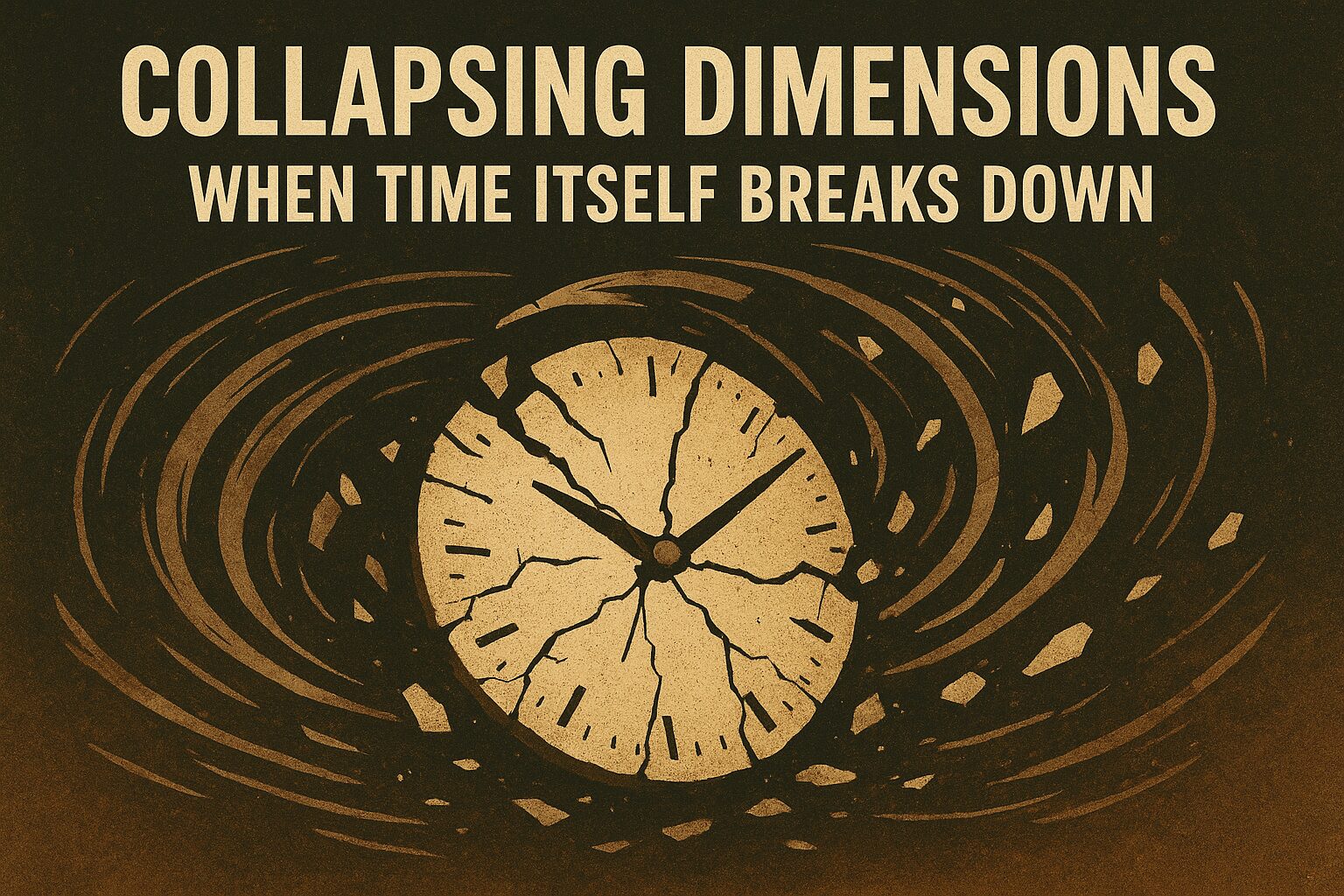
  • Collapsing Dimensions – When Time Itself Breaks Down

    Collapsing Dimensions – When Time Itself Breaks Down

    Collapsing Dimensions: When Time Itself Breaks Down

    Time, as one of the fundamental axes in our universe, governs every aspect of our reality. It marches inexorably forward, setting the rhythm for birth, growth, decay, and ultimately, death. Yet, physicists and philosophers have long pondered what happens when time itself begins to falter, potentially collapsing and breaking down. This article seeks to explore such phenomena, examining both theoretical underpinnings and their implications.

    The Nature of Time: A Brief Overview

    Time is often perceived as a constant progression, a straight line moving from past to future. Theoretical physicist Albert Einstein transformed our understanding of time with his theory of relativity, which merged time with the three spatial dimensions into a single four-dimensional continuum: spacetime. According to Einstein, time is relative and can be warped by gravity, leading to the proposition that time could potentially collapse under certain conditions.

    “The distinction between the past, present, and future is only a stubbornly persistent illusion.” — Albert Einstein

    Conceptualizing Time Collapse

    In physics, a collapse of time could be viewed metaphorically through black holes and singularities, where the usual flow of time ceases to apply. Within a singularity, the gravitational pull is so immense that it distorts spacetime to such an extent that the conventional timeline vanishes. As Stephen Hawking illustrated in his theories, at the singularity at a black hole’s core, all known laws of physics break down.

    • Singularities: In a singularity, densities become infinite, and thus, temporal dimensions no longer function as we understand.
    • Event Horizon: This is the boundary surrounding a black hole beyond which no information can escape, indicating a boundary of time as well.

    From a quantum mechanics perspective, the breakdown of time can also be theorized through the quantum theory of gravity, which seeks to reconcile general relativity with the principles of quantum mechanics.

    Speculative Scenarios: Time as a Collapsing Dimension

    Time Reversal and Entropy

    The second law of thermodynamics, asserting that entropy or disorder tends to increase over time, implies a directionality to time. Some scientists propose situations where this arrow of time could potentially reverse. For example, should the universe undergo a cyclical pattern of expansion and contraction (the “Big Bounce” theory), time might reverse its course in the contracting phase.

    “In a hotter, far-distant future, the universe might begin to behave very differently, with decreasing entropy causing time to run backward.” — Scientific American

    Parallel Universes and Dimensional Breakdowns

    Another speculative idea borrowed from the multiverse theory is that time could collapse or function differently across parallel universes. These universes might have entirely different physical laws, where time is a circle, a loop, or an entirely non-existent construct.

    • In string theory’s extra dimensions, the collapsing of time in one of these could significantly impact the entire fabric of cosmic order.
    • Quantum tunnels: Wormholes could theoretically allow for time travel or collapsing dimensions of time to fold onto themselves.

    Philosophical Implications

    The idea of time collapsing also presents numerous philosophical quandaries. Our perception of existence is intricately tied to the flow of time. If time can cease to exist or function in a fundamentally diverging manner, what implications would this have for concepts like causality, free will, and identity?

    • Causality: If future events can influence the past, the intricate dance of cause and effect dissolves into chaos.
    • Identity: Personal identity across time provides continuity to consciousness. A breakdown of time could shatter this cohesion.

    The philosopher and cognitive scientist Daniel Dennett suggests that how we reckon time is crucial to consciousness, positing that any significant alteration to time’s fabric might radically alter our self-awareness and perception of reality.

    “Our model of time is fundamental to the way we experience our consciousness and reality.” — Daniel Dennett

    Conclusion

    While the collapse of dimensions and time remains largely within the realm of theoretical physics and speculative philosophy, the very exploration of these ideas stretches our understanding of the universe and our place within it. The concept pushes the boundaries of human thought, challenging both scientists and philosophers to reevaluate the fabric of reality.

    As we continue to probe the depths of black holes, quantum fields, and potential multiverse paradigms, we edge closer to a more profound comprehension of time itself. Whether time can indeed collapse or break down remains one of the universe’s most tantalizing mysteries, urging us to explore further, think deeper, and remain curious.

  • The Cosmic Microwave Background – A Whisper from the Universe’s Past Life

    The Cosmic Microwave Background – A Whisper from the Universe’s Past Life

    The Cosmos is a vast arena filled with mysteries and unanswered questions. Among these is a relic from the early universe known as the Cosmic Microwave Background (CMB) — a faint glow permeating the entirety of space, offering profound insights into the origins and evolution of our universe.

    What is the Cosmic Microwave Background?

    The CMB is essentially the afterglow of the Big Bang, the prevailing theory describing the beginning of our universe. Roughly 380,000 years after this colossal event, the universe cooled down sufficiently for protons and electrons to combine and form neutral atoms. At this point, photons, which had been constantly interacting with charged particles, could travel freely.

    This decoupling of matter and radiation released a ‘snapshot’ of the universe at that young stage. The CMB is this radiation, stretched into the microwave spectrum by the continual expansion of the universe over the billions of years since.

    The Discovery of the CMB

    In 1965, astronomers Arno Penzias and Robert Wilson stumbled upon the CMB while using a large horn antenna at Bell Labs in Holmdel, New Jersey. They detected an unusual background noise that was incredibly uniform in all directions. After ruling out other possibilities, they realized they had discovered the CMB, providing strong evidence for the Big Bang theory. This remarkable discovery earned Penzias and Wilson the Nobel Prize in Physics in 1978.

    A Window into the Early Universe

    The CMB is much more than just evidence of the Big Bang. By studying minute variations in its temperature (on the order of one part in 100,000), scientists can infer a wealth of information about the early universe’s composition, structure, and expansion rate. As noted by the cosmologist George F. Smoot, “The CMB is the handwriting of God” [source: Cosmology.com].

    In recent decades, missions like NASA’s Wilkinson Microwave Anisotropy Probe (WMAP) and the European Space Agency’s Planck satellite have mapped the CMB with exceptional precision. These observations have helped refine models of cosmic inflation and the universe’s content — including the mysterious dark matter and dark energy.

    The Future of CMB Research

    While the CMB continues to be a cornerstone in cosmological studies, future missions and telescopes may unearth even deeper insights into the universe’s infancy. The continued exploration of this cosmic echo will likely unveil further whispers from the universe’s past, guiding us toward better understanding the fundamental principles governing all cosmic phenomena.

  • Dark Matter Mysteries – Ghost Particles in the Cosmic Graveyard

    Dark Matter Mysteries – Ghost Particles in the Cosmic Graveyard

    Dark Matter Mysteries – Ghost Particles in the Cosmic Graveyard

    In the vast and eerie stretches of space, there lies an enigmatic essence that has long mystified scientists – dark matter. Often described as the unseen skeleton of the universe, dark matter provides the scaffolding that dictates the formation of galaxies, yet its true nature remains a cosmic riddle. This invisible and intangible matter accounts for approximately 27% of the universe, dwarfing the ordinary matter we can see, which only makes up about 5%. The remaining 68% is dark energy, another enigmatic component driving the universe’s accelerated expansion.

    The Invisible Landscape

    Dark matter does not emit, absorb, or reflect light, making it invisible and detectable only through its gravitational effects. One of the primary evidences of dark matter was observed by astronomer Fritz Zwicky in the 1930s. He noticed that galaxy clusters were moving faster than what could be accounted for by visible matter alone. Zwicky introduced the term “dunkle Materie,” or dark matter, to describe this mysterious phenomenon.

    “The first clue that we might be wrong about the mass of the cosmos came in the early 1930s when Swiss astronomer Fritz Zwicky calculated that galaxies in the Coma cluster were zipping around way too fast. They should be flying apart, although they were not.” — Scientific American

    Probing the Darkness

    Scientists employ various methods to unveil the presence of dark matter. One approach is to examine the cosmic microwave background (CMB) radiation, the afterglow of the Big Bang, as it provides clues about the universe’s composition. Tiny variations in this backdrop enable researchers to infer the amount of dark matter in the universe.

    • Gravitational Lensing: This phenomenon occurs when a massive object, like a galaxy cluster, warps the space around it, bending and magnifying the light from objects behind it. By studying these distortions, astronomers can infer the presence and distribution of dark matter.
    • Galaxy Rotation Curves: The study of spiral galaxies has revealed that stars at the outer edges rotate at speeds that cannot be explained by visible matter alone, suggesting the presence of an invisible mass.
    • Direct Detection Experiments: In deep underground laboratories, scientists conduct experiments to capture dark matter particles directly. These highly sensitive detectors seek to observe the rare interactions between dark matter and baryonic matter.

    Theoretical Contenders

    Several hypotheses attempt to explain the nature of dark matter. Leading candidates include:

    • WIMPs (Weakly Interacting Massive Particles): These hypothetical particles are predicted by extensions of the Standard Model of particle physics. Despite extensive searches, including the Large Hadron Collider, WIMPs have yet to be detected.
    • Axions: Extremely light particles that might arise in theories addressing why certain symmetry properties of particle interactions hold true.
    • Modified Gravity Theories: Some scientists propose altering the laws of gravity at large scales, such as in the MOdified Newtonian Dynamics (MOND) theory, as an alternative to dark matter’s existence.

    “Dark matter is the universe’s ghost, roaming the cosmos with a potent force felt through gravity, but utterly undetectable by any other means.” — Nature

    Cosmic Graveyards – The Observation Challenges

    The pursuit of understanding dark matter faces significant observational and experimental challenges. Its ghost-like nature means it leaves no direct trace, akin to trying to study the architecture of a house using merely shadows. As astroparticle physicist Gianfranco Bertone noted, “We may have to accept that we won’t be able to discover dark matter directly, but this doesn’t mean that we can’t learn about its properties.”

    One intriguing avenue of research involves studying regions dubbed “cosmic graveyards,” areas dominated by dark matter. These regions, free from the interference of luminous baryonic matter, offer clearer insights into dark matter’s distribution due to their lack of traditional interference. Observing phenomena such as cosmic voids provides potential breakthroughs in understanding this elusive substance.

    The Road Ahead

    Though dark matter remains one of the greatest mysteries in modern physics, every potential insight brings us closer to a comprehensive understanding of the universe. Continued innovations in technology and a deeper understanding of cosmic processes hold promise for humanity’s pursuit of these spectral particles.

    As research progresses, the boundary between science and the unknown beckons us with its myriad mysteries, urging forward the quest to illuminate this translucent cornerstone of the cosmos. In the words of astrophysicist Neil deGrasse Tyson, “The universe is under no obligation to make sense to you.” The journey to uncover dark matter’s secrets is as much about expanding the mind as it is about revealing the universe.

  • The Expanding Universe – Life in a Forever Dying Cosmos

    The Expanding Universe – Life in a Forever Dying Cosmos

    The universe has long been a source of wonder and mystery, and among its many fascinating phenomena is the concept of an expanding universe. The foundational observation that led to this understanding was made by Edwin Hubble in the 1920s when he discovered that galaxies are moving away from us, indicating that the universe is expanding.

    “The expansion of the universe was one of the most important intellectual discoveries of the 20th century,” said the renowned cosmologist Stephen Hawking.

    This expansion is not merely a slow march. Observations in the late 20th century suggested that the pace is accelerating, a phenomenon attributed to a mysterious component known as dark energy. This force is now understood to make up about 68% of the universe, driving galaxies away from each other at ever-increasing speeds.

    A Universe Heading Towards Isolation

    The implications of an expanding universe pose profound questions for the future. As galaxies drift further apart, the universe seems destined for a state of isolation, where each galaxy becomes a lonely oasis in the vastness of space. Eventually, the sky would darken as galaxies recede beyond the observable horizon.

    • Stars will burn out, leading to a scarcity of light and warmth.
    • With the depletion of stellar fuel, black holes may dominate an otherwise dark universe.
    • The continued expansion will render the density of matter exceedingly sparse.

    Yet, this cosmic isolation unravels slowly over unimaginable aeons, granting a resilient species ample time to adapt or find solace in their stellar neighborhood. As theoretical physicist Freeman Dyson noted, life, or what remains of it, may find undying ways to “hitch rides on cosmological time machines” to resist cosmic ennui.

    Life Finds a Way

    Contemplating the far reaches of time invites reflections on the very nature of existence. Are we in a universe that is forever tethering on the brink of oblivion, or is the story more nuanced? Physics might suggest bleakness, but life’s persistent edge finds hope even in uncertainty.

    Carl Sagan once mused, “Somewhere, something incredible is waiting to be known.” This spirit of exploration and discovery could be the key to thriving even as the cosmos inches towards stillness.

    While the future of an ever-expanding universe seems bleak, the indomitable will to survive and adapt could lead intelligent life to unparalleled innovations and perhaps new understandings of life, the universe, and the very nature of existence. For now, we remain observers of this grand, cosmic dance, searching for our place in a universe that continues to drift into the unknown.

  • Supernovae as Cosmic Graves – Stars Ending in Fire and Light

    Supernovae as Cosmic Graves – Stars Ending in Fire and Light

    In the vast tapestry of the universe, where stars are the showpieces illuminating the cosmic stage, supernovae serve as the dramatic finales. These celestial events, characterized by dazzling brilliance and immense energy release, signify the violent deaths of stars. Although they mark the end of stellar life, supernovae play an essential role in enriching the cosmos and influencing the cosmic order.

    The Stellar Life Cycle

    Stars, the building blocks of galaxies, have life cycles that span millions to billions of years. Born from clouds of gas and dust, stars spend most of their lives fusing hydrogen into helium in a stable phase known as the main sequence. As they exhaust their nuclear fuel, the fate of stars diverges. For massive stars, it is a fate intertwined with the phenomenon of supernovae.

    “Supernovae are one of the key processes that shape the structure of galaxies and distribute elements throughout the universe,” says Dr. Alex Filippenko, an astronomer at the University of California, Berkeley.

    Types of Supernovae

    • Type I Supernovae: These occur in binary systems where a white dwarf exceeds its critical mass, leading to a catastrophic collapse and explosion.
    • Type II Supernovae: Result from the gravitational collapse of massive stars, at least eight times the mass of the Sun, when they run out of nuclear fuel.

    The differences in these types highlight the varied conditions under which stars end their life, often determined by their initial mass and environment.

    The Lightshow of Cosmic Death

    The explosion of a supernova is an astronomical spectacle visible across vast distances. The Hubble Space Telescope has captured stunning images of supernova remnants, colorful tapestries marking the sites of stellar demise. The light from these explosions can outshine entire galaxies for weeks or even months.

    “The light curves and spectra of supernovae allow us to understand the composition and dynamics of the explosions,” notes Dr. Robert Kirshner of the Harvard-Smithsonian Center for Astrophysics.

    Elemental Alchemy

    As supernovae explode, they act as cosmic forges, creating heavy elements that are essential for life. Elements such as iron, nickel, and even gold owe their existence to these celestial cataclysms. These materials are ejected into space, seeding the interstellar medium with the raw elements necessary for forming new stars and planets. Supernovae thus contribute to the ongoing cycle of creation and destruction in the universe.

    This process of stellar alchemy has profound implications for our understanding of the cosmos. It highlights the interconnectedness of life and death on a galactic scale, where the end of one star offers the building blocks for another.

    Impact on the Cosmos

    Beyond their role in element formation, supernovae impact their galactic neighborhoods in multiple ways:

    • Shockwaves: The forceful shockwaves generated by supernovae can trigger the formation of new stars by compressing nearby gas clouds.
    • Remnants: The beautiful, often complex shapes of supernova remnants provide clues about the nature of the original explosions and the material ejected.
    • Cosmic Rays: Supernovae are believed to be a source of cosmic rays, high-energy particles that travel across the universe and affect planetary atmospheres.

    Such far-reaching effects emphasize how supernovae, while destructive in nature, play a vital role in the dynamic and evolving universe. They are not merely ends but also catalysts for new beginnings.

    The Future Study of Supernovae

    With advancements in technology, astronomers are uncovering more about supernovae and their integral role in the universe. Missions like the Chandra X-ray Observatory and upcoming projects like the Nancy Grace Roman Space Telescope aim to pierce deeper into the mechanisms behind these powerful explosions.

    “Future observations will help us better understand the exact mechanisms that lead to stellar explosions,” predicts Dr. Mark Sullivan from the University of Southampton.

    Through these ongoing investigations, astronomers hope to unravel more about the life cycles of stars, the distribution of elements, and the overall dynamics of galaxies themselves.

    Conclusion

    Supernovae, in all their fiery glory, serve as cosmic graves marking the end of stellar lives. Yet, from their ashes, new possibilities arise—new stars, planets, and perhaps even life itself. They are celestial reminders of the universe’s cycle of death and rebirth, a dance of destruction that creates, indeed, the cosmos as we know it.