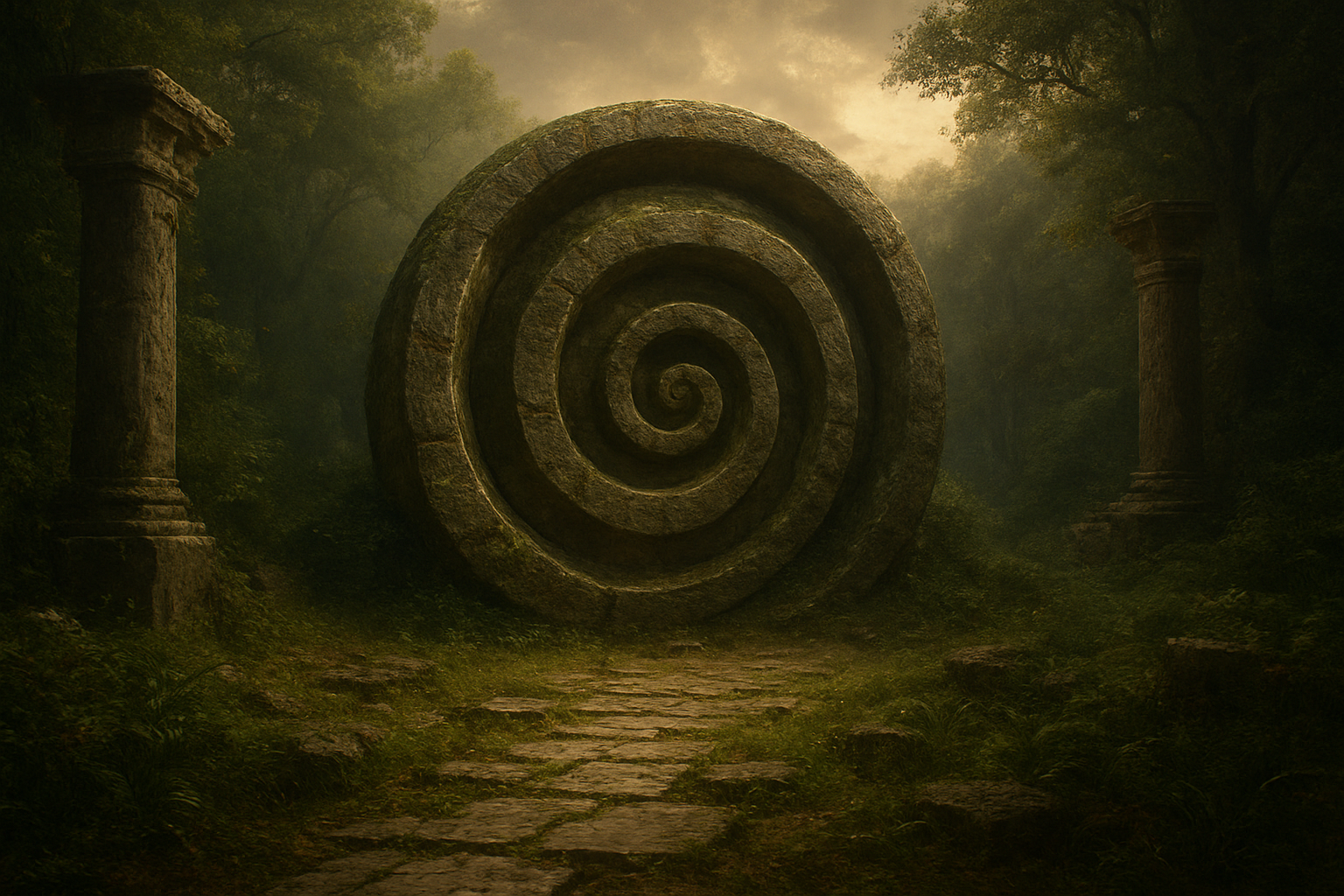
The spiral is a timeless and universal symbol found throughout our world, from the swirl of galaxies and hurricane clouds to the structure of DNA. Its presence in ancient art, architecture, and mythology across different cultures suggests deep symbolic meanings and connections to life, death, and the cyclical nature of existence.
The Spiral in Ancient Cultures
- Celtic Spirals: The Celts, who inhabited much of Western Europe during the Iron Age, prominently featured spiral motifs in their art. These spirals were often associated with the sun, and the natural cycle of life, death, and rebirth. The triple spiral, or triskelion, is particularly notable, representing the interconnectedness of earth, water, and sky.
- Egyptian Spirals: In ancient Egyptian culture, spirals were connected to the cycles of birth and rebirth. The symbol of the spiral can be found in hieroglyphics and artworks, often related to the flow of time and the process of transformation. The spiral also symbolized the rise of the soul to the heavens, indicating its profound spiritual significance.
- Greek Spirals: In Greece, the spiral represents the concepts of infinity and continuity. It was a core element in much of their architectural ornamentation, such as with the Ionic column capitals. The spiral design emphasizes the perpetual flow and progression of life and learning.
A Universal Symbol of Dynamics
The spiral not only permeates human creative expressions but also finds striking parallels in nature, resonating with the natural geometries that shape our world. As a universal symbol, the spiral is a metaphor for dynamic balance and change.
“The logarithmic spiral is interesting because it appears in the growth patterns of many shells and biological organisms. Its mathematical properties are such that the spiral grows and ages in a manner similar to other forms found in nature.” – Wolfram MathWorld
The Spiral in Mythology and Spirituality
The notion of the spiral as a spiritual or mystical symbol traverses numerous mythological narratives and spiritual practices, where it is often tied to personal and cosmic evolution.
- Hindu and Buddhist Traditions: In Hinduism and Buddhism, spirals are symbolic of the journey inward, reaching towards enlightenment. The mandala, a prominent symbol in these traditions, often employs spiralic designs, illustrating the path from the outer reality to the inner core of spiritual truth.
- Native American Symbolism: Among Native American tribes, the spiral symbol appears frequently. For instance, the Hopi see the spiral as a representation of their migration journeys and life paths. Spirals are considered sacred symbols of union and interconnection within the universe.
An Enduring Enigma
Despite the ubiquity and age-old prominence of spirals in human culture, they remain enigmatic. One plausible explanation for their widespread appeal may be rooted in their visual and mathematical harmony. Spirals possess both simplicity and complexity, making them adaptable symbols for a myriad of cultural, philosophical, and scientific interpretations.
As we delve into the mysteries of spirals, we are reminded of the words of American astronomer Carl Sagan who once reflected on the interconnectedness of cosmos and life on Earth:
“The cosmos is within us. We are made of star-stuff. We are a way for the universe to know itself.” – Carl Sagan
This poetic connection resonates profoundly with the significance of the spiral as a representation of the intricate dance of life. It is a symbol that invites reverence and reflection, beckoning us to contemplate the unseen patterns that weave through the tapestry of existence.
Conclusion
The spiral is more than just an artistic motif; it’s an integral archetype that spans across mythologies, spiritual traditions, and scientific understanding. Rooted in our ancestors’ attempt to make sense of their world, the spiral continues to fascinate and challenge us to ponder the deeper connections embedded in our universe.
Embracing the mystery of the spiral can help us appreciate the intricate patterns that underlie our existence and inspire a deeper connection with the rhythms of life and the cosmos.
Comments