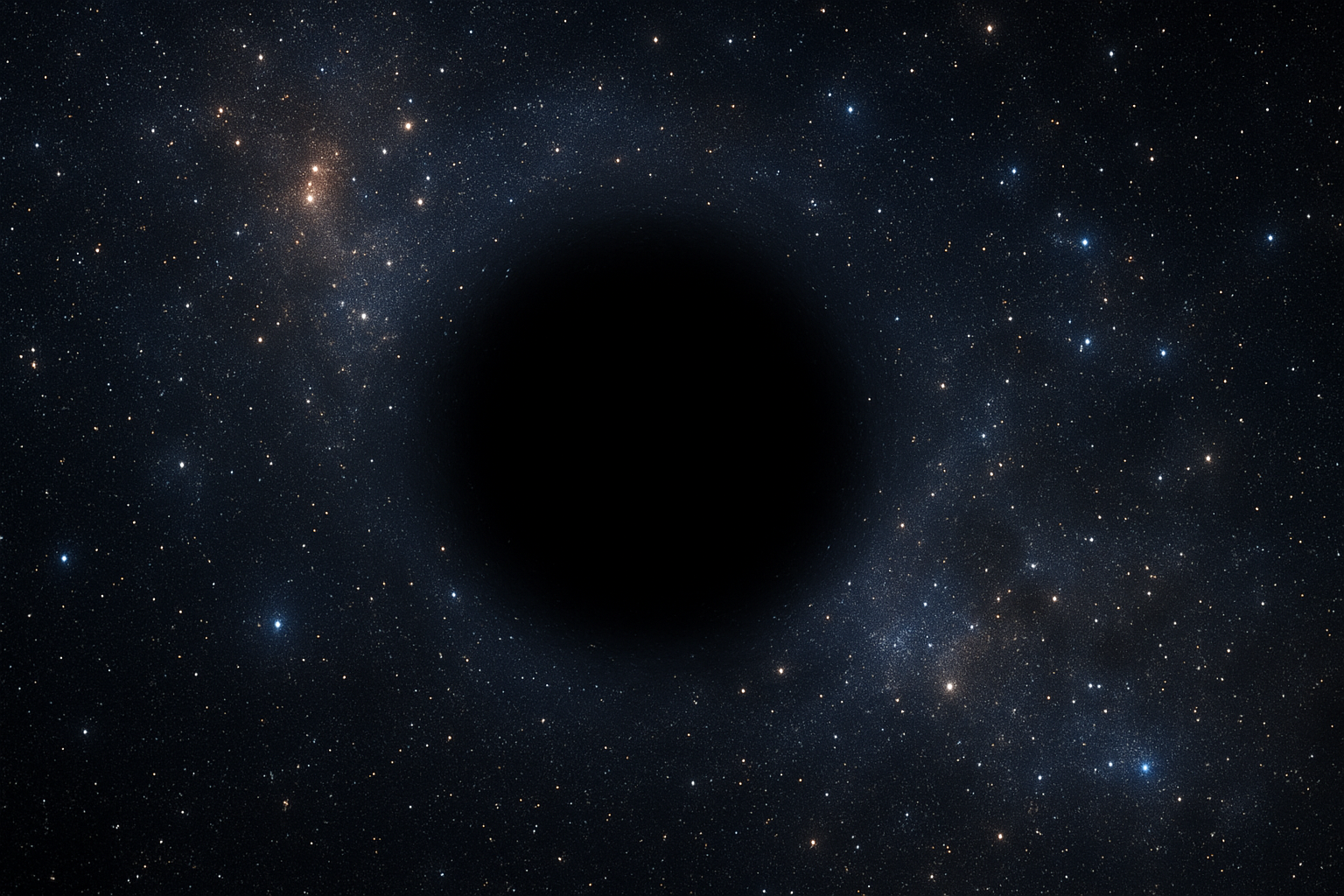
In the vast expanse of the universe, humans are but mere specks amidst an almost incomprehensible sea of stars and galaxies. Yet, it is not the teeming stars or the brightness of galaxies that capture the imagination the most—it is the overwhelming emptiness that lies between them. This profound void has mystified astronomers and philosophers alike for centuries.
The Nature of Cosmic Emptiness
The universe is predominantly made of space that appears empty, a concept both simple and elusive. Known as the “void,” this emptiness accounts for a significant part of the universe. But this does not mean that voids are entirely vacuum—they contain low-density gases and dark matter. According to astrophysicist Brian Greene, “In those vast, cold portions of the universe… the environment is as close to absolute nothingness as any we know of in nature.”
Cosmic Voids and Their Significance
Cosmic voids are regions with significantly lower density compared to the average cosmic density. These voids make up about 80% of the universe’s volume and play an essential role in the universe’s large-scale structure, influencing the gravitational dynamics of surrounding galaxies.
- Dark Matter Mysteries: Voids are expected to be less influenced by dark matter compared to denser regions, providing unique conditions to study this elusive substance.
- Gravitational Lensing: The interaction between voids and dark matter affects gravitational lensing, helping astronomers map dark matter distribution across the universe.
- Expansion Insights: Voids expand as the universe does, offering clues about cosmic expansion and the universe’s fate.
The Philosophical Implications of Emptiness
The idea of a void is not just a scientific curiosity; it also poses significant philosophical questions. What does it mean to exist in a universe predominantly devoid of matter? The void challenges our notions of presence and absence and compels us to redefine them. Philosopher Parmenides, famously mused, “What is not, is not,” emphasizing the difficulty of speaking about nothingness.
“For the stuff of the universe, take the emptiness of space and everything in it,” —Brian Greene, The Elegant Universe.
Emptiness and Human Understanding
Our understanding of the void has evolved over time. Aristotle believed that “nature abhors a vacuum,” a view superseded by discoveries in physics demonstrating that emptiness is an integral part of our cosmos. Quantum mechanics further complicates the picture by suggesting that even the emptiest space teems with virtual particles popping in and out of existence.
- From Aristotle to Einstein: The shift from Aristotle’s interpretations to Einstein’s theories of relativity marks a profound evolution in comprehending the void.
- Quantum Fluctuations: Subatomic interactions showcase that even the void is full of potential activities, challenging our perception of ’emptiness.’
- Cognitive Reflection: Human perception has always grappled with the notion of the void, mostly filling it with myth, art, and philosophy.
The Emotional and Existential Impact
On an emotional and existential level, the void resonates deeply. It symbolizes the unknown, the unexplained, and sometimes, the feared. This emptiness is often used allegorically to express existential dread or the feeling of insignificance. Carl Sagan eloquently remarked, “The cosmos is within us. We are made of star-stuff. We are a way for the universe to know itself.” This interplay of connection and detachment can lead to a deeper understanding of our place in the universe.
Conclusion
The mystery of the void goes beyond science, touching the realms of philosophy, psychology, and art. It forces a reflection on the nature of existence and our place within the universe. The cosmic void, far from being a barren wasteland, is a field rich in scientific and existential inquiries. As we continue to explore these vast, empty spaces, we may inch closer to understanding not just the universe, but ourselves.
In considering the mystery of the void, we are reminded of the complexity of the universe and the fact that sometimes, the truest mysteries are not about what is there, but what is not.
Comments