Tag: human

  • The Forgotten Pantheon – Mythology of the Cosmos

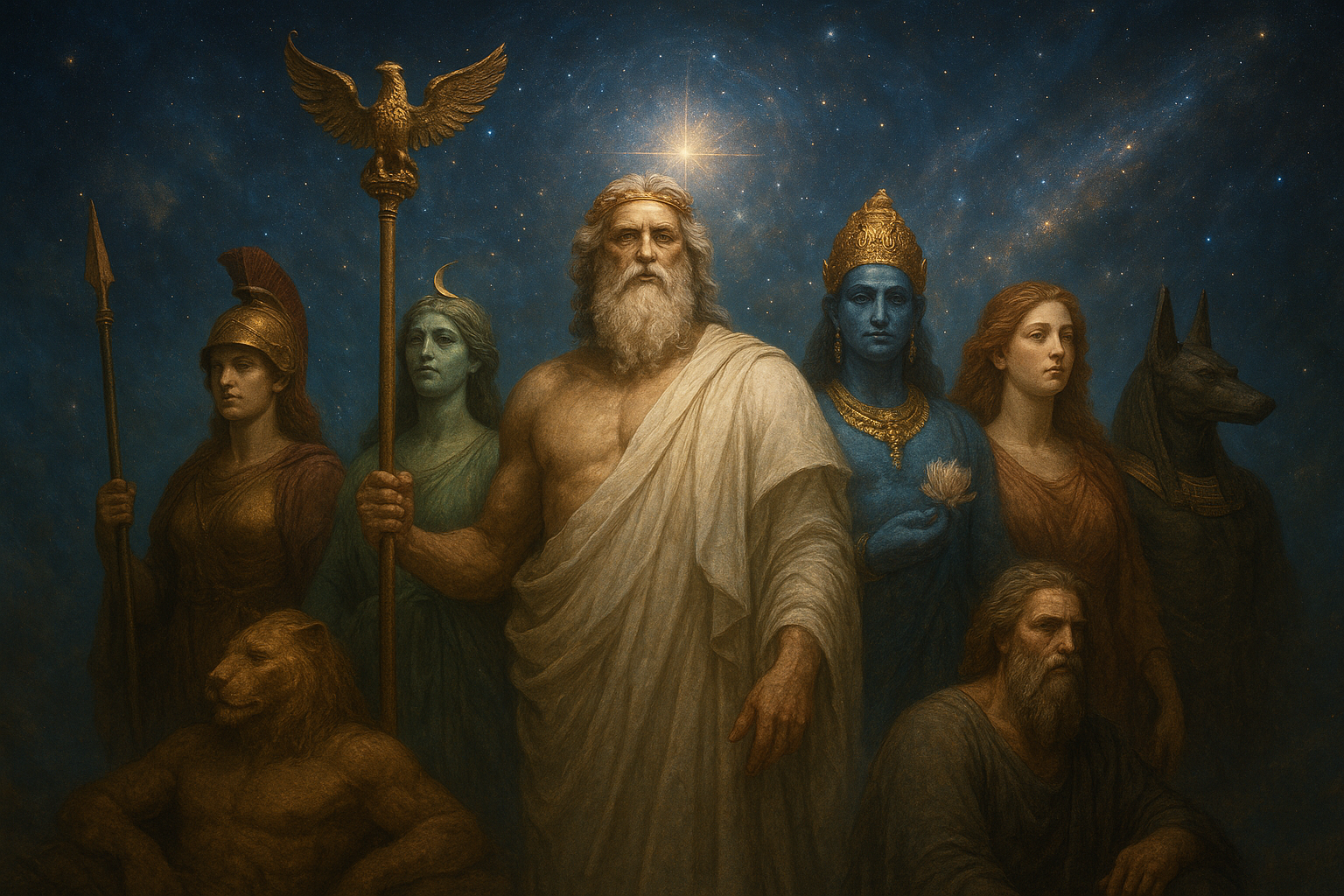
    Throughout human history, the night sky has served not only as a natural calendar and a navigation guide but also as a rich tapestry for storytelling. While many are familiar with the Greek, Roman, and Norse interpretations of the cosmos, there exists a forgotten pantheon—a compendium of celestial tales and deities that spin a narrative often overshadowed by mainstream mythologies.

    Starry Origins: Creation Myths of the Cosmos

    Many cultures have their unique perspectives on the creation of the universe, often attributing it to divine forces. For instance, the Maasai people of East Africa have a profound tale about the origins of the cosmos. They believe that in the beginning, there was only darkness, and then a god named Enkai created the universe. Stars were the offspring of the Moon, supporting a cosmic family half-forgotten by modern astronomers.

    Similarly, in Japanese folklore, there exists the story of Izanagi and Izanami, the divine couple who, through divine wands, stirred the waters below the heavens to create the Japanese islands. Their actions led to the formation of stars as droplets of divine substance, illuminating the sky.

    Cosmic Deities and Celestial Beings

    • The African Celestial Rhino: Among the Tswana people of Botswana, a celestial rhinoceros known as Kgosikgolo wanders the night sky. This mythological being is seen as an eternal watchman of the heavens, representing strength and resilience.
    • Ainu Star Maidens: In the Ainu culture of Japan, stars are seen as maidens, daughters of the great god “Kamuy.” They dance across the sky, and their movements dictate the cycles of life and nature.
    • Maya Astral Spirits: The ancient Maya revered the stars not just as distant balls of gas, but as manifestations of their gods. The Hero Twins, Hunahpu and Xbalanque, defeated the Lords of the Underworld and ascended into the heavens as the sun and moon, illuminating the world with their divine presence.

    The Celestial Dance: Astrology and Ancient Beliefs

    Astral bodies have always influenced human civilizations, with astrology being the bridge between celestial phenomena and human affairs. For the ancient Babylonians, astrology was a science interwoven with mythology. The movement of stars and planets was believed to be the writings of gods across the heavens, foretelling significant events on Earth.

    “The stars in the night sky have been maps, stories, and cosmic guides throughout the history of humanity.”

    In Chinese tradition, the Dragon and Phoenix become celestial indicators, symbolizing the emperor and empress. The positions of these constellations at different times of the year were used to dictate imperial decisions and predict the fates of dynasties.

    The Mystical Zodiac of Ancient Cultures

    The concept of a zodiac is prevalent across various civilizations, each with its unique interpretation:

    • The Egyptian Zodiac: Ancient Egyptians divided the sky into 36 decans, each associated with a god’s influence. They believed that certain decans, when seen at dusk or dawn, held divine messages from the gods.
    • Indigenous Australians: Known for their deep spiritual connection with the land and sky, Indigenous Australians have a zodiac rooted in the creation stories of the Dreamtime. The Emu in the Sky, formed by dark clouds between the stars, is a significant element in their astral lore.
    • Native American Star Maps: For tribes such as the Lakota, stars were not just points of light but symbols of their ancestors. The Lakota Sioux’s beliefs include the legend of the Seven Sisters, mirroring the Greek Pleiades but with its own cultural significance and teachings.

    The Tales Written in the Sky

    Across cultures, the mythologies of the cosmos serve as a canvas upon which societies project their dreams, fears, and explanations of the universe:

    In Mongolian myths, Orion’s Belt is known as the Three Beauties, representing three unforgettable queens known for their beauty and grace. This contrasts with the Asian interpretation of the same three stars as representing the Kuja Dosa, a warning of potential misfortune.

    Meanwhile, the Celtic people named the constellation we know as the Big Dipper the Plough or sometimes the 7 Oxen, describing the inexorable toil of farm life set against the backdrop of the universe’s eternal turning wheel.

    The Enduring Legacy of Celestial Mythology

    These tales, imbued with endless creativity and cultural significance, illustrate a universal human need to find order and meaning in celestial patterns. As modernity races forward, these myths risk being overshadowed by scientific advancement. Yet, they persist, whispering the eternal truth of humanity’s cosmic insignificance and boundless imagination.

    “The cosmos is within us. We are made of star-stuff. We are a way for the universe to know itself.” – Carl Sagan

    In conclusion, exploring the forgotten pantheon of cosmic mythology opens a window into how different cultures perceived the stars as divine actors in the universal play. It reveals a world where science and magic converge, where celestial narratives are as much a part of the human experience as the stars are part of the night sky.

    Therefore, as we gaze upwards, let us remember the vibrant mythologies, the sacred stories, and the forgotten pantheons that help us bridge the gap between earthly existence and cosmic wonder.

  • The Collective Archetype – Patterns Across Civilizations

    The Collective Archetype – Patterns Across Civilizations

    The concept of the collective archetype has fascinated historians, sociologists, and psychologists for decades. Archetypes are recurrent symbols or motifs that appear in the lore of cultures across the world, and they provide deep insights into universal human experiences. The study of these archetypes reveals that, despite geographical and temporal distances, human societies develop strikingly similar myths and symbols.

    Understanding Archetypes

    Archetypes, as first popularized by Swiss psychiatrist Carl Jung, are innate universal psychic dispositions that form the substrate from which the basic themes of human life emerge. Jung noted, “The collective unconscious is common to all; it is the foundation of what the ancients called ‘the sympathy of all things.’” (Carl Jung, 20th century).

    These archetypes manifest in myths, religions, dreams, and literature, embodying shared themes such as the Hero’s Journey, the Great Mother, and the Wise Old Man. Their symbolic nature speaks to fundamental human concerns such as birth, death, and personal development.

    Patterns in Mythology

    Perhaps the most clear example of archetypal patterns is seen in mythology. Many ancient tales, from Homer’s Odyssey in Greece to the Ramayana in India, depict a hero’s journey. This journey involves a departure, initiation, and eventual return, a theme analyzed comprehensively by Joseph Campbell in his seminal work The Hero with a Thousand Faces. Campbell elucidates that “A hero ventures forth from the world of common day into a region of supernatural wonder: fabulous forces are there encountered and a decisive victory is won” (Joseph Campbell, 1949).

    Additionally, many cultures embrace the duality of creation and destruction through archetypes such as the Phoenix – emblematic of rebirth from destruction, a motif echoed in myths from the Egyptians to the Chinese.

    Archetypes in Different Cultures

    Ancient Egypt

    • The concept of maat in Egyptian culture stands for truth and order, with the eponymous goddess personifying universal harmony. The story of Osiris and Isis recounts themes of betrayal, death, and resurrection.

    Classical Greece

    • Greek mythology introduces the archetype of the tragic hero in figures such as Oedipus and Hercules, each seeking redemption through trials and suffering.

    Indigenous Cultures

    • Native American tribes, like the Cherokee, speak of Sky Woman and Earth Diver myths, highlighting the sacredness of creation and humanity’s connection to the earth.

    The Role of Modern Media

    In modern times, archetypal patterns extend beyond traditional myths into contemporary media. Films, books, and video games often draw on ancient storytelling structures, consciously or unconsciously using the Hero’s Journey as groundwork. For example, the epic space opera Star Wars, which creator George Lucas has cited as based on Campbell’s work, illustrates the battle between good and evil through classic archetypal themes.

    Moreover, video games such as The Legend of Zelda series exploit the archetype of the hero striving against evil, offering players an immersive taste of these timeless patterns.

    “When we dream, our minds are carrying the story forward. It’s something that is central to who we are and that remember the past. That’s why myths never die.” – Neil Gaiman, acclaimed author and mythologist.

    The Importance of Studying Archetypes

    Identifying and understanding archetypal patterns enables us to connect with other cultures, recognize our shared humanity, and explore the deepest parts of the human psyche. This exploration fosters empathy and offers perspectives on universal life challenges we all face. As Carl Jung put it, “Knowing your own darkness is the best method for dealing with the darknesses of other people.”

    In conclusion, while specific details and characters may differ, the shared patterns found in myths and stories worldwide reveal an interconnectedness that transcends borders and centuries. Delving into these collective archetypes allows each generation to find meaning in the universal experiences of life, death, love, and heroism, echoing the timeless human quest for understanding.

  • Abstract Divinities – Symbols Beyond Form

    Abstract Divinities – Symbols Beyond Form

    In the vast tapestry of human history, art and spirituality have danced together in a timeless ballet, resulting in a profound repository of symbols that transcend the mere physicality of form. “Abstract divinities” signify more than just visual interpretations; they represent the essence of cultures, beliefs, and the progression of human thought.

    The Nature of Abstract Divinities

    Abstract divinities are not confined to the limits of anthropomorphic representations. Instead, they dwell in the realm of the intangible, the metaphysical, and the esoteric. These symbols may appear in a myriad of forms—including geometric shapes, patterns, or even color arrangements—that encapsulate deeper meanings recognized across cultures.

    • Universal Connectivity: Many abstract symbols signify universal concepts such as infinity, movement, or unity. The circle, for example, is found in countless cultures symbolizing eternity and completeness.
    • Transcendent Ideals: Not concerned with the literal portrayal of the divine, abstract symbols focus on transcending earthly ideals, allowing believers and viewers alike to reach for higher spiritual planes.
    • Expressive Potential: Abstract art permits a breadth of interpretation that accommodates personal experiences and beliefs, encouraging introspection and spiritual exploration.

    Historical Perspectives

    Throughout history, the abstract has been an intrinsic part of religiosity and art:

    Ancient Civilizations

    The ancient Egyptians, with their complex pantheon, employed abstract art forms alongside the more widely recognized imagery of gods like Ra and Anubis. The Ankh, with its looped top, is more than a depiction of life and eternity; it is an abstract representation of the balance between male and female energies, life’s dualities.

    Eastern Philosophies

    In Eastern religions such as Buddhism and Hinduism, abstract representation thrives. The Mandala, a circular symbol used in various meditative practices, represents the universe and is a powerful tool for sacred contemplation. According to Learn Religions, “its apparent simplicity transcends our understanding to unfold deeper psychological awareness and spiritual growth.”

    Modern Artistic Movements

    The 20th century witnessed an explosion of abstract art with figures like Kandinsky and Rothko. In Kandinsky’s words, “Color is a power which directly influences the soul.” Artists used this language to evoke spiritual and emotional responses, much like abstract symbols in religious contexts.

    Symbolism Across Cultures

    Abstract divinities often carry varying meanings across different cultural landscapes but share a commonality in their abstract representations. They convey spiritual truth that, while maybe culturally specific, resonates globally:

    • Yin and Yang: In Taoist philosophy, the yin yang symbol represents balance—a dance between opposing forces that is essential to the harmony of the universe.
    • The Eye of Horus: An ancient Egyptian symbol often associated with health, protection, and royal authority, embodying abstract qualities that transcend its origin.
    • The Om: Vibrating through the cosmology of Hinduism, Buddhism, and Jainism, the Om symbol is an abstract representation of the sacred sound, often described as “the vibration of the universe.”

    The Influence of Technology and Science

    As our world becomes increasingly intertwined with technology, abstract symbols continue to evolve. Code, with its enigmatic algorithms and binary systems, is an abstract language with its own set of divinities—shaping the digital universe in much the same way symbols shaped the spiritual one.

    Space exploration has given rise to new abstract symbols. The NASA insignia, known as the ‘meatball’, incorporates abstract elements that reflect grand ideas of discovery and innovation while paying homage to the astronomical landscapes beyond Earth.

    Modern Reflection and the Future of Abstract Divinities

    In modern times, there is a renaissance of interest in abstract divinities. With global connectivity, ancient symbols are rediscovered and reinterpreted. Individuals seek new forms of spirituality and expression outside traditional frameworks, often turning to abstract symbols to guide their inward journeys.

    “Symbols and archetypes present us with universal motifs that transcend time and place, leading us gently into layers of the unconscious. Here we connect with something profoundly innate and intimately human,” says Joshua Anderson, a noted Jungian therapist.

    Closing Thoughts

    Abstract divinities, those symbols beyond form, are more than archaic relics or esoteric curiosities; they are an ongoing human effort to articulate the inarticulable, to visualize the invisible. They remind us that beneath our differences exists a shared pursuit—finding meaning and connection within the grand, sometimes abstract, architectures of life and the universe.

    In an era where the visual is manufactured, consumed, and discarded at lightning speed, the enduring nature of abstract symbols holds invaluable lessons. Their timelessness and adaptability offer both a lens into our collective past and a beacon lighting the path for future spiritual exploration.

  • Infernal Archetypes – Demons in Myth and Psyche

    Infernal Archetypes – Demons in Myth and Psyche

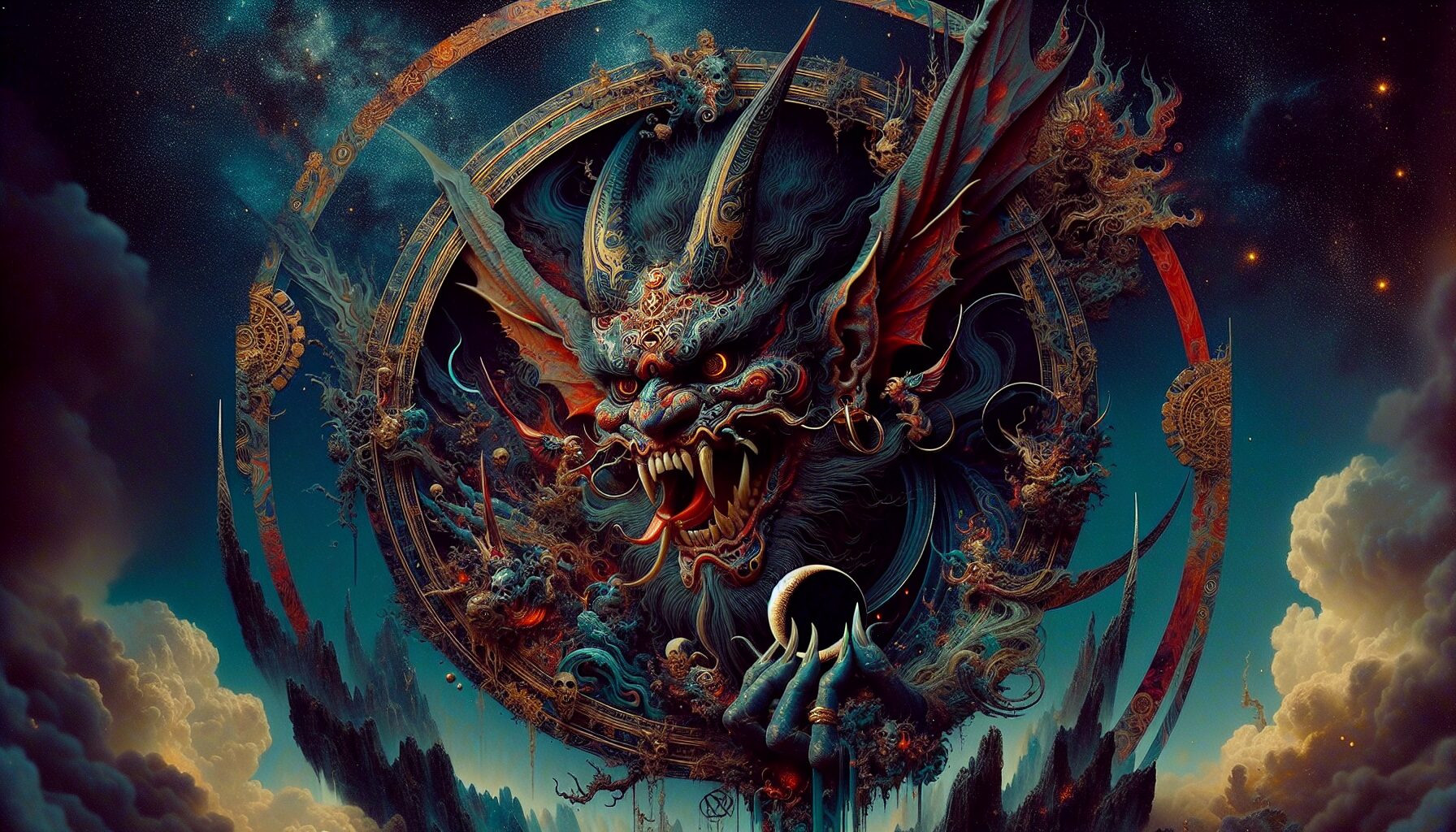
    Throughout history, demons have held a potent place in the myths and stories of cultures worldwide. These infernal entities embody fear, temptation, and the unknown, acting both as figures of evil and as reflections of the human psyche. From the terrifying Asuras of Hindu mythology to the cunning tempters of Judeo-Christian lore, demons represent complex archetypes that bridge the supernatural and the psychological.

    Demons in Cultural Myths

    The presence of demons in mythology is pervasive and diverse. In Japanese folk traditions, Oni are malevolent spirits, often depicted as gigantic, ogre-like creatures wielding iron clubs. These figures are feared for their capacity to disrupt order and bring calamity.

    In contrast, Middle Eastern tales feature the notorious Djinn, which are considered spirits capable of good or evil. These beings, as noted in Islamic culture, can shape-shift, alter reality, and influence human fates, creating narratives that challenge our understanding of free will and destiny.

    Demons and the Human Psyche

    Psychologically, demons can be seen as manifestations of the darker elements of the human mind. Renowned psychoanalyst Carl Jung discussed the concept of the “shadow,” which represents the suppressed aspects of personality. Jungian theory suggests that encountering our inner demons is a necessary part of personal growth and self-discovery.

    “One does not become enlightened by imagining figures of light, but by making the darkness conscious.”

    This quote, attributed to Jung, highlights the importance of integrating these shadowy parts into conscious awareness, thereby reducing their potential to control and manipulate behavior unknowingly.

    Modern Interpretations and Significance

    In contemporary culture, demons continue to captivate and terrify, from horror films to literature. They often symbolize internal struggles such as guilt, addiction, and fear. By externalizing these internal demons, modern narratives provide a platform for audiences to confront and question their own fears and anxieties.

    Thus, demons remain a vital part of both collective myths and individual psychology. They are reminders of the innate balance between light and shadow, good and evil, in the vast tapestry of human experience. The study of these archetypes offers valuable insights into the consciousness, encouraging a journey into the depths of the mind where these infernal entities reside.

    In exploring demons as archetypes of myth and psyche, we can better understand the roles they play in our stories and in our lives—a dance of darkness and light, always compelling, always relevant.

  • Primordial Shadows – Archetypes Beneath Consciousness

    Primordial Shadows – Archetypes Beneath Consciousness

    In the realm of psychology and myth, the concept of archetypes — those universal, archaic symbols and images that derive from the collective unconscious — continues to captivate the modern imagination. These primordial shadows linger just beyond the fringes of our conscious awareness, influencing our thoughts, behaviors, and the stories we tell.

    The notion of archetypes was popularized by the Swiss psychiatrist Carl Gustav Jung. He proposed that these elements are manifestations of themes deeply ingrained in humanity, appearing in various forms across cultures and epochs. Jung stated, “The term archetype is often misunderstood as meaning certain definite mythological images or motifs, but these are nothing more than conscious representations; it would be more correct to call them archetypal images.” (source)

    Understanding Archetypes

    Archetypes reside in the unconscious realm, shaping human experience from the shadows. They are not inherited ideas but rather forms or patterns that mold the way we perceive and interpret the world.

    • The Shadow: Represents the repressed, often darker aspects of our psyche. It embodies the unknown and is frequently reflected in the villains and monsters of myths and stories.
    • The Anima/Animus: Symbolizes the gender opposite to the individual’s conscious identity, reflecting deeper, integral opposites within the self.
    • The Self: Often visualized as a circle or mandala, this archetype represents the unified consciousness and the culmination of integrating other archetypes.

    Impact on Modern Culture

    Archetypes permeate all forms of storytelling, from ancient myths to contemporary narratives. The hero’s journey, as depicted in countless films and novels, draws heavily on archetypal structures. As Joseph Campbell noted in his influential work The Hero with a Thousand Faces, “A hero ventures forth from the world of common day into a region of supernatural wonder…” (Campbell Foundation).

    In film, these archetypal figures are evident in characters like Luke Skywalker and Darth Vader, who embody the hero and the shadow respectively. These narratives resonate with audiences due to their connection to shared human experiences and subconscious motifs.

    “Archetypes are like riverbeds which dry up when the water deserts them, but which it can find again at any time,” Carl Jung wrote, metaphorically describing the timeless shifts of human consciousness (Goodreads).

    The exploration of archetypes invites us to delve into the depths of our psyche, unveiling the universality of human experience beneath the illusion of individual isolation. As we reflect on these primordial shadows, we connect with the shared journey of humanity, navigating the mysterious pathways of the mind.

  • Ethereal Darkness – Spiritual Lessons in Night

    Ethereal Darkness – Spiritual Lessons in Night

    Ethereal Darkness: Spiritual Lessons in Night

    Nighttime has always been a canvas upon which humanity has projected its deepest fears, dreams, and reflections. Where the daytime is filled with the bustle of activity and the relentless pursuit of goals, night embraces us in its quietude, offering valuable spiritual lessons for those willing to listen. Through the ages, philosophers, mystics, and poets have sought to unravel the mysteries of the night, finding in its shadows profound insights into the human experience.

    The Symbolism of Night

    Throughout history, the night has served as a powerful symbol in many cultures, representing both the unknown and the unseen. The dichotomy between day and night often mirrors the dual nature of human existence, balancing between light and shadow, knowledge and mystery.

    “We all have a dark side to our personalities. We all have a dark side and it’s essential because half the world is dark and half the world is light.” ― David Lynch

    For David Lynch, an iconic filmmaker known for exploring the bizarre facets of reality, this balance is crucial. The darkness within us parallels the literal darkness outside—a part of the cosmic order, a necessary component of the universe’s wholeness.

    Night as a Time for Reflection

    Unlike the chaotic distractions of the day, night provides a serene backdrop against which we can reflect on our lives. The quietude of night invites introspection, allowing us to delve into the deeper layers of our consciousness, where truths often lie hidden beneath the surface.

    • Silence and Insight: In the stillness of night, we find the opportunity to listen to our inner voice. Silence provides the mental space needed for contemplation and self-discovery, honing our ability to gauge our emotions and thoughts without the interference of external clatter.
    • Dreams as Guides: Night brings with it the realm of dreams—a fertile ground for spiritual and psychological exploration. As Carl Jung posited, “Who looks outside, dreams; who looks inside, awakes.” Dreams can serve as a bridge to the unconscious, revealing insights that are often ignored by our waking minds.

    The Spirit of the Wilderness

    Another profound aspect of nighttime is its invitation to connect with the natural world. Starlit skies and the nocturnal sounds of nature beckon us to step outside the boundaries of human constructs and embrace the vastness of the cosmos. This connection can foster a sense of humility and wonder, grounding us in the reality that we are but a small part of a larger universe.

    “We are not human beings having a spiritual experience; we are spiritual beings having a human experience.” ― Pierre Teilhard de Chardin

    Teilhard de Chardin’s words remind us that our identities are not confined to our physical selves. By attuning ourselves to the rhythms of nature, especially those unveiled by night, we gain insights into our spiritual essence—our connection to the universe and everything in it.

    Lessons of Letting Go

    The rhythm of day transitioning into night speaks to the natural cycles of endings and new beginnings. Night encourages us to let go of the day’s burdens, fostering a spirit of renewal and acceptance.

    • The Art of Surrender: In yielding to the darkness, we learn the art of surrender—acknowledging what we cannot control and embracing the present moment.
    • Embracing the Unknown: As night obscures our vision, it challenges us to trust beyond what we can see, teaching us resilience and faith.

    Conclusion

    In the embrace of night, we find more than just a counterpart to day; we discover an opportunity for profound spiritual growth. While darkness may often be feared or misunderstood, it holds within it the potential for transformation and enlightenment. By engaging with the ethereal qualities of nighttime, we embark on a journey towards greater self-awareness and cosmic connection.

    As you next find yourself enveloped by the mystique of night, consider the lessons it quietly imparts. Welcome the silence, look within, and embrace the freedom that comes with traversing the shadows. For it is here, in the midst of darkness, that some of the most luminous truths reside.

    For further reading on the spiritual significance of night, you might explore articles by and about Carl Jung and works discussing the philosophies of Pierre Teilhard de Chardin and others.

  • The Shadow Archetype – Darkness as Human Pattern

    The Shadow Archetype – Darkness as Human Pattern

    In the rich tapestry of human psychology, the shadow archetype holds a place of intrigue and complexity. Originally coined by Carl Jung, the shadow represents the unconscious part of the psyche where repressed desires, memories, and emotions reside. This archetype embodies the dark aspects of one’s personality, those parts we wish to conceal from the world and often, from ourselves.

    “Until you make the unconscious conscious, it will direct your life and you will call it fate.” – Carl Jung

    The shadow exists in everyone, a fundamental component influencing behavior and perception. Rather than viewing it as wholly negative, Jung believed facing our shadow is essential for achieving personal growth and self-awareness. This confrontation leads to what he termed individuation, the process of integrating different elements of the psyche to form a well-rounded personality.

    • Origins and Meaning: Derived from the depths of the unconscious mind, the shadow archetype can contain everything outside the light of consciousness. It is often perceived as chaotic or unruly, yet it holds the keys to creativity and insight, providing a deeper understanding of human emotions and motivations.
    • Recognition and Acceptance: Recognizing one’s shadow involves acknowledging parts of oneself that might be deemed unacceptable or uncomfortable. This includes negative traits like anger, envy, and greed, but also positive qualities that may seem too overwhelming or threatening, such as assertiveness or ambition.
    • Integration and Growth: Integration is the process of embracing these dark elements and using them constructively. By harmonizing the shadow with the conscious self, individuals can experience a more authentic and fulfilled life, as understanding the full spectrum of their inner world leads to a balanced existence.

    In literature and myth, the shadow often manifests as a character or force acting against the hero, symbolizing internal struggles reflected outwardly. From Frankenstein’s monster to Jekyll and Hyde, these narratives explore the consequences of ignoring or denying the shadow, illustrating how repression can lead to destruction or chaos.

    “The shadow is a moral problem that challenges the whole ego-personality, for no one can become conscious of the shadow without considerable moral effort.” – Carl Jung

    Recognizing and reconciling with the shadow requires courage and honesty. In doing so, we unlock deeper layers of self-awareness, nurturing connections between our light and dark sides. This integration not only cultivates personal harmony but also fosters empathy and understanding toward others, as we become more attuned to the hidden aspects of human nature.

    For more insights into Jung’s theories, you can visit the C. G. Jung Page.

  • The Infernal Mirror – Demons Reflecting the Self

    The Infernal Mirror – Demons Reflecting the Self

    The Infernal Mirror: Demons Reflecting the Self

    For centuries, demons have plagued the imagination, serving as both terrifying adversaries and potent symbols of humanity’s inner struggles. Whether through literature, art, or religion, these diabolical figures manifest an intricate web of meanings that reflect the multifaceted nature of human psychology and morality.

    The Historical Context of Demonic Imagery

    Demons have been a significant part of mythologies and religions throughout history. From the Assyrian Alû spirits to the malevolent forces described in the New Testament, these entities have personified the darker aspects of the human condition. As Jeffrey Burton Russell, a prominent historian of theology, states, “Demons reflect the social, psychological, and moral dilemmas of their times” (Harvard University Press).

    The role of demons evolved from mere external threats to intricate symbols that cast a spotlight on human imperfections and fears. In many early texts, they were seen as literal beings causing havoc, while later interpretations view them as metaphors for internal battles.

    Psychoanalytic Perspectives: Demons as Archetypes

    The psychoanalytic approach offers a compelling framework for understanding demons as projections of the self. Sigmund Freud’s theories on the subconscious mind suggest that our deepest fears and desires often manifest as external symbols. Carl Jung expanded on this by introducing the concept of archetypes.

    “Demons are symbolic of the shadow – the repressed aspects of our psyche that we refuse to acknowledge.” – Carl Jung

    In Jungian analysis, the shadow is a part of the unconscious mind composed of repressed weaknesses and instincts. When these elements remain unexamined, they can project outwardly in the form of ‘demons,’ representing the struggle between our conscious ideals and subconscious drives.

    Demons in Literature: A Mirror to Morality

    Literature has long been a medium through which the struggle between good and evil is explored. Demonic figures in stories often serve as mirrors of the protagonists’ internal conflicts and societal dilemmas. In John Milton’s “Paradise Lost,” Satan is depicted not just as the ultimate evil but as a complex character embodying rebellion, pride, and ambition.

    William Blake, a well-known critic of Milton, argues that Milton was “of the Devil’s party without knowing it,” suggesting that the poet subconsciously aligned more with Satan’s rebellious nature than with divine authority. This notion underscores how demons can symbolize the attractive yet destructive qualities within ourselves.

    Religious Interpretations: Redemption and Damnation

    In religious contexts, demons often embody the struggle between sin and virtue. The Catholic Church’s depiction of demonic possession symbolizes a soul at war, torn between divine grace and mortal sin. Exorcisms traditionally serve as rituals of purification, the ultimate battle between good and evil fought within the individual.

    Father Gabriel Amorth, a renowned exorcist, described in his writings that “demons are terrifying reminders of the consequences of human error and the potential for redemption through faith” (Catholic Education Resource Center).

    The Artistic Depiction: A Reflection of Culture

    In art, demons have been depicted in myriad forms, reflecting cultural attitudes toward sin, morality, and human nature. The Medieval period saw an intense focus on demonic forms as both literal creatures of Hell and allegories for earthly vices. Hieronymus Bosch’s nightmarish landscapes and figures represent not only religious warnings but also a mirror to the human imagination.

    Mary Douglas, a social anthropologist, observed that “artistic depictions of demons often reflect societal boundaries, embodying the chaos and disorder that lie just beyond the borders of accepted norms” (Oxford Reference).

    The Modern Demon: Technology and Isolation

    In contemporary society, demons have taken on new forms, often embodying the challenges presented by modern technology and urban isolation. Films and literature explore themes of technological corruption, where artificial intelligence and digital landscapes spawn new ‘demons’—manifestations of our fear of losing control to an increasingly automated world.

    For instance, the demon in Fyodor Dostoevsky’s The Possessed can be seen as a precursor to modern interpretations of societal upheaval and ideological madness, reflecting fears of personal and communal transformation.

    Conclusion: The Everlasting Presence of Demonic Reflection

    Demons, in their myriad forms, continue to serve as powerful symbols reflecting the deepest conflicts within the human soul. Their presence persists as a testament to our continued struggle with personal and societal challenges. As external manifestations of our inner fears and desires, demons compel us to confront aspects of the self that we would rather hide.

    From ancient texts to modern cinema, these infernal reflections question, challenge, and ultimately, illuminate the complexities of the human experience.

    As we continue to evolve, so too will our demons, adapting to new contexts and challenges, yet always holding up the mirror to our innermost beings, forcing us to question who we are and what we might become.

  • Psychic Archetypes – Human Patterns Through Time

    Psychic Archetypes – Human Patterns Through Time

    Throughout history, human civilization has been captivated by the idea of archetypes—universal patterns and symbols residing in the collective psyche. These archetypes are recurring motifs found across cultures, encapsulating the essence of human experience in a truly profound way.

    The Origins of Archetype Theory

    The concept of archetypes was first popularized by Swiss psychiatrist Carl Gustav Jung. Jung proposed that these archetypes are not learned but innate elements of the human psyche, manifesting as common themes in dreams, myths, art, and behaviors worldwide.

    “Archetypes… are residues of the most ancient and universal types of expressions of the human mind. They tell us stories of the struggles and triumphs of humanity.” — C.G. Jung

    Jung identified several key archetypes, including the Self, the Shadow, the Anima/Animus, and the Persona. Each of these represents different facets of the human experience, navigating the inner world and reflected in our outer reality.

    Key Archetypes Across Cultures

    Despite cultural differences, similar archetypes emerge around the globe, embodying fundamental aspects of life and identity.

    • The Hero: Seen in figures such as Hercules from Greek mythology and Knight Arthur from the Arthurian legends, the Hero embarks on a journey filled with trials and transformations.
    • The Mother: The nurturing force represented by deities like Gaia or Demeter, symbolizing fertility, protection, and nourishment.
    • The Trickster: A shape-shifting character with cunning and wit, found in Norse Loki and Native American Raven mythologies, often disrupting norms to challenge or enlighten.

    The Psychological Significance of Archetypes

    Archetypes carry significant psychological weight. They guide individuals through their personal growth and development.

    “An understanding of the interplay between different archetypes leads to greater self-awareness and personal integration.” — Analytical Psychology Studies

    The Hero’s Journey, for instance, illustrates the path of self-discovery and transformation, suggesting that each person’s life is a quest filled with opportunities for growth and learning.

    Archetypes in Modern Culture

    The influence of archetypes extends into modern literature, film, and art. From the epic quests of Frodo Baggins in The Lord of the Rings to the introspective journey of Neo in The Matrix, these narratives tap into archetypal patterns that resonate deeply with audiences.

    Consider Star Wars, where archetypal characters like Luke Skywalker (the Hero), Yoda (the Wise Old Man), and Darth Vader (the Shadow) epitomize the timeless struggle between light and darkness, good and evil.

    The Future Role of Archetypes

    In an ever-evolving society, will archetypes continue to hold relevance? As psychologists and anthropologists delve deeper into the workings of the mind, the archetype framework may expand or adapt, yet their core essence will likely remain intact.

    They offer a lens through which to view contemporary challenges and uncertainties, providing insight into human behavior and inspiring creativity and tradition across generations.

    Psychic archetypes weave the tapestry of human history—from the distant past to an unknowable future—showcasing our shared journey through time. As we embrace these patterns, we perhaps draw closer to understanding the complexities of our collective psyche, enabling us to connect with one another on deeper, more meaningful levels.

    Conclusion

    Psychic archetypes signify a universal language of the human soul. As we continue to study and interpret these archetypes, we unlock timeless wisdom and find parallels between ancient lives and modern experiences. By embracing these enduring patterns, humanity may gain not only a greater sense of cultural identity but also profound personal insight.

    For further reading, consider exploring Jung’s seminal works, such as Collected Works, to dive deeper into his theories and insights.

  • The Demon’s Labyrinth – Occult Journeys Through Shadow

    The Demon’s Labyrinth – Occult Journeys Through Shadow

    The world of the occult, veiled in mystery and intrigue, is often seen as a realm where shadows intertwine with the human psyche’s darkest recesses. It is a place where the lines between reality and fantasy blur, creating a labyrinth of fear and enlightenment for those who dare to enter.

    The Allure of the Occult

    For centuries, individuals have been drawn to the occult in search of power, knowledge, and sometimes, a deeper understanding of existence itself. The allure of the unknown is irresistible, enticing seekers into a labyrinthine journey fraught with peril and revelation.

    “Do not be deceived; I was not drawn to the occult by lurid spookeries or quests for power. I sought the occult for truths of the universe that I felt had been hidden too long.” – H.P. Lovecraft

    H.P. Lovecraft, a master of the mysterious, encapsulates this allure beautifully. The occult is not just about dark rituals and enigmatic symbols; it is an exploration of the hidden truths of the universe.

    Charting the Labyrinth: Common Themes and Symbols

    Within the demon’s labyrinth, seekers encounter a plethora of themes and symbols, each carrying a narrative as old as time:

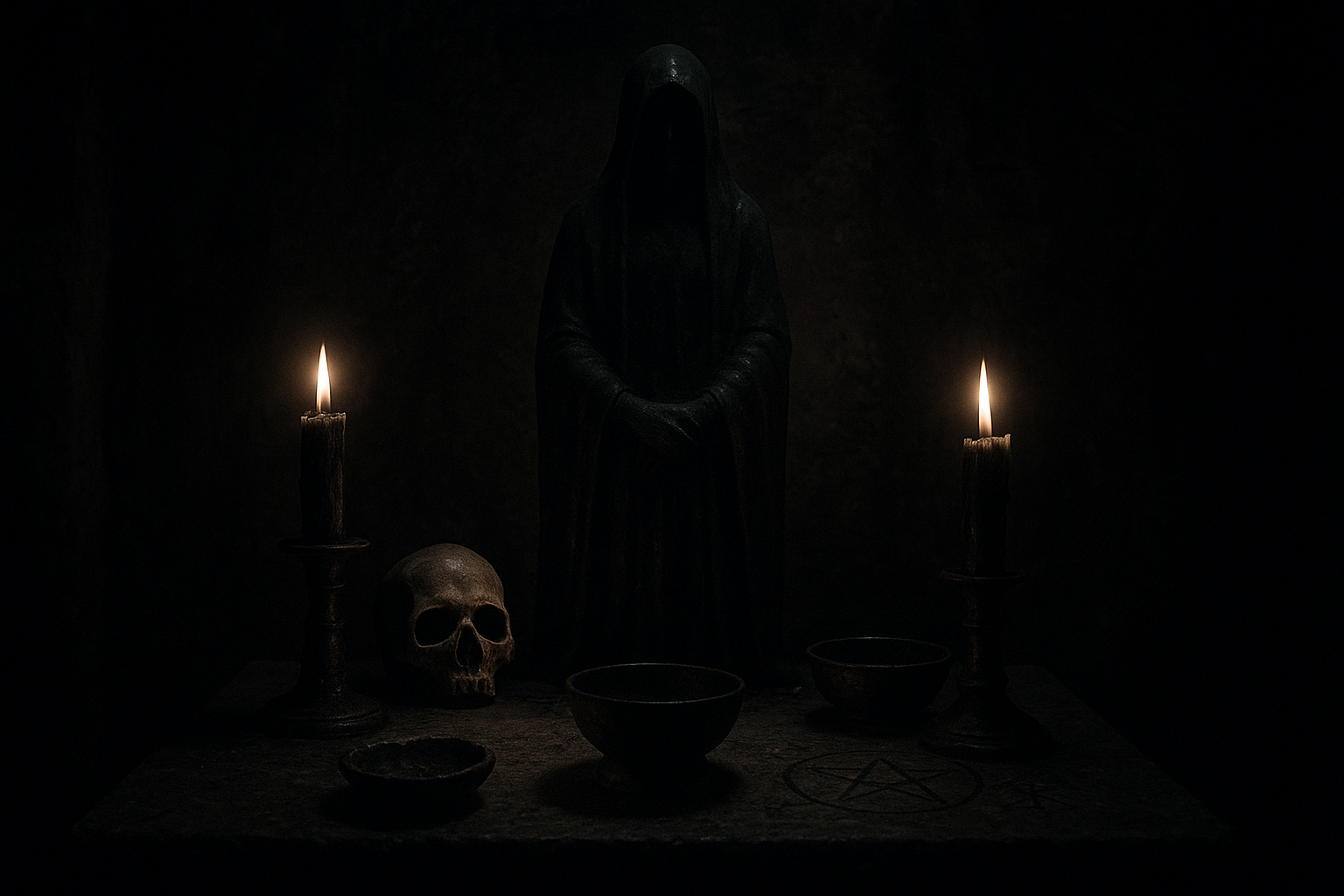
    • The Pentagram: Often misrepresented, the pentagram serves as a powerful symbol in many occult traditions, representing the elements and the spirit interconnected.
    • The Ouroboros: An ancient symbol depicting a serpent eating its own tail, symbolizing the cyclical nature of life and the death-rebirth continuum.
    • The Shadow: Inspired by Carl Jung’s Shadow Archetype, representing the repressed parts of the human psyche, often explored and confronted within occult practices.

    These symbols are prevalent not just in occult manuscripts but also in literature, art, and even modern media, often sparking curiosity and sometimes fear.

    The Journey Through Shadow

    Walking through the demon’s labyrinth is as much an internal journey as it is an external one. It forces the seeker to confront the darker aspects of their personality and the fears they hold. Carl Jung once posited,

    “Knowing your own darkness is the best method for dealing with the darknesses of other people.” – Carl Jung

    This journey is transformative, as it often leads to a reconciliation with one’s own shadow, fostering self-awareness and inner strength.

    The Hazards of the Occult Path

    However, navigating the labyrinth is not without risk. The potential for losing oneself to the darkness can lead to fragmented identities and existential dread. Throughout history, there are numerous accounts of individuals who have delved too deeply, losing touch with reality or falling into hopeless despair.

    Therefore, responsible exploration of the occult requires a grounding in self-awareness and often guidance from mentors or structured groups, such as those found in traditions like Wicca or Hermeticism, which offer frameworks for understanding and growth.

    The Modern Perspective

    In the contemporary era, interest in the occult has resurged. With the rise of digital communities and resources, more people are exploring these ancient practices than ever before. Some seek empowerment, others a sense of community, and many simply wish to explore their spiritual beliefs outside mainstream religion.

    This renewed interest sometimes leads to what has been termed “new-age occultism”, characterized by a blend of ancient wisdom with modern beliefs. The digital age has democratized access, allowing a wealth of information and misinformation to coexist.

    Conclusion

    The demon’s labyrinth remains a potent metaphor for the occult journey: a venture through the unknown, testing our fears and beliefs, and offering the potential for profound self-discovery. Whether approached with reverence, skepticism, or curiosity, it continues to challenge and enthrall those who walk its shadowed paths.

    Ultimately, the journey is as personal as it is universal, a timeless exploration of the human spirit in search of meaning and transcendence in the labyrinth of shadows.