Tag: life

  • Starlit Graves – Mythic Death Across the Cosmos

    Starlit Graves – Mythic Death Across the Cosmos

    Starlit Graves: Mythic Death Across the Cosmos

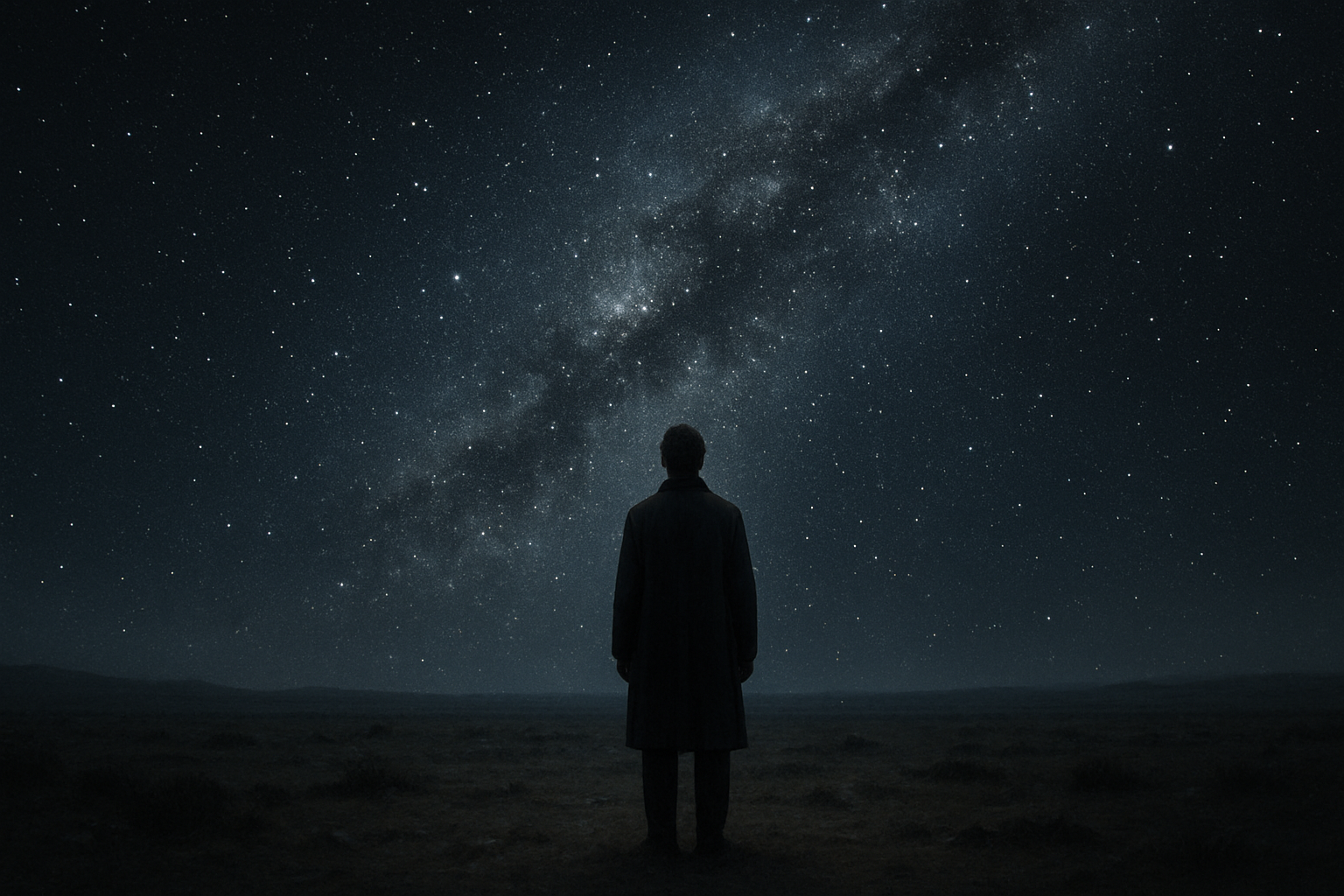
    Throughout human history, the cosmos has inspired countless myths and stories, often portraying it as a realm of mystery and power. In many cultures, the stars serve not only as navigational beacons or markers of time but also as the resting places of gods, heroes, and spirits. This mythic intertwining of celestial phenomena and death creates a rich tapestry of beliefs that reflect both our awe of the universe and our understanding of mortality.

    The Celestial Sphere: A Mythic Perspective

    The night sky, with its expanse of stars, has long been interpreted as a cosmic stage where the stories of life and death unfold. Through their observations, ancient cultures developed intricate mythologies that attributed spiritual significance to the constellations and planetary movements.

    Myths of Cosmic Heroes and Heroines

    • Orion: In Greek mythology, Orion was a giant huntsman whom Zeus placed among the stars as the constellation Orion after his death. Greek mythology often immortalized heroes in the sky, symbolizing their eternal presence and influence. “Orion, the great hunter, eternally pursues the Pleiades across the sky,” writes Encyclopaedia Britannica.
    • Chilam Balam: The Maya believed that deceased kings and heroes ascended to the heavens and became stars. The sacred book, Chilam Balam, records stories of these celestial transformations, mirroring their enduring legacy.
    • Sirius and Anubis: The ancient Egyptians connected the star Sirius to Anubis, the god of death. They viewed Sirius’s heliacal rising as a symbol of rebirth and renewal, coinciding with the annual flooding of the Nile and a new life cycle.

    Cosmic Judgments and Afterlife Destinations

    Various cultures have envisioned the cosmos as both a physical and spiritual realm. Here, cosmic events often coincide with beliefs about judgment, reward, and punishment in the afterlife.

    “The Hopi believe that upon death, the spirit travels west to the ‘Afterlife World.’ As the spirit journeys, it is guided by the stars, which act as spirits of ancestors leading the deceased on their path,” explains Astronomer Bryan Bates in his study of Native American celestial navigation.

    • Egyptian Duat: The Duat was the realm of the dead and a dimension within the sky for the Egyptians. This journey through the night sky was fraught with peril but guided by celestial markers such as the Milky Way.
    • Nordic Valhalla: In Norse mythology, those who die in battle are chosen by Odin to reside in Valhalla, often envisioned as a place in the heavens. This realm of warrior spirits ties the concept of heroic death to a celestial afterlife.

    Modern Interpretations and Symbolism

    As our understanding of the universe has evolved, so has the symbolic use of celestial imagery in literature, art, and popular culture. Modern interpretations often reflect a blend of ancient mythologies with contemporary scientific discoveries.

    • Stardust and Rebirth: Modern astrophysics posits that the elements within our bodies were formed within stars. This idea resonates with the notion of cosmic rebirth and aligns with ancient philosophies. As Carl Sagan famously said, “The cosmos is within us. We are made of star-stuff.” This view reinforces the mythic cycle of death and rebirth on a cosmic scale (Sagan, Smithsonian Magazine).
    • Literary Themes: Many writers and poets draw upon these cosmic themes as metaphors for existential contemplation. Consider the works of Dante Alighieri, whose Divine Comedy portrays the heavens as both a literal and allegorical representation of the soul’s journey.

    Conclusion: The Eternal Dance of Life and Death

    The universe, with its grand and mysterious vistas, inspires a profound contemplation of life and death. Across cultures and time, humanity has turned its gaze upward, seeking narratives in the stars to make sense of existence and its inevitable end. This search for understanding and meaning echoes the eternal dance of life and death, woven into a cosmic fabric that continues to captivate our imaginations.

    In embracing these myths, we connect with a universal heritage—a shared human experience that transcends individual cultures and speaks to the interconnected nature of life, death, and the cosmos itself. Whether seen as graves or cradles, the stars compel us to ponder our place in the universe and the stories we create to explain it.
  • Alien Funerals – Extraterrestrial Rituals of Ending

    Alien Funerals – Extraterrestrial Rituals of Ending

    Alien Funerals: Extraterrestrial Rituals of Ending

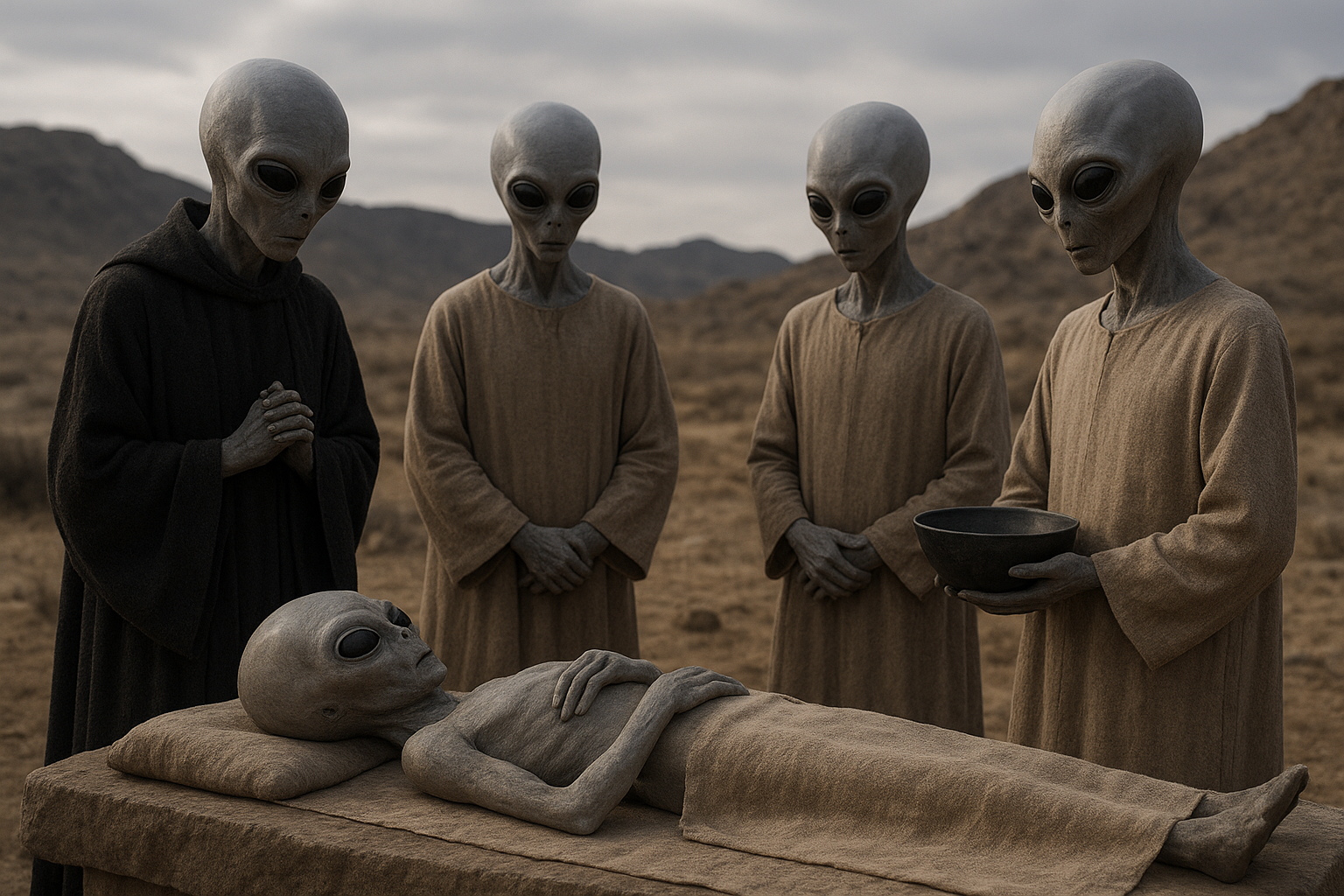
    The vastness of our universe suggests that life, in various forms, could exist beyond our planet. While much attention is given to the possible culture and technologies of extraterrestrial beings, one intriguing aspect often overlooked is how these life forms might handle death. What might alien funerals entail?

    Imagining the funerary rituals of extraterrestrial beings opens the door to endless possibilities. Just as Earth’s cultures vary widely in how they honor the dead, so too might alien civilizations have developed unique practices and beliefs.

    Possibilities in Alien Funerary Practices

    • Cremation and Dispersal: Much like some Earth cultures, extraterrestrial beings may opt for cremation. The remains could be scattered across their home planet or even into space, symbolizing a return to the cosmos.
    • Technological Transformations: Considering advanced technology, some civilizations might transform deceased individuals into digital consciousness, allowing the deceased to exist forever in a virtual world. This idea reflects the human aspiration showcased in science fiction films like Transcendence and television series like Black Mirror.
    • Planetary Burial: Planets or moons within their solar system could be designated as sacred burial grounds. These bodies would serve as eternal resting places, akin to cemeteries on Earth.
    • Starship Memorials: In honor of fallen comrades, certain species might launch star-bound memorial vessels, forever traversing the galaxy. Such spacecraft could serve as both mausoleums and monuments to achievement, embodying the eternal journey.

    Interstellar Philosophies on Death

    While earthly customs are deeply rooted in religious and cultural beliefs, alien species might approach death from an entirely different perspective. The advanced races might view passing as a step in a cyclical process, akin to the Hindu belief in reincarnation or the idea of returning one’s essence to a universal life force.

    Claude La Fray, an acclaimed ufologist, reflects, “The universe is rich with mysteries. Conceiving of alien life without acknowledging their philosophies on existence and mortality would narrow our view of what it means to be sentient.” His insights can be further explored in publications such as “The Universal Soul: Exploring Extraterrestrial Consciousness”.

    “The whole universe is in a symbiotic relationship with itself: life and death as processes more fundamental than what we as humans would categorize as ‘an ending.’” – Dr. Linda Littlejohn, Astrobiologist at The University of Exeter

    As we continue our search for extraterrestrial life, pondering these rituals offers a window into understanding the profound ways in which alien life forms might navigate the unavoidable reality of death.

  • The Shadowed Threshold – Death as Portal

    The Shadowed Threshold – Death as Portal

    Death has long been portrayed as the ultimate unknown, a shadowed threshold that every human must one day cross. Throughout history, exploration of this concept has influenced the narratives of cultures and spiritual traditions across the globe. Yet, within the mystique of this inevitable end lies the tantalizing notion of death as a gateway, a corridor to new beginnings or realms often unexplored by the living.

    Understanding Death Beyond the Finality

    Conventional views of death regard it as the closure of life’s chapter, an end to personal narrative. However, numerous philosophies and faiths suggest a transformative aspect to death, positioning it as a vital transition rather than a conclusive halt. In various texts, death is not merely a cessation but a metamorphosis into something far greater.

    “Death is the beginning of immortality.” — Maximilien Robespierre

    Robespierre’s words echo the belief that life as we know it is a limited perception, and death could be a movement towards an immortality of a different nature. This concept is reflected in many spiritual doctrines, where death does not stand as an end but as a transformative passage to a profound rebirth or enlightenment.

    Near-Death Experiences: Glimpses Beyond

    Near-death experiences (NDEs) have captured interest across scientific and anecdotal spheres. Dr. Raymond Moody, in his seminal work, “Life After Life“, documented countless cases where individuals describe passage through a tunnel, encounters with ethereal beings, and overwhelming senses of peace, suggesting a non-terminal characteristic of death. (Life After Life)

    While empirical evidence around NDEs remains inconclusive, these experiences shed light on how individuals perceive death as less of a consummation and more of an adventurous transition. For many, these narratives affirm beliefs that death indeed acts as an interdimensional portal.

    Mythologies and Traditions: Mapping the Afterlife

    Across various cultures, mythologies have personified the idea of death as a gateway. The ancient Egyptians meticulously documented their beliefs of the afterlife, where the soul navigated dangerous realms guided by sacred texts such as the Book of the Dead. Similar concepts appear in The Tibetan Book of the Dead, guiding souls through the bardos — intermediary states after death.

    “The supreme bliss is in the understanding of death. With it, all fears vanish.” — Bhagavad Gita

    The Bhagavad Gita, a cornerstone of Hindu philosophy, teaches that death is a transition of the soul into new forms and realms. Such perspectives highlight a universal human curiosity and the desire to map the terrain beyond life’s boundary.

    Physiological and Philosophical Perspectives

    From a physiological standpoint, neuroscientists have explored the brain’s activity as life fades. Hypotheses suggest that the brain might play a final vivid symphony of sensory experiences, possibly explaining mystical and peaceful sensations reported in NDEs.

    Philosophically, existential thinkers such as Jean-Paul Sartre and Martin Heidegger have pondered the meaning of death. According to Heidegger, confronting the inevitability of death can bring authenticity to life, prompting existential introspection. (Stanford Encyclopedia of Philosophy on Heidegger)

    The Portal Within: Personal Reflections

    Ultimately, contemplating death as a portal extends beyond cultural and philosophical examination towards a deeply personal and intimate journey. Each individual grapples differently with the questions of existence and what lies beyond. Acknowledging death as a passage can engage us in profound reflection, encouraging a richer, fuller embrace of life itself.

    Personal reflections on death as a transition can foster resilience, shape our ethical frameworks, and inspire compassionate engagement with the world. For many, opening up to the notion of a transformative threshold invites both solace and a sense of purpose, transforming the inevitable end into a hopeful continuance.

    Embracing the Unknown

    Evolving views on death as a portal do not aim to dispel fear entirely. Rather, they offer new ways of understanding our existence and potential beyond. While the shadows of the threshold may remain, approaching death with curiosity and openness can illuminate life with deeper meanings and connections.

    As the great mystic Rumi once shared:

    “Goodbyes are only for those who love with their eyes. Because for those who love with heart and soul, there is no such thing as separation.” — Rumi

    In this light, death indeed emerges as less of an end and more of an enduring embrace — a transition into the unknown that is rich with possibility and profound in its promise.

  • The Obscure Spiral – Mystery in Mythology

    The Obscure Spiral – Mystery in Mythology

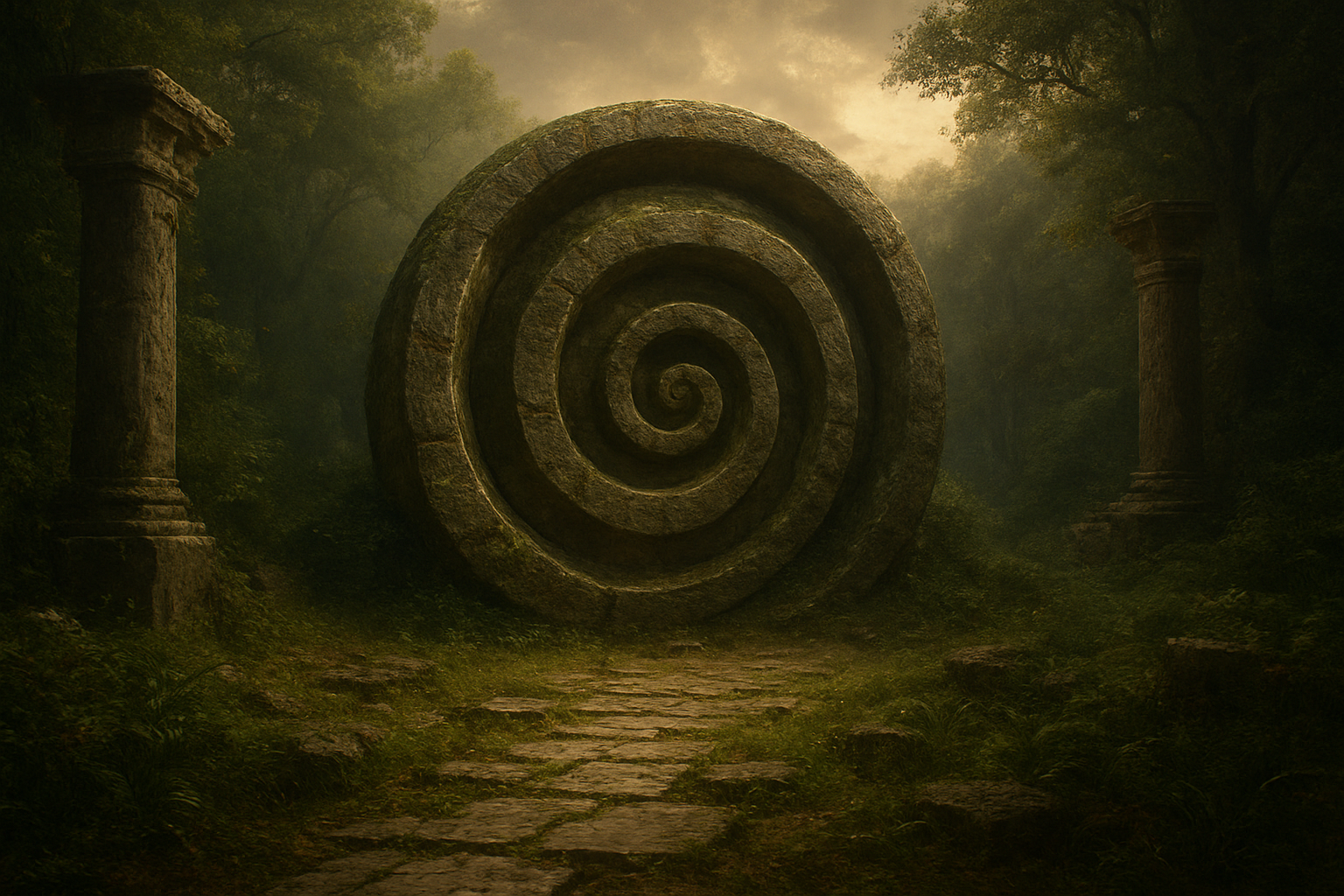
    The spiral is a timeless and universal symbol found throughout our world, from the swirl of galaxies and hurricane clouds to the structure of DNA. Its presence in ancient art, architecture, and mythology across different cultures suggests deep symbolic meanings and connections to life, death, and the cyclical nature of existence.

    The Spiral in Ancient Cultures

    • Celtic Spirals: The Celts, who inhabited much of Western Europe during the Iron Age, prominently featured spiral motifs in their art. These spirals were often associated with the sun, and the natural cycle of life, death, and rebirth. The triple spiral, or triskelion, is particularly notable, representing the interconnectedness of earth, water, and sky.
    • Egyptian Spirals: In ancient Egyptian culture, spirals were connected to the cycles of birth and rebirth. The symbol of the spiral can be found in hieroglyphics and artworks, often related to the flow of time and the process of transformation. The spiral also symbolized the rise of the soul to the heavens, indicating its profound spiritual significance.
    • Greek Spirals: In Greece, the spiral represents the concepts of infinity and continuity. It was a core element in much of their architectural ornamentation, such as with the Ionic column capitals. The spiral design emphasizes the perpetual flow and progression of life and learning.

    A Universal Symbol of Dynamics

    The spiral not only permeates human creative expressions but also finds striking parallels in nature, resonating with the natural geometries that shape our world. As a universal symbol, the spiral is a metaphor for dynamic balance and change.

    “The logarithmic spiral is interesting because it appears in the growth patterns of many shells and biological organisms. Its mathematical properties are such that the spiral grows and ages in a manner similar to other forms found in nature.” – Wolfram MathWorld

    The Spiral in Mythology and Spirituality

    The notion of the spiral as a spiritual or mystical symbol traverses numerous mythological narratives and spiritual practices, where it is often tied to personal and cosmic evolution.

    • Hindu and Buddhist Traditions: In Hinduism and Buddhism, spirals are symbolic of the journey inward, reaching towards enlightenment. The mandala, a prominent symbol in these traditions, often employs spiralic designs, illustrating the path from the outer reality to the inner core of spiritual truth.
    • Native American Symbolism: Among Native American tribes, the spiral symbol appears frequently. For instance, the Hopi see the spiral as a representation of their migration journeys and life paths. Spirals are considered sacred symbols of union and interconnection within the universe.

    An Enduring Enigma

    Despite the ubiquity and age-old prominence of spirals in human culture, they remain enigmatic. One plausible explanation for their widespread appeal may be rooted in their visual and mathematical harmony. Spirals possess both simplicity and complexity, making them adaptable symbols for a myriad of cultural, philosophical, and scientific interpretations.

    As we delve into the mysteries of spirals, we are reminded of the words of American astronomer Carl Sagan who once reflected on the interconnectedness of cosmos and life on Earth:

    “The cosmos is within us. We are made of star-stuff. We are a way for the universe to know itself.” – Carl Sagan

    This poetic connection resonates profoundly with the significance of the spiral as a representation of the intricate dance of life. It is a symbol that invites reverence and reflection, beckoning us to contemplate the unseen patterns that weave through the tapestry of existence.

    Conclusion

    The spiral is more than just an artistic motif; it’s an integral archetype that spans across mythologies, spiritual traditions, and scientific understanding. Rooted in our ancestors’ attempt to make sense of their world, the spiral continues to fascinate and challenge us to ponder the deeper connections embedded in our universe.

    Embracing the mystery of the spiral can help us appreciate the intricate patterns that underlie our existence and inspire a deeper connection with the rhythms of life and the cosmos.

  • The Cosmic Silence – Death as Mystery

    The Cosmic Silence – Death as Mystery

    The universe is expansive, filled with complexities and unknowns that often lead us to ponder the great mysteries of existence. Among these, the enigma of death continues to be one of the most profound. As we navigate through life, death remains the ultimate horizon we cannot see beyond—a cosmic silence that echoes with unanswered questions.

    The Biological Perspective: End of a Cycle

    From a biological standpoint, death is merely the cessation of bodily functions. Cells fail to regenerate, and vital systems come to a halt. Yet, even with this clinical understanding, the mystery deepens when we consider the intricate processes that precede this finality. Is there more to death than the mere stopping of the biological mechanisms?

    • Cellular Death: Our cells undergo a process called apoptosis, or programmed cell death, which is essential for growth and maintenance. Through this lens, death is an integral part of life itself.
    • Aging: Aging, the gradual decline of biological functions, leads to death. Despite advances in medicine, the mystery behind why we age and die is still largely unresolved.

    Cultural and Philosophical Views on Death

    Across cultures and throughout history, death has been a central theme of philosophical inquiry, art, and religion. It is through these lenses that we seek to find meaning or solace in the end of life.

    • Religious Perspectives: Many religions offer interpretations of what lies beyond death. For instance, Buddhism discusses the cycle of rebirth, while Christianity speaks of an eternal life. These beliefs provide comfort, suggesting a continuation beyond physical death.
    • Philosophical Considerations: Philosophers like Socrates viewed death as a gateway to the ultimate truth. In Plato’s “Phaedo,” Socrates argues that the soul is immortal and that death is the philosopher’s soul’s release into a higher state of existence (Plato, Phaedo).

    Scientific Theories on Consciousness After Death

    The question of consciousness after death remains one of science’s most tantalizing mysteries. While empirically elusive, several theories offer perspectives worth considering:

    • Quantum Consciousness: Theories like that of physicist Roger Penrose suggest that consciousness arises from quantum processes. This line of thought implies that consciousness might persist after bodily death in some form, though this remains theoretical and highly controversial.
    • Near-Death Experiences (NDEs): Stories of NDEs often describe seeing bright lights or experiencing a sense of peace. Research, such as by Dr. Sam Parnia, has explored these phenomena, suggesting they might be evidence of consciousness continuing post-mortem. Still, scientific validation remains incomplete.

    Death in Literature and Art

    Through literature and art, humanity has long sought to interpret and give voice to the elusive concept of death. Creators have portrayed it both as an end and a transmutation into something greater:

    • Literary Explorations: In poetry and prose, death often symbolizes not just an ending but a complex transition. Emily Dickinson, for instance, frequently wrote about death as a journey, evident in poems such as “Because I could not stop for Death” (Dickinson).
    • Artistic Depictions: Death in art is often symbolized through allegories and abstract representations that seek to capture its ineffable essence. The Renaissance period, in particular, was rife with sumptuous paintings exploring mortality and the afterlife, such as Hieronymus Bosch’s “The Garden of Earthly Delights.”

    Personal and Collective Reflection

    Death’s mystery prompts introspection on both personal and collective levels. The conversations about mortality lead to deeper inquiries into the value and temporality of life:

    • Personal Contemplation: Facing the inevitability of death often leads individuals to re-evaluate life choices and seek deeper fulfillment.
    • Societal Impact: As seen during global events such as pandemics, collective encounters with mortality spur shifts in cultural values and priorities.

    “No one wants to die. Even people who want to go to heaven don’t want to die to get there. And yet death is the destination we all share. No one has ever escaped it. And that is as it should be, because Death is very likely the single best invention of Life. It is Life’s change agent. It clears out the old to make way for the new.”

    —Steve Jobs

    Conclusion: Embracing the Mystery

    Despite centuries of inquiry and reflection, death remains one of life’s greatest mysteries. While science, philosophy, and religion each offer partial answers, the full truth eludes us. Perhaps, in accepting the mystery of death, we find a fuller appreciation for life. As we ponder the cosmic silence, we are reminded of our own temporary existence, prompting us to live with greater urgency and respect for the unknown.

  • Arcane Funeral Rites – Occult Ceremonies of Passage

    Arcane Funeral Rites – Occult Ceremonies of Passage

    Arcane Funeral Rites: Occult Ceremonies of Passage

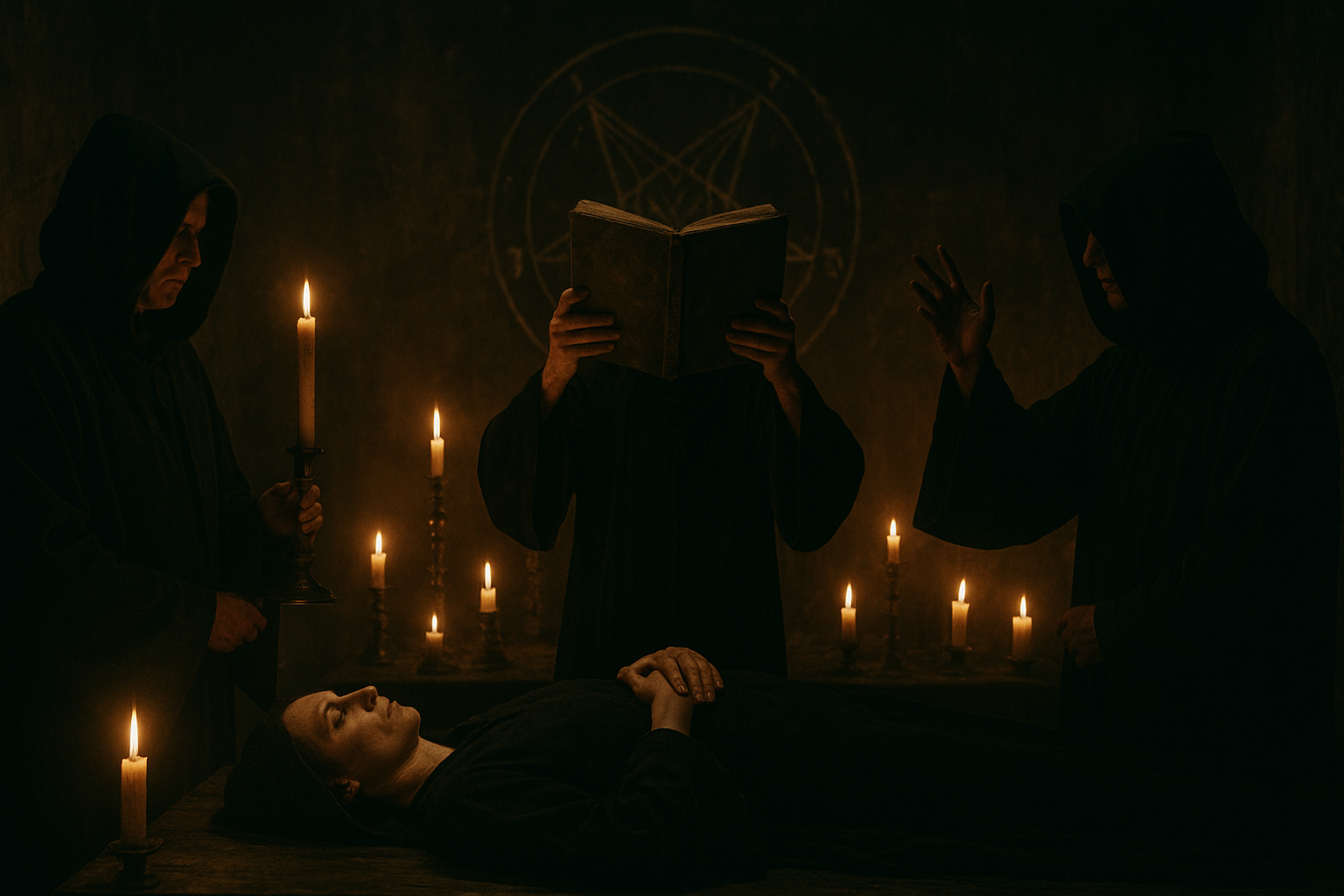
    Humanity has long been fascinated by the mysteries of life and death. From the dawn of civilization, various cultures have devised elaborate rituals to honor the dead, reflect beliefs about the afterlife, and soothe the living. In the tapestry of global funeral practices, occult ceremonies hold a shadowy allure, promising insight into the unknown and a connection to ancient wisdom.

    The Origins of Occult Funeral Rites

    The term “occult” originally meant “hidden” or “secret.” While today it often carries connotations of dark magic or forbidden practices, many occult funeral rites were simply rituals shrouded in secrecy, passed down within small communities or chosen families. These rites often reflect an intimate relationship with the natural world and the forces believed to govern life and death.

    Occult funeral practices can be found across the globe, from the venerable traditions of the Druids to the mystical ceremonies of Ancient Egyptian priests. Understanding these rituals provides us with a glimpse into the metaphysical worldviews of our ancestors and their nuanced relationship with mortality.

    Celtic Funeral Rites: Communion with the Spirit World

    The Druids, the spiritual leaders of the ancient Celts, played a crucial role in Celtic funeral rites. These rituals were less about mourning and more about celebration, signaling a passage to the Otherworld—a place rich with wisdom and eternal joy.

    Druids often performed ceremonies in sacred groves, believed to be the nexus between our world and the next. These places resonated with the spirits of nature, aligning the energies required for safe passage into the afterlife. Ceremonies included chanting, offerings to the gods, and the use of sacred fires to purify and guide the soul.

    “The Druid tradition teaches that death is not the end, but a transformation—a journey to the Otherworld. Their rites provided communion with the spirits and ensured no journey was undertaken alone,” says John Matthews, a renowned historian and mycologist, in his book The Element Encyclopedia of the Celts.

    Egyptian Book of the Dead: Guiding the Departed

    Ancient Egyptian funerary practices stand as one of the most documented and intricate occult traditions in history. Egyptians believed in preserving the body through mummification, ensuring the soul’s continuance in the afterlife. The Book of the Dead served as a spiritual guide, containing spells, hymns, and instructions to navigate the afterlife’s challenges.

    Each deceased individual was provided with a personalized scroll, unique to their journey. This sacred text was believed to protect and assist the spirit, equipping it with the wisdom necessary to face judgment and gain entry into the Field of Reeds, their vision of paradise.

    “For the Egyptians, death was another adventure. Their meticulous rituals reflected a society deeply connected to spiritual exploration and the mysteries of the universe,” writes Egyptologist Dr. Salima Ikram in Ancient Egypt and the Afterlife.

    Voodoo: Living Amongst the Spirits

    Voodoo (or Vodou) offers another fascinating perspective on death and the afterlife. Primarily practiced in Haiti and the African diaspora, Voodoo funerals involve elaborate rituals to ensure the deceased’s soul passes safely into the afterlife, where ancestors guide and watch over the living.

    The Voodoo ceremony, or Waka, typically takes place a year and a day after death. During this time, the soul is believed to reside in the spirit world, waiting for the ceremony that will release it to embark towards eternal rest.

    Voodoo rituals are vibrant, involving rhythmic drumming, dancing, and singing. Offerings are made to the loa, deities that serve as intermediaries between the human and spirit worlds. These acts are performed with the hope of gaining favor and securing a peaceful afterlife for the departed.

    “Voodoo rites present a profound communion with the invisible world. They remind us that life and death are two sides of the same coin, eternally entwined,” according to Wade Davis, an anthropologist and author of The Serpent and the Rainbow.

    Wiccan Traditions: Embracing the Cycle of Life and Death

    Modern Wiccan traditions echo ancient pagan practices, viewing death as a part of the natural cycle of life. Wiccans celebrate the departed through rituals that emphasize the soul’s rebirth and the continuity of life.

    • Samhain: Celebrated on October 31, Samhain represents a time when the veil between the worlds is thinnest, making communication with the dead easier. Wiccans pay homage to their ancestors by lighting candles and setting places for the deceased at the table.
    • The Wiccan Requiem: Conducted in a coven, this ceremony involves chanting and casting a circle of protection. Participants call upon deities to guide the spirit into the Summerland, the Wiccan paradise, where the soul rests before reincarnation.

    “In Wiccan beliefs, death is not to be feared but welcomed as a return home, a reunion with the earth and the sacred cycle of life,” writes Marion Green in The Path of the Hedge Witch.

    Implications and Continuing Influence

    Occult funeral rites continue to fascinate and resonate within contemporary spiritual practices. These ceremonies speak to a universal desire to understand what lies beyond, and to assure the living that their loved ones’ spirits are at peace.

    As today’s societies seek meaningful ways to honor their dead, such mystical traditions offer rich sources of inspiration. They remind us that while death may be the ultimate mystery, it is an integral component of the human experience, inviting us into a larger and timeless journey.

    In exploring these hidden paths and secret traditions, we find that death, though cloaked in shadows, can also illuminate the pathways of spirituality, connecting us profoundly to those who have come before us.

    Whether through rituals that celebrate rebirth, guide spirits to paradise, or seek the favor of deities, occult funeral rites invite reflection on the deepest mysteries of existence, reminding us that in every ending lies a new beginning.

  • Nocturnal Cathedrals – Petit Mort as Spiritual Passage

    Nocturnal Cathedrals – Petit Mort as Spiritual Passage

    Nocturnal Cathedrals: Petit Mort as Spiritual Passage

    The intertwining of human experience with metaphysical understanding has long intrigued philosophers, artists, and theologians alike. Among the many aspects of life that provoke such contemplation, the concept of the petit mort, or “little death,” provides a captivating lens through which to explore the elusive boundaries between the corporeal and the spiritual. This article delves into the idea of the petit mort as a spiritual passage, one that echoes like the quiet resonance of a cathedral enveloped in the night.

    Origins and Meaning of Petit Mort

    The term petit mort is of French origin, most commonly used to describe the post-orgasmic state, a moment of emptiness that follows intense pleasure. The phrase suggests more than just physical culmination; it hints at a deeper moment of transcendence where consciousness flickers between life and the contemplative finality of death. As Ernest Hemingway observed in his writings, “All thinking men are atheists.” Yet, even in this existential absence, the petit mort surfaces as a quasi-spiritual passage—a metaphorical death that mirrors surrender and release.

    Exploration through Art and Literature

    Art and literature have long sought to capture the ethereal nature of the petit mort. In works such as Gustav Klimt’s paintings, the aesthetic expression of intertwining bodies and the use of gold leaf evoke both the tactile pleasure of human connection and an otherworldly transcendence. Similarly, in literature, writers like D.H. Lawrence have captured the petit mort in his novel Lady Chatterley’s Lover, addressing how physical intimacy transcends mere gratification to touch upon elements of spiritual awakening and personal transformation.

    Nocturnal Cathedrals: The Symbolism of Sacred Spaces

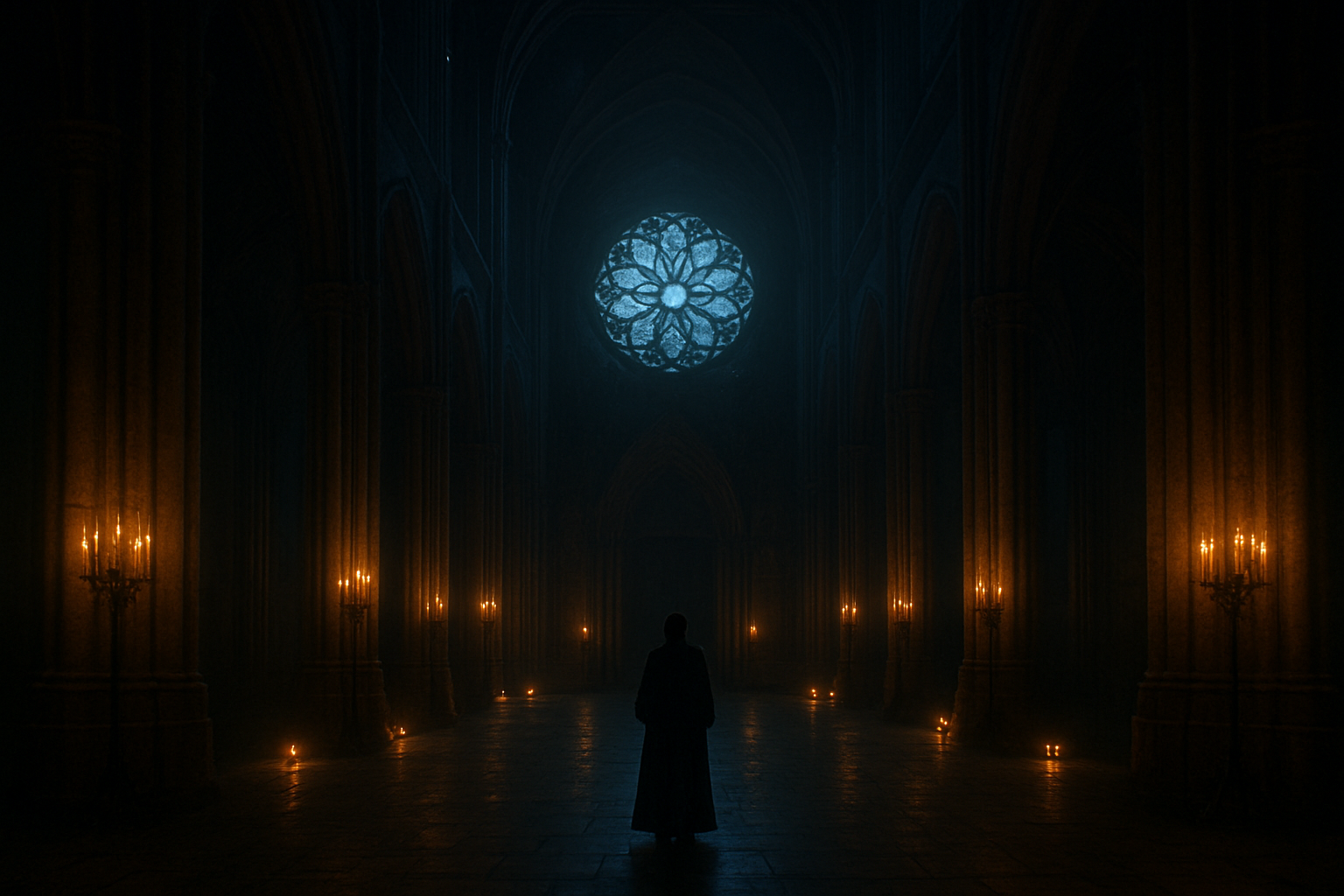
    The imagery of “nocturnal cathedrals” conjures visions of shadowy grandeur, silent halls, and soaring spires reaching toward the infinite. These structures symbolize the contemplation and sanctuary one finds within oneself during moments of internal or literal darkness. Like the mystical silence filling a cathedral at night, the petit mort allows a fleeting yet profound silent communion with the self—a temporal void where body and spirit align in shared mystery.

    Philosophical and Theological Reflections

    “The nearer the dawn, the darker the night.” —Henry Wadsworth Longfellow

    This poetic claim by Longfellow suggests the intrinsic link between darkness and enlightenment, an essential theme in understanding the petit mort within spiritual contexts. The act of surrendering culminates in a balance between opposing forces, echoing Taoist principles of Yin and Yang, where the culmination of life’s pleasures paradoxically teaches us of life’s cessation.

    The theologian Thomas Aquinas also contemplated on human sensation as a conduit to divine contemplation. He posited that experiencing profound pleasure connects with spiritual ecstasy, forging a path to the divine. Hence, in the context of petit mort, the brief suspension of self that accompanies total surrender becomes a conduit that mirrors the spiritual state of via negativa—the unapparent presence found in divine absence.

    Modern Interpretations and Implications

    In today’s fast-paced world, the pace at which one experiences life leaves little room for introspection. Yet, the significance of the petit mort as a spiritual revelation lends itself to contemporary mindfulness practices. These moments invite a pause, encouraging reflection on life and mortality. In yoga and meditation, for instance, achieving oneness with oneself aligns with the petit mort experience—where concentration meets release.

    This notion of practicing presence aligns with spiritual practices promoting holistic views of living, where acknowledging our transient pleasures bolsters awareness of a greater continuum. As transformative as the architecture of a cathedral, individual spiritual practices represent personal sacred spaces for inner reflection and transcendence.

    The Universality of Petit Mort in Human Experience

    The experience of the petit mort is universal yet deeply personal. It calls upon everyone to recognize briefly when the mind and soul free themselves from social identities and labored thoughts. This universal aspect presents a gentle reminder of mortality and life’s fleeting nature—just as John Donne articulated in his meditation, “No man is an island, entire of itself; every man is a piece of the continent.” Through such reflections, the petit mort becomes a key to understanding our place in the interconnected web of human experience and the divine mystery.

    As the world grows increasingly interconnected and fragmented, the visceral and spiritual resonance of the petit mort offers a communal ground of existence that transcends cultural and temporal barriers. In acknowledging the “little death” as both a climax and a passageway within this nocturnal cathedral we call life, we find glimpses of eternity within the confines of the ephemeral.

  • Obsidian Silence – Death as a Cosmic Event

    Obsidian Silence – Death as a Cosmic Event

    Obsidian Silence: Death as a Cosmic Event

    The concept of death has always been a profound and deeply personal experience for humanity. Yet, when viewed through the lens of the cosmos, death takes on a new perspective—one that sees it as a universal phenomenon that transcends earthly boundaries. In the vast tapestry of the universe, death is not merely the cessation of life but a significant cosmic event.

    Understanding the Cosmic Perspective

    Scientific inquiries and philosophical musings have long explored death’s role beyond the terrestrial plane. Astrophysicists consider it not just in biological terms but also astronomical. Stars, like organic beings, have lifecycles. A star’s demise creates phenomena such as supernovas, which in turn give birth to new celestial bodies and even life-sustaining elements.

    “A supernova explosion is a trillion times more brilliant than our Sun. For weeks, it shines intensely, before fading.” – NASA

    This powerful transformation is not unlike the cycle of life and death on Earth. The death of stars contributes to the birth of new myths and celestial formations, showing how intimately connected death and creation are in the universe.

    The Role of Supernovas

    • Stellar Nucleosynthesis: During a supernova, the intense pressure allows nuclear fusion, creating heavier elements such as iron and nickel. These are crucial to formation processes across the cosmos, including the very fabric of our solar system.
    • Cosmic Recycling: The remnants of supernova explosions are scattered into space, seeding nearby nebulae and instigating the birth of new stars. This recycling is essential for the dynamism and continuity of the universe.

    Such events underscore the essential role that death plays in cosmic evolution. Without the death of stars, the universe would be a vastly different place, potentially bereft of the conditions necessary for life as we know it, including the elements that make up our own planet and bodies.

    Life, Death, and the Universe

    On Earth, life perpetuates and evolves through death. This is mirrored in cosmic processes. As Brian Cox, a renowned physicist, states:

    “We are the cosmos made conscious and life is the means by which the universe understands itself.” – Brian Cox, The Guardian

    From this perspective, death becomes a passage rather than an end—a crucial chapter in the continuum of cosmic existence. In ecosystems, for example, decaying matter provides nutrients for new growth, facilitating the regenerative cycles that keep life dynamic and adaptable.

    Cultural Interpretations

    Human culture has long pondered death as more than a mere fate. It is regarded with reverence, fear, and acceptance across different cultures, often considered a transition to another form of existence or part of a greater cycle.

    • Ancient Egyptians: Viewed death as a journey to the afterlife, with intricate burial practices designed to aid this transition.
    • Buddhism: Teaches that death is a natural part of the cycle of samsara—birth, death, and rebirth—leading ultimately towards enlightenment.
    • Mayan Civilization: Believed in the cyclical nature of life and death, celebrating the deceased as part of an ongoing connection to the Earth and cosmos.

    These interpretations echo the cosmic cycle of death and rebirth observed in the universe, reflecting humanity’s innate understanding of its place in the cosmic order.

    Conclusion

    The cosmic event of death invites us to reconsider our relationship with the universe. In a grander cosmic scheme, death is not a solitary, final act but a resounding echo that reverberates through galaxies and can stimulate the spark of creation. As scientists deepen our understanding of these cosmic processes, it becomes evident that human life is intertwined with universal cycles on a much larger scale than we often realize.

    In examining death through this expansive perspective, we are reminded of the universe’s vastness and interconnectedness, a reminder that perhaps death is merely another note in the eternal symphony of the cosmos.

    For more interesting insights into cosmic events and their implications on human understanding, visit NASA and The Guardian.

  • Celestial Extinction – Petit Mort Across the Planes

    Celestial Extinction – Petit Mort Across the Planes

    The cosmos, a tapestry of seemingly endless wonder, teems with the light of stars and the enigmatic beauty of celestial bodies. Yet, just as life has its ethereal moments of transition, so too do stars and planets experience their own unique forms of extinction. This article explores the poetic tristesse of celestial deaths, often referred to as “petit mort”, the small death, across the vastness of space.

    The Fading Glow of Stars

    Stars are the quintessential elements of our universe, the fierce beacons of light that guide sailors and inspire poets. Their life cycle is grounded in the balance of nuclear fusion and gravitational forces. However, this glamorous existence is finite.

    • Red Giants and White Dwarfs: As a star exhausts its hydrogen fuel, it expands into a red giant. Eventually, the outer layers are shed, and the core contracts into a white dwarf. This process marks a star’s transition from a brilliant blaze to a cold ember, signifying a gradual fading into darkness.
    • Supernovae: Larger stars end their lives in spectacular explosions known as supernovae. According to NASA’s observations, these cataclysmic events are among the brightest and most powerful known phenomena in the universe, releasing vast amounts of energy and enriching the cosmos with heavy elements.
    • Black Holes and Neutron Stars: If the remnant core of a massive star is great enough, it may collapse into a black hole, a region of spacetime from which nothing can escape. Alternatively, it may form a neutron star, a dense stellar corpse left to spin in the vacuity of space.

    Planetary Disappearance

    While stars dominate the narratives of cosmic death, planets also face their end, albeit in less cataclysmic but equally fascinating transitions.

    • Rogue Planets: Some planets are cast adrift from their parent stars, becoming rogue planets that wander the galaxy alone. According to the European Southern Observatory, these celestial nomads are “not bound to any star and are free-floating through the galaxy.”
    • Inward Migration: Planets can also move toward their host star over time until they are consumed. This process, often observed in exoplanet systems, can result in a planet’s fiery end as it gets engulfed by its sun.
    • Impact Events: Collisions with asteroids or comets can spell disaster for planets. The famous impact that led to the extinction of dinosaurs on Earth is a reminder of the fragility of planetary life.

    The Romantic Notion of Celestial Extinction

    Despite the harsh realities of destruction, celestial extinction can be seen through a romantic lens. As French philosopher Gaston Bachelard once noted, “The imagination enlarges our perception of poetic space”. The cycles of celestial death and rebirth illustrate the predictability and inevitability of change.

    “We are all made of star stuff,” Carl Sagan eloquently stated. This cycle of creation and annihilation reflects the interconnectedness of the cosmos, where dying stars seed the birth of new stars and perhaps new worlds.

    The Implications for Human Understanding

    The study of celestial extinction has profound implications for our understanding of the universe and our place within it. From philosophical questions about permanence and destruction to practical concerns about the future of technology and our search for extraterrestrial life, the concept of extinction stretches across disciplines.

    • Technology and Knowledge: Understanding the processes behind celestial extinction leads to technological advances, such as developing better models to predict the life cycles of stars.
    • Philosophical Reflections: As philosopher A.N. Whitehead observed, “The history of philosophy is the study of oversimplifications.” Celestial extinction challenges oversimplifications, encouraging deeper inquiries into the nature of existence.
    • Search for Extraterrestrial Life: Studying these processes helps scientists understand the potential habitability of other planets and the conditions that might lead to life, or its end, in distant star systems.

    Conclusion

    Celestial extinction, the cosmological petit mort, is a reminder of the ephemeral nature of existence and the countless narratives written across the skies. From the quiet fading of a white dwarf to the violent drama of a supernova, these processes highlight the cyclical, interconnected story of the universe—a story that despite its scale, finds resonance in our hearts.

    As we look up at the night sky, we see only a fraction of its beauty, aware that every star has a tale, a lifetime, and eventually, an end. It is in these endings that we find the seeds of new beginnings, an eternal dance between life and death mirrored in the celestial sphere.

    For more insights into the cosmic ballet, visit the Space.com and explore humankind’s quest to understand the universe.

  • The Final Breath – Petit Mort and Cosmic Dissolution

    The Final Breath – Petit Mort and Cosmic Dissolution

    The delicate dance between life and death has fascinated humans for millennia. In the realm of spiritual and existential exploration, the concept of ‘Petit Mort’ offers a poetic reflection on the inevitable journey towards cosmic dissolution. But what if these two seemingly disparate experiences—orgasm and death—held deeper connections to our cosmic understanding?

    The Meaning of ‘Petit Mort’

    Petit Mort, or “little death,” is a French term that describes the momentary lapse in consciousness experienced during orgasm. This term encapsulates the transcendent experience that mimics, in a diminutive form, the great dissolution—the final breath of life. The very phrase hints at a metaphorical death, a temporary release of the self that echoes the finality of mortality.

    “To experience ‘Petit Mort’ is to transcend the mundane, to momentarily touch the stratosphere of existence where consciousness flirts with its own dissolvement” – Dr. Helen Fisher, anthropologist and author.

    Orgasm as a Metaphor for Death

    The biological processes leading to orgasm involve a complex orchestration of the nervous system, where pleasure and ecstasy culminate in a momentary collapse—a ‘little death.’ This experience, some argue, parallels the biological shutdown at the time of death, where consciousness fades as the body ceases its relentless charge. Thus, orgasm becomes a microcosm, a rehearsal of the cosmic dissolution that awaits us all.

    • Physical Release: Both orgasm and death involve a release—whether of life energy or existential burdens.
    • Transcendent State: Embracing the unknown, each moment offers a temporary escape from reality.
    • Psychological Impact: Both can leave a profound imprint on our emotional and mental states.

    Cosmic Dissolution: Our Final Destiny

    As we contemplate cosmic dissolution, we step into the metaphysical realm, where human life is but a fleeting presence in an expansive universe. The final breath—and what follows—has been explored through myriad lenses: philosophical, scientific, and spiritual. The Vedas of ancient India describe cosmic dissolution as Mahapralaya, where the universe, too, undergoes a cyclical destruction and rebirth, much like the culmination and release experienced in orgasm.

    “In the cosmic dance of Shiva, creation and dissolution are in perpetual harmony, embodying the inevitable cycle of life and death” – Encyclopaedia Britannica.

    Finding Connection Between the Two

    In connecting orgasm and cosmic dissolution, we are reminded of the impermanence of existence. The fleeting nature of ‘Petit Mort’ serves as a reminder of our ultimate fate, igniting a profound understanding of our own mortality. Yet, within this understanding lies a powerful liberation—by recognizing the transient nature of both, we find freedom to fully engage with the present.

    Philosophical Insights: The philosopher Friedrich Nietzsche once pondered, “That which does not kill us makes us stronger.” While Petit Mort is but a fleeting flirtation with mortality, it strengthens our resolve to live vibrantly, in anticipation of our eventual cosmic dissolution.

    Living With Death in Mind

    The juxtaposition of ‘Petit Mort’ and cosmic dissolution compels us to live with intention and awareness of our eventual end. It is a call to embrace life with fervor and authenticity, cherishing every breath and every interaction, conscious that they form the tapestry of our brief narrative on this planet.

    • Mindful Living: Engage fully in each moment, aware of its fleeting nature.
    • Acceptance of Mortality: Understand death as a natural progression, not a fearful unknown.
    • Embrace of Transience: Let the impermanence enhance appreciation for life’s experiences.

    Conclusion

    “The Final Breath – Petit Mort and Cosmic Dissolution” weaves together the threads of life’s ultimate mysteries. By embracing the impermanence that both orgasm and death reveal, we open ourselves to the grand narrative of existence. In doing so, we prepare ourselves—not for an end, but for a renewal with each passing moment.

    In the end, acknowledging ‘Petit Mort’ in relation to cosmic dissolution is not about fearing the end, but about understanding that each step we take brings us closer to a profound transformation, a metaphorical and literal return to the cosmos from which we came.